For many years, whether I was working with cities and provinces, engaging the ICT industry, teaching, developing ecosystems, working inside government, or simply listening to people who were trying to create opportunities in places far from the usual centers of growth, I kept returning to essentially the same question: why do some communities, institutions, and countries manage to move forward while others, despite having equally talented people and sometimes even greater resources, remain unable to translate their potential into sustained progress?
My recent conversations at the sidelines of AIM Congress 2026 in Dubai with Dr. Klisman Murati, Founder and CEO of Pareto Economics and creator of the Global Power Index, brought this question back to me in a much larger context, because his work attempts to understand what actually makes countries powerful beyond the usual discussion of GDP, population, political influence, or economic size, and instead looks more deeply at whether countries have developed the capabilities that allow them to withstand disruption, attract capital, create industries, advance technologically, build human capacity, and sustain economic strength over time.

What particularly interested me was not simply the possibility of ranking countries, because rankings can tell us where we stand at one point in time, but the much harder question of why we stand where we stand, whether we are moving forward or backward, and what exactly determines our trajectory.
That conversation naturally brought me back to our frustrations as Filipinos for many years in relation to leadership in the Philippine. If we can measure the capabilities that make nations strong, then I believe we should also become much more deliberate about measuring whether our leaders are actually strengthening those capabilities and translating them into outcomes that people can see, experience, and sustain.

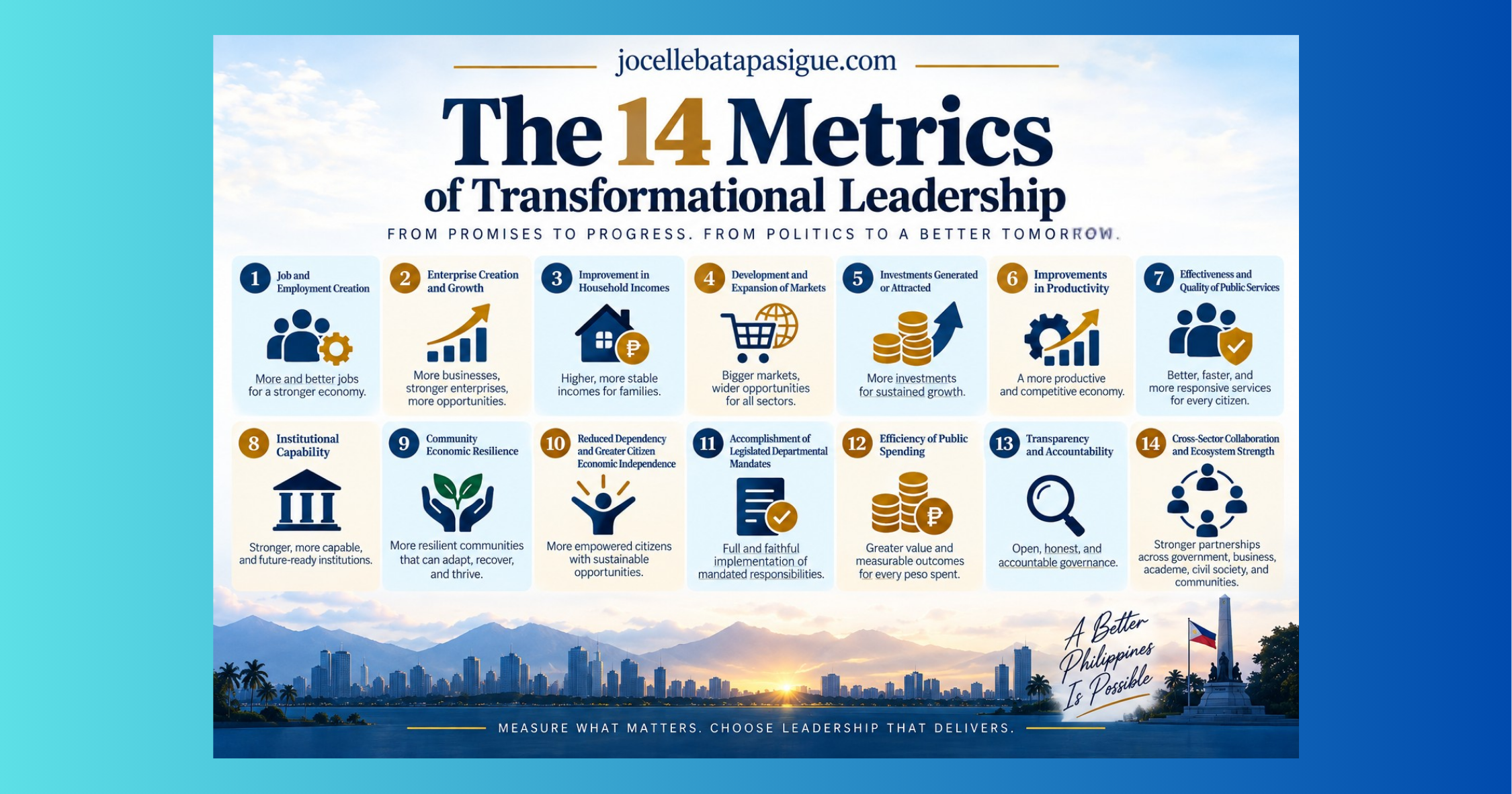
This is where I see a strong connection between the national power framework developed by Dr. Murati and what I have developed for several yesars which I call the 14 Metrics of Transformational Leadership, because while his framework asks what capabilities make a country powerful, my own framework asks a more immediate question for government and public leadership: what measurable change should happen when leadership is genuinely transformational?
The 14 Metrics of Transformational Leadership is a criteria for choosing leaders based on results. Since many of them are now new but are reelected. I have become increasingly convinced that this question matters because we have spent too much of our political life measuring the wrong things, sometimes rewarding visibility instead of results, announcements instead of outcomes, activity instead of productivity, and political popularity instead of measurable transformation.

This does not mean that programs, projects, public engagement, or political communication are unimportant, because leadership must certainly communicate, convene, mobilize, and inspire, but none of these should ever become substitutes for the more fundamental obligation of leadership, which is to leave people, institutions, communities, and economies stronger than they were before.
Understanding National Power Beyond GDP
Dr. Klisman Murati’s Global Power Index 4.0 does not define national power through a single economic indicator. Developed by Pareto Economics, the GPI measures national capability across 194 countries using more than 85 variables and distinguishes between a country’s present level of capability and the direction in which that capability is moving. Its ten Specialized Indices examine Energy Security, Water Security, Industrial Capacity, Technological Leadership, Geostrategic Positioning, Financial Resilience, Critical Minerals Security, Human Capital, Investment Attractiveness, and Economic Self-Reliance.
10 Specialized Indices of National Capability
The Global Power Index 4.0, developed by Pareto Economics and created by Dr. Klisman Murati, examines national capability through ten specialized indices. Each dimension is assessed through both a Level perspective—where a country stands today—and a Growth perspective—whether that capability is strengthening or weakening over time.
Energy Security Index
Measures the resilience of a nation’s energy supply, including exposure to supply disruption, transition risk, and broader energy vulnerability.
Water Security Index
Assesses the sustainability of a country’s water position, including long-term water availability and the infrastructure needed to support it.
Industrial Capacity Index
Evaluates the strength, depth, and sophistication of a country’s manufacturing base and its wider productive and capital-goods capability.
Technological Leadership Index
Measures how innovative and technologically capable a country is, including innovation capacity and the ability to maintain technological sovereignty.
Geostrategic Positioning Index
Assesses how effectively a country is connected to global trade flows through logistics, infrastructure, trade relationships, and market access.
Financial Resilience Index
Measures the stability of the financial system, including banking strength, sovereign fiscal health, and vulnerability to economic or financial shocks.
Critical Minerals Security Index
Evaluates a country’s position in strategic minerals that are increasingly important to advanced industry, technology, and the energy transition.
Human Capital Index
Measures the skill, productivity, and overall strength of the workforce and the human-capital base that supports long-term development.
Investment Attractiveness Index
Assesses how appealing a country is for capital deployment, including market depth, deal flow, liquidity, foreign-investment momentum, and financial infrastructure.
Economic Self-Reliance Index
Examines the strength and sophistication of productive capabilities and the extent to which a country can sustain critical economic functions without excessive strategic dependence.
For the Philippines, this approach raises an important governance question: if national capability can be assessed through measurable structural dimensions, how should leadership be evaluated in relation to the outcomes that those capabilities are expected to produce?

I find these dimensions particularly useful because they force us to look beyond headline economic numbers and recognize that development is systemic, since energy affects industry, water affects food and economic security, industrial capability affects employment and trade, technology affects productivity, human capital affects innovation, financial resilience affects investment, geography affects connectivity and markets, and all of these ultimately depend on institutions and policies capable of making different parts of the economy work together. This is particularly relevant to the Philippines because I have never believed that our fundamental problem is a lack of potential.
Everywhere I have gone across the country, I have seen capable people, young Filipinos eager to learn, entrepreneurs willing to take risks, local leaders who genuinely want to create opportunities, schools trying to respond to changing industries, communities ready to embrace digital technologies, and businesses willing to invest when they see the right environment.
We have natural resources, strategic geography, enormous human capital, global experience through our diaspora, strong English-language capability, a growing technology ecosystem, an established position in services, and pockets of extraordinary innovation across the country.
Yet we must also be willing to ask ourselves, without defensiveness and without hiding behind optimistic narratives, why so much of this potential has not yet translated into the scale of economic power that we know the Philippines should be capable of achieving. For me, the answer increasingly lies in the word conversion.
Our challenge is not simply whether we have talent, but whether talent is converted into innovation and productive opportunity; it is not simply whether we have natural resources, but whether those resources become higher-value industries; it is not simply whether we attract investment, but whether that investment deepens local capability; it is not simply whether we produce graduates, but whether our economy creates opportunities worthy of their skills; and it is not simply whether government creates policies, but whether those policies actually change outcomes. Potential is important, but potential that is never converted remains potential. Yet we must also be willing to ask ourselves, without defensiveness and without hiding behind optimistic narratives, why so much of this potential has not yet translated into the scale of economic power that we know the Philippines should be capable of achieving.
For me, the answer increasingly lies in the word conversion.
Our challenge is not simply whether we have talent, but whether talent is converted into innovation and productive opportunity; it is not simply whether we have natural resources, but whether those resources become higher-value industries; it is not simply whether we attract investment, but whether that investment deepens local capability; it is not simply whether we produce graduates, but whether our economy creates opportunities worthy of their skills; and it is not simply whether government creates policies, but whether those policies actually change outcomes.
Potential is important, but potential that is never converted remains potential. This is where leadership matters.
My thinking around the 14 Metrics of Transformational Leadership came from years of watching how government performance is communicated and how political leadership is evaluated, because we have become very good at counting activities while remaining much less rigorous about measuring whether those activities actually changed anything.
It is not enough to be able to say that something was done; leadership should increasingly be required to demonstrate what changed because it was done.

National Power as a System of Interdependent Capabilities
The Global Power Index 4.0 reflects an increasingly important principle in development analysis: national strength is produced through the interaction of multiple systems rather than through a single dominant variable.
Energy security affects the cost and reliability of industrial production; water security influences agriculture, public health, urban development, and industry; industrial capacity determines the depth of the productive economy; technological leadership shapes innovation and productivity; financial resilience influences the ability of institutions and markets to withstand shocks; and investment attractiveness affects the flow of capital into productive activities. Human capital, geostrategic positioning, critical minerals security, and economic self-reliance further determine whether a country can sustain development and reduce strategic vulnerability.
The framework is particularly useful because it distinguishes between a country’s current capability and its direction of travel. A country may possess substantial existing strength but be losing momentum, while another may have a lower current level but be strengthening rapidly. This distinction between level and trajectory is analytically significant because development policy is concerned not only with present conditions but also with the durability and direction of change.
In the Philippine context, the same distinction is important. The country possesses substantial human capital, strategic geography, natural resources, a large domestic market, a globally experienced workforce, and significant participation in services and selected technology-related industries, but the existence of these assets does not necessarily establish that they are being converted efficiently into higher productivity, stronger domestic industries, technological capability, resilient institutions, or broad-based prosperity.
The relevant issue is therefore not simply whether assets exist, but whether the institutional, legal, regulatory, economic, and policy environment is capable of converting them into sustained national capability.
The 14 Metrics of Transformational Leadership
A practical framework for assessing whether leadership is creating measurable public value through stronger jobs, enterprises, incomes, institutions, public services, resilience, accountability, and collaboration.
Job and Employment Creation
More and better jobs for a stronger economy.
Enterprise Creation and Growth
More businesses, stronger enterprises, and more opportunities.
Improvement in Household Incomes
Higher, more stable incomes for families.
Development and Expansion of Markets
Bigger markets and wider opportunities for all sectors.
Investments Generated or Attracted
More investments that contribute to sustained growth.
Improvements in Productivity
A more productive and competitive economy.
Effectiveness and Quality of Public Services
Better, faster, and more responsive services for every citizen.
Institutional Capability
Stronger, more capable, and future-ready institutions.
Community Economic Resilience
More resilient communities that can adapt, recover, and thrive.
Reduced Dependency and Greater Citizen Economic Independence
More empowered citizens with sustainable opportunities.
Accomplishment of Legislated Departmental Mandates
Full and faithful implementation of mandated responsibilities.
Efficiency of Public Spending
Greater public value and measurable outcomes for every peso spent.
Transparency and Accountability
Open, honest, and accountable governance.
Cross-Sector Collaboration and Ecosystem Strength
Stronger partnerships across government, business, academe, civil society, and communities.
The Conversion Problem in Development
The concept of conversion provides a useful analytical bridge between national capability and leadership performance.
Human capital creates economic value when it is matched with productive employment, research, enterprise development, technological adoption, and innovation.
Natural resources create strategic value when extraction is connected to processing, industrial development, technology transfer, and higher-value production.
Investment creates national capability when it develops infrastructure, strengthens domestic supply chains, transfers knowledge, raises productivity, creates quality employment, and builds durable economic activity.
Geographic advantage creates economic value when ports, logistics, digital connectivity, trade facilitation, and regional integration allow firms and communities to access larger markets.
Technology creates productivity when it improves processes, reduces transaction costs, strengthens decision-making, and enables new products, services, and business models.
Policy creates public value when legal authority, institutional capacity, public expenditure, and administrative action result in measurable improvements in economic and social outcomes.
Seen from this perspective, the key governance challenge is not merely the accumulation of assets, but the effectiveness of the conversion mechanisms that connect those assets to outcomes.
How The 14 Metrics of Transformational Leadership Can Help
The 14 Metrics of Transformational Leadership are intended to assess this conversion process at the level of governance and public administration. They do not replace statutory mandates, constitutional duties, audit standards, or sector-specific performance indicators, but they provide an outcomes-oriented framework for examining whether leadership produces measurable and durable public value.
1. Job and Employment Creation
The first metric is job and employment creation because no matter how sophisticated our economic strategies become, ordinary people will continue to experience development most directly through their ability to earn, provide for their families, and create a future for themselves.
Employment remains one of the clearest indicators of whether economic activity is generating benefits for citizens. The appropriate measure, however, is not simply the volume of employment-related programs, training sessions, or job fairs, but whether policies and programs contribute to the creation of stable, productive, and increasingly higher-value employment.
For years, particularly in my work in ICT development, I have argued that opportunities should not be concentrated only in Metro Manila or in a few major urban centers, because a young Filipino in Bacolod, Ilagan, General Santos, Roxas, Dumaguete, or any other city or province should not have to leave home simply because meaningful economic opportunity was never brought closer to where that person lives.
This metric therefore links workforce development with investment, industrial policy, enterprise growth, skills formation, infrastructure, and technological change, recognizing that employment outcomes depend on the broader economic ecosystem.
This is why I believe leaders should not simply report how many people attended employment programs or skills training, but should be able to show whether their leadership actually helped create more jobs, better jobs, and higher-value jobs, because the purpose of workforce development is not training itself but economic mobility.
2. Enterprise Creation and Growth
Enterprise development is essential to employment, productivity, innovation, and local economic resilience. The relevant measure is not merely the number of firms registered but whether businesses survive, scale, adopt technology, access finance, expand markets, and create employment.
I have equally strong feelings about enterprise development because I believe the Philippines will never reach its full economic potential if too few Filipinos are able to move from being workers and consumers toward becoming entrepreneurs, creators, producers, innovators, and employers themselves.
It is therefore not sufficient to celebrate the number of businesses registered if we do not know how many survive, grow, hire additional workers, reach new markets, adopt technology, and eventually scale, because the real strength of an economy is reflected not simply in how easy it is to register a business but in whether that business has a realistic pathway toward success.
For me, transformational leadership must create conditions in which businesses can grow rather than merely be born. This requires a regulatory and institutional environment that reduces unnecessary friction while supporting fair competition, financing, procurement access, digital participation, and market integration.
3. Improvement in Household Incomes
This metric is important because national economic statistics can often sound very different from what families actually experience, and while GDP growth certainly matters, economic growth becomes difficult to celebrate when household incomes remain stagnant, purchasing power is eroded, or families continue to feel economically insecure.
Macroeconomic growth should ultimately translate into stronger household welfare. This metric therefore examines whether incomes rise in real terms, whether families become more economically secure, and whether opportunities are distributed broadly enough for growth to be experienced at household level.
This is also why I found one of Dr. Murati’s observations during our exchange at the AIM Congress particularly meaningful, because he emphasized that policy affects people immediately while many economic indicators arrive only later, which means policymakers should become much better at understanding what is happening to people from the ground rather than waiting exclusively for delayed macroeconomic statistics.
If our numbers say the country is progressing while families do not feel that progress, then government must be willing to understand the gap rather than dismiss the experience of citizens.
The importance of this measure is reinforced by the fact that aggregate economic indicators may improve while household purchasing power, employment quality, or income security remain weak.
4. Development and Expansion of Markets
Economic growth depends not only on production but also on access to markets. Leadership performance can therefore be assessed by examining whether firms, producers, professionals, farmers, and entrepreneurs gain access to larger domestic, regional, or international markets through improvements in logistics, digital connectivity, standards, trade facilitation, and market infrastructure.
A business cannot grow if it cannot find customers, and this is why market development should be recognized as a leadership outcome rather than left entirely to individual enterprises.
For an archipelagic economy, this measure is particularly relevant because geographic dispersion can either constrain development or become an advantage when supported by appropriate infrastructure and policy.
When government improves logistics, builds digital connectivity, develops trade relationships, strengthens standards, supports e-commerce, or brings producers into larger value chains, it is not simply providing assistance but expanding the economic geography available to its people.
This has always been particularly important to me because countryside development cannot succeed if local enterprises are permanently confined to small local markets, and digital transformation becomes powerful precisely when geography no longer determines the size of opportunity.
5. Investments Generated or Attracted
We often celebrate investment announcements, but I have learned to become more interested in what happens after the announcement, because the value of an investment is ultimately determined by whether it generates jobs, builds industries, introduces technology, creates new markets, strengthens local supply chains, and leaves behind capability that remains in the community.
Investment should be evaluated not merely by announced values but by its contribution to productive capacity. Relevant considerations include employment creation, technology transfer, development of domestic suppliers, workforce upgrading, infrastructure, and long-term capital formation. This is why investment attraction should never be measured purely by headline numbers.
The quality of investment matters along with its location, its effect on local firms matters and its ability to create new industries matters. And whether the investment becomes part of a wider ecosystem matters enormously.
When Dr. Murati speaks about investment attractiveness as part of national power, I see this not simply as the ability to convince investors to enter the country, but as our ability to create an environment in which good capital finds good opportunities and both are able to stay and grow.
This approach also recognizes that investment attractiveness is influenced by regulatory predictability, institutional credibility, infrastructure quality, rule of law, market opportunity, and administrative efficiency.
6. Improvements in Productivity
For many years, development discussions in the Philippines have focused heavily on employment, and rightly so, but I believe we also need a much stronger conversation about productivity because an economy cannot sustainably raise incomes if the productivity of its people, enterprises, and institutions remains stagnant.
Productivity is fundamental to sustainable income growth and competitiveness. This metric examines whether workers, firms, institutions, and sectors are becoming capable of producing more value through better skills, technology, infrastructure, process innovation, and organizational improvement.
This is where technology becomes extremely important to me, particularly now with artificial intelligence, automation, analytics, and digital tools, because technology should not merely be adopted for its novelty but should enable Filipinos to create greater value, compete globally, and do work that would previously have been impossible or prohibitively expensive.
In the context of artificial intelligence and digital transformation, the central question is therefore not simply whether technology has been adopted, but whether it has produced measurable gains in output, quality, speed, cost, or decision-making.
The question should never be whether we have adopted AI, but what became more productive because we did.
7. Effectiveness and Quality of Public Services
Having spent time both inside and outside government, I have become convinced that citizens do not experience government through strategic plans or organizational charts; they experience government through the services they need when they actually need them.
Public institutions derive legitimacy in part from their ability to deliver services efficiently, fairly, and consistently. This metric therefore assesses accessibility, timeliness, reliability, affordability, transparency, and citizen experience. Digitalization is relevant only insofar as it improves these outcomes; transferring an inefficient process to an online platform does not, by itself, constitute transformation.
This is why public service quality matters enormously, and why I sometimes worry that digital transformation becomes confused with digitization, because moving an inefficient process online does not necessarily make it efficient.
A digital government service should ultimately save citizens time, reduce cost, eliminate unnecessary steps, improve access, increase transparency, and make government easier to deal with, because technology should reduce the distance between institutions and citizens rather than simply place the same bureaucracy behind a computer screen.
8. Institutional Capability
This may be one of the metrics I feel most strongly about because I have seen programs disappear when leaders leave, systems weaken when champions move on, and initiatives that should have become permanent institutions remain dependent on personalities.
Sustainable development requires institutions that remain functional beyond individual political terms. This metric examines professional competence, data systems, continuity mechanisms, administrative procedures, institutional memory, strategic planning, and the ability to make decisions based on evidence.
Transformational leadership should therefore be measured by whether institutions become stronger, more professional, more capable, and more future-ready, because the real legacy of leadership should never be an institution that cannot function without the leader who created it.
Institutional strength is particularly important because development gains become fragile when programs depend excessively on individual personalities rather than durable systems. If everything collapses when one person leaves, then what was built was not an institution. It was dependence.
9. Community Economic Resilience
The Philippines understands disruption perhaps better than many countries because our communities repeatedly face typhoons, earthquakes, health emergencies, economic shocks, and now increasingly technological and climate-related disruptions.
For me, resilience should therefore be understood not simply as the ability to recover from disaster but as the ability of communities to continue creating opportunity despite uncertainty, which requires diversified economies, strong local enterprises, digital infrastructure, skills, access to finance, functioning institutions, trusted networks, and people who are capable of adapting when circumstances change.
Economic resilience refers to the capacity of communities to absorb shocks, adapt to disruption, and continue economic activity under changing conditions. This metric considers the diversification of livelihoods, strength of local enterprises, access to finance, digital capability, continuity planning, infrastructure resilience, and institutional capacity to respond to natural, economic, technological, or geopolitical shocks.
A resilient community should not merely return to where it was before the crisis; ideally, it should learn enough from disruption to become stronger afterward.
10. Reduced Dependency and Greater Citizen Economic Independence
Social protection remains necessary, particularly during periods of vulnerability, but development policy should also expand the capacity of citizens to participate productively in the economy.
I believe government has an unquestionable responsibility to support people who need assistance, particularly during crisis and vulnerability, but I also believe that the ultimate purpose of development should be to expand people’s ability to create sustainable opportunities for themselves.
This metric therefore considers whether public interventions create pathways toward employment, skills, enterprise creation, financial inclusion, asset formation, and sustainable income rather than prolonged structural dependency where greater self-sufficiency is achievable.
Public assistance should therefore, whenever possible, become a bridge toward capability rather than a permanent destination, because the greatest form of empowerment is not continuously receiving help but eventually gaining enough skills, income, assets, confidence, and opportunity to no longer require it.
This is the citizen-level equivalent of economic self-reliance.
11. Accomplishment of Legislated and Departmental Mandates
Public institutions are established by law and are therefore accountable for the performance of their assigned functions.
This metric may sound obvious, but it needs to be stated because public institutions already have responsibilities defined by law, and sometimes political attention becomes so focused on highly visible initiatives that the basic mandates of institutions receive less scrutiny than they deserve.
This metric evaluates whether agencies and officials fulfill statutory, regulatory, and administrative mandates, recognizing that highly visible initiatives cannot substitute for deficiencies in core institutional responsibilities.
I believe every public official should ultimately be answerable to a very simple question: what were you legally entrusted to accomplish, and how much of it did you actually accomplish?
Leadership should first deliver the mandate before it manufactures the narrative.
12. Efficiency of Public Spending
Budget utilization measures whether funds were spent; it does not necessarily measure whether value was created.
One of the habits I hope we can change in Philippine governance is the tendency to equate budget utilization with accomplishment, because spending public money is not itself a measure of success. What matters is the public value created by that spending.
If we spent one billion pesos, then we should be able to ask what changed because of that billion pesos, whether productivity increased, incomes improved, travel time decreased, educational outcomes strengthened, communities became safer, businesses became more competitive, or citizens received better services.
Every peso represents resources entrusted by the public, which means every peso should ultimately be connected to an outcome.
A stronger approach evaluates whether expenditure produced measurable improvements in services, infrastructure, productivity, income, institutional capability, human development, or resilience.
This metric therefore supports the use of outcome-based budgeting, performance indicators, cost-effectiveness analysis, and post-implementation evaluation.
13. Transparency and Accountability
I have come to believe even more strongly that trust is economic infrastructure because people invest, collaborate, participate, and take risks differently when they believe institutions are credible.
Transparency and accountability strengthen institutional legitimacy and reduce uncertainty for citizens, businesses, investors, and development partners. Transparency should therefore not be regarded merely as compliance with disclosure requirements but as part of how government earns confidence, while accountability means leaders being willing to show not only what succeeded but also what did not work, why it did not work, and what will be changed as a result.
This connects directly with Dr. Murati’s point about measuring impact in real time, because an intelligent government should not fear evidence that a policy is failing; it should use that evidence to correct the policy.
This metric includes access to information, measurable performance targets, transparent procurement, public reporting, auditability, and mechanisms for correcting policies or programs that fail to produce intended outcomes.
14. Cross-Sector Collaboration and Ecosystem Strength
This final metric perhaps reflects most clearly what I have believed throughout my work in ICT and innovation development, which is that ecosystems create opportunity because no single institution possesses everything required for transformation.
Many development challenges require coordinated action across government, industry, academe, civil society, investors, technology communities, and local institutions.
Government may have policy and resources, industry understands markets, academe develops knowledge and talent, startups bring innovation, investors provide capital, communities provide context, and civil society often brings trust and reach, but the greatest value appears when these actors stop operating as isolated sectors and begin working as an ecosystem.
This metric therefore examines whether leadership creates durable systems of collaboration with shared objectives, defined roles, regular information exchange, and mechanisms for coordinated action rather than relying solely on episodic consultation.
This is why I have always placed such importance on bringing people together, sometimes even before there is a project, because trust precedes collaboration and collaboration precedes impact.
Where Dr. Murati’s Ten Dimensions and My Fourteen Metrics Meet
The more I reflect on these two frameworks, the more I see them as describing two sides of the same development problem, because Dr. Murati’s ten dimensions help us understand what capabilities a country needs, while the 14 Metrics ask whether leadership is turning those capabilities into measurable public outcomes.
Energy security becomes meaningful when it enables industry and lowers economic friction; industrial capacity matters when it creates enterprises, jobs, and higher incomes; technological leadership matters when it increases productivity and improves services; human capital matters when people find meaningful opportunities to apply their abilities; investment attractiveness matters when capital produces local capability; financial resilience matters when businesses and communities can withstand shocks; geostrategic positioning matters when it becomes connectivity and market access; critical minerals matter when they generate higher-value industries; and economic self-reliance matters when both the nation and its citizens become increasingly capable of producing and sustaining value. The relationship, therefore, is not complicated.
National capability creates the possibility of transformation, while leadership determines whether that possibility is converted into reality.
The Philippine Question
I continue to believe deeply in the Philippines, but believing in our potential should never prevent us from asking difficult questions about why we have not yet converted enough of that potential into national power.
This set of metrics therefore examines whether leadership creates durable systems of collaboration with shared objectives, defined roles, regular information exchange, and mechanisms for coordinated action rather than relying solely on episodic consultation.
Linking the GPI to Leadership Performance
The relationship between the GPI and the 14 Metrics is best understood through the distinction between structural capability and governance outcomes.
The GPI measures dimensions that help determine whether a country has the capacity to exercise economic and strategic power, while the 14 Metrics assess whether leadership is translating available resources, institutions, and policy authority into measurable results.
The relationship can be illustrated through several examples.
Industrial capacity should contribute to employment, enterprise growth, productivity, and market expansion.
Technological leadership should support productivity, innovation, institutional efficiency, and service quality.
Human capital should translate into employment, higher incomes, entrepreneurship, and technological capability.
Investment attractiveness should result in productive capital formation, employment, technology transfer, and stronger domestic supply chains.
Financial resilience should support enterprises, reduce vulnerability, and strengthen economic continuity during shocks.
Geostrategic positioning should improve access to trade, logistics, investment, and markets.
Critical minerals security should create opportunities for higher-value processing and industrial development rather than being limited to resource extraction.
Economic self-reliance should strengthen domestic productive capability while reducing excessive strategic dependency.
The analytical connection is therefore clear: structural capability establishes the conditions under which development can occur, while governance performance determines whether those conditions are converted into measurable public outcomes.
Implications for Philippine Governance
For the Philippines, the most important policy issue is not simply the identification of comparative advantages but the strengthening of the institutions and systems that convert those advantages into economic capability.
This requires greater coherence between industrial policy, innovation policy, workforce development, investment promotion, infrastructure, energy, digital transformation, education, financing, and regional development. It also requires more disciplined measurement.
Programs should distinguish between inputs, outputs, and outcomes. Public expenditure should be linked to demonstrable public value. Employment programs should be assessed through placement, income, and career progression rather than participation alone. Investment promotion should be evaluated through realized investment, domestic value creation, and employment effects. Digital initiatives should be assessed through time saved, cost reduced, access improved, and service quality increased.
Such an approach would also help address a recurring weakness in public administration: the tendency to equate completion of activity with achievement of purpose.
Policy as Institutional Infrastructure
One of the most significant implications of the GPI framework is the importance of policy quality in shaping national capability.
Policy influences capital allocation, industrial development, technological adoption, workforce formation, infrastructure investment, and market confidence. It therefore functions as a form of institutional infrastructure: when policy is predictable, coherent, evidence-based, and adaptable, it reduces transaction costs and supports long-term decision-making; when it is inconsistent or slow to adjust, it can weaken confidence and constrain investment.
This is particularly relevant to emerging technologies and rapidly changing economic sectors because conventional legislative and administrative processes may not always move at the same speed as markets or innovation.
A more adaptive governance model would therefore treat policy as an iterative process involving design, implementation, measurement, evaluation, and adjustment, rather than as a one-time act completed upon enactment or issuance.
This approach is consistent with the GPI’s emphasis on trajectory as well as present capability: the quality of a system is reflected not only in its current position but also in its capacity to improve.
Toward an Outcomes-Based Standard of Leadership
The practical value of the 14 Metrics lies in providing a framework for moving leadership assessment from visibility and activity toward outcomes and institutional performance.
This approach is consistent with basic principles of public administration and public law, under which public authority is exercised for a defined public purpose and is subject to standards of accountability, legality, efficiency, and public interest.
Leadership performance should therefore be assessed according to whether the exercise of authority produces durable improvements in economic opportunity, institutional capability, service delivery, fiscal efficiency, resilience, and citizen welfare.
Such an approach does not reduce governance to numbers, because not every dimension of public value can or should be quantified. It does, however, require evidence sufficient to distinguish genuine transformation from political narrative.
Conclusion
The Global Power Index 4.0 provides a structured framework for understanding the capabilities that contribute to national power and for distinguishing between current strength and future trajectory. Its ten Specialized Indices demonstrate that national capability is multidimensional and depends on the interaction of economic, technological, industrial, financial, resource, and human systems.
The 14 Metrics of Transformational Leadership provide a complementary framework for evaluating whether public leadership translates those capabilities and public resources into measurable outcomes.
For the Philippines, the central policy challenge is therefore not simply the accumulation of assets, but the effectiveness of the systems that convert those assets into productive capacity, institutional strength, resilience, and broad-based economic opportunity.
A more rigorous development framework should accordingly distinguish between what the country possesses, what its institutions are capable of doing, and what leadership actually delivers.
That distinction is essential to any serious assessment of national transformation.