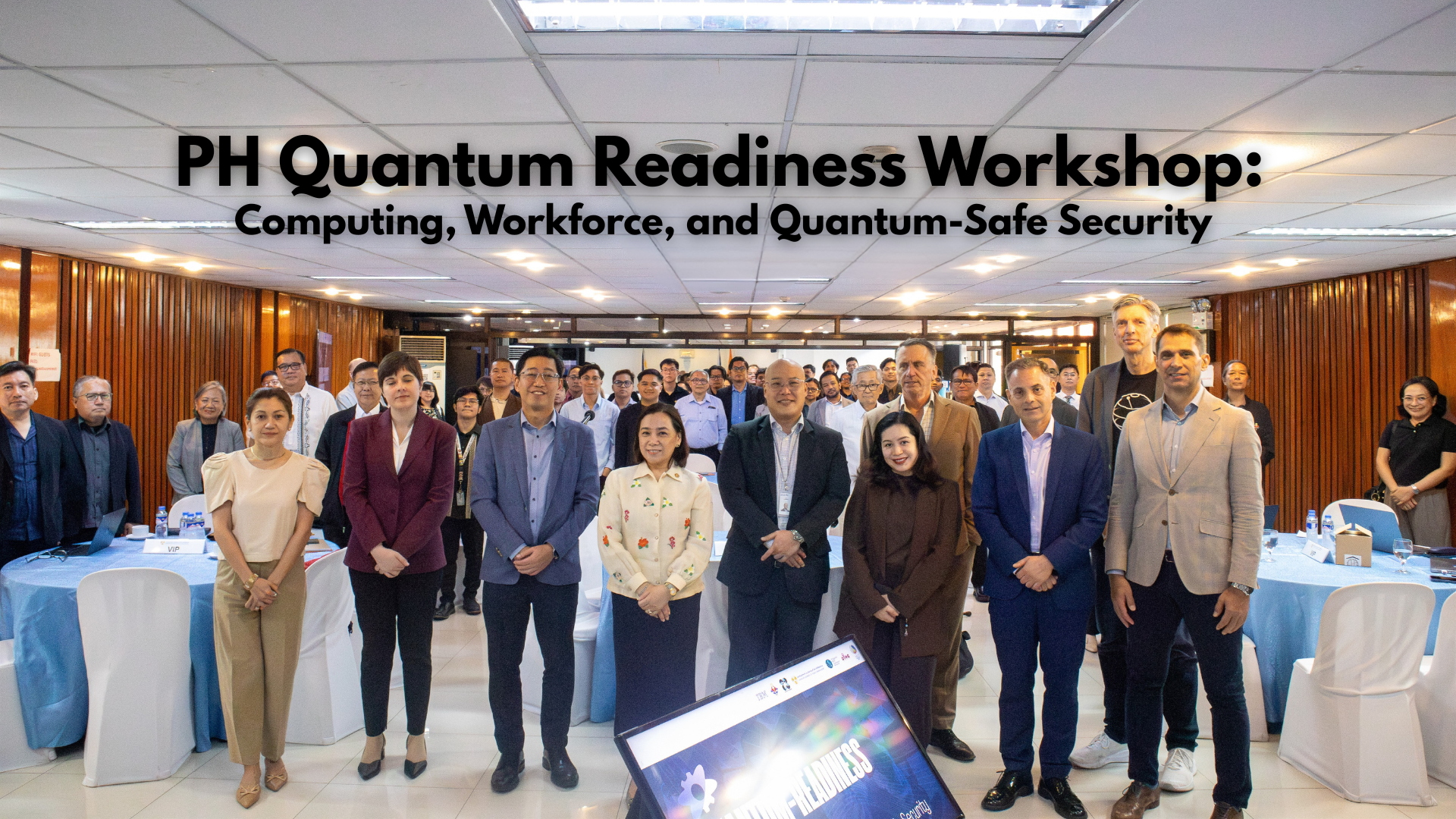
The Philippines’ journey toward quantum computing readiness gained stronger momentum as the Quantum Computing Society of the Philippines (QCSP) convened stakeholders from government, academe, industry, and technology communities to explore how the country can strategically prepare for the next frontier of computing and emerging technologies.
The recent Quantum Science and Technology Adoption and Translation Workshop, convened by the Quantum Computing Society of the Philippines (QCSP), reflects this shift. Bringing together stakeholders across sectors, the initiative signals a more deliberate national effort to prepare for a technological inflection point—one that many global leaders believe will redefine industries, research capabilities, and economic structures in the coming decades.

The event featured a strong lineup of global and local experts, including Dr. Efstathia Katsigianni, IBM Quantum Safe Project Executive; Rizwan Hussain, Head of IBM Quantum Sales for Asia Pacific and Japan; Julian SK Tan, IBM Quantum Business Development Executive for ASEAN and India; Dr. Jan-Rainer Lahmann, Distinguished Engineer within IBM’s Quantum Computing team; Umut Cikla, IBM Quantum Safe Research Executive; and Dr. Eric Alvarez Galapon, Professor of Physics at the National Institute of Physics, University of the Philippines Diliman.


Co-organizing the program were the Development Academy of the Philippines Graduate School of Public and Development Management (DAP-GSPDM), the Department of Science and Technology (DOST), and the Department of Information and Communications Technology (DICT), in collaboration with advocates from the Digital Innovation for Women Advancement (DIWA) and the Philippine ICT Innovation Network (PIIN).

Supporting the engagement was an IBM delegation composed of Leo Capinpin, Technology Leader and Country General Manager; Princess Ascalon, Government and Regulatory Affairs Executive; Lope Doromal, Chief Technology Officer; Paolo Paraiso, IBM Technology; John Ryan Pulido, Alan Gosiengfiao, and Eliza Rimando of IBM Consulting; and Ada Marchadesch, Communications Manager.

Bobby Corpus Jr., President of the Quantum Computing Society of the Philippines, said the workshop reflects QCSP’s commitment to convening government, academe, industry, and technology communities to build a stronger foundation for Quantum PH—one driven by volunteerism, collaboration, and the shared belief that the Philippines can prepare early, participate meaningfully, and compete in the emerging quantum future.

Also supporting the event was Atty. Jocelle Batapa-Sigue, Convenor of the Philippine ICT Innovation Network (PIIN) and Digital Innovation for Women Advancement (DIWA), who served as lead discussant, reinforcing the importance of multi-stakeholder collaboration and countryside inclusion in building the country’s quantum ecosystem.
“Quantum readiness is not only about mastering a powerful new technology. It is about preparing our research, industries, workforce, and innovation ecosystem to think ahead, work together, and build the capabilities that will allow the Philippines to compete, create, and lead in the future,” says Batapa-Sigue.
The program was hosted by Dylan Josh Lopez of QCSP, who served as master of ceremonies.

The program also featured remarks from Leo Capinpin of IBM Philippines, Dr. Lizan E. Perante-Calina and Dr. Leocadio S. Sebastian of the Development Academy of the Philippines, and Engr. Niñaliza H. Escorial of DOST-PCIEERD, underscoring cross-sector collaboration for Philippine quantum readiness.

The workshop covered eight major focus areas identified as potential high-impact sectors for quantum applications in the Philippines: Finance, Energy, ICT, National Security and Defense, Disaster Risk Reduction and Management (DRRM), Transport and Logistics, Materials and Pharmaceuticals, and Quantum Supply Chain and Industrial Support.
A Window of Opportunity
One of the most important insights emerging from the workshop is that quantum computing is no longer a distant, speculative technology. Data shared during the sessions showed that quantum computing already accounts for an average of 11% of global R&D budgets, up from 7% in 2023. This rapid increase underscores how industries are beginning to take quantum seriously—not just as a research frontier, but as a future driver of enterprise value.
Sectors such as aerospace, defense, government, banking, healthcare, insurance, and life sciences are already exploring quantum applications. These industries are investing early to understand how quantum computing could eventually solve problems that remain intractable using classical systems—ranging from complex simulations in chemistry to optimization challenges in logistics and finance.
For the Philippines, this represents a strategic window. Rather than attempting to catch up later at higher cost, the country has the opportunity to engage early—by building talent, aligning institutions, and fostering collaboration.

Grounding Quantum in the Philippine Context
While global trends provide direction, the workshop made it clear that the Philippine approach must be grounded in local strengths and realities.
The country already possesses a strong foundation in digital talent, IT services, and academic research, particularly in physics, mathematics, and engineering. Institutions such as the University of the Philippines and other leading universities and research centers play a critical role in advancing theoretical and applied knowledge.
At the same time, the Philippines has a globally recognized IT-BPM sector, a growing startup ecosystem, and an increasing focus on digital transformation across industries. These elements create a unique opportunity: to integrate quantum readiness into existing digital strengths rather than building entirely from scratch.
The Four Pillars: R&D, Industry, Workforce, and Ecosystem
Central to the discussions was a clear framework for national quantum readiness, anchored on four interconnected pillars: Research and Development (R&D), Industry, Workforce, and Ecosystem.

Research and Development remains the scientific backbone. The Philippine Quantum Science and Technology Roadmap (2025–2035) provides a foundational direction for advancing research, supported by institutions such as DOST and the country’s academic community.
Industry engagement is emerging as a key driver of future value. Early exploration in finance, healthcare, agriculture, energy, and IT services shows how quantum computing may eventually support complex problem-solving and innovation. Companies are also beginning to assess quantum-safe security as a long-term priority.
Workforce development is the most immediate opportunity. The structured “crawl, walk, run” learning pathway presented during the workshop enables Filipinos—from students to professionals—to progressively build quantum skills through awareness, hands-on training, certification, and research engagement.
Ecosystem-building ties these efforts together. Government, academe, industry, international partners, and community organizations must work in alignment to ensure sustained progress.
Insights from the Quantum Readiness Framework
The workshop introduced a practical approach to building national capability through a Quantum Innovation and Collaboration framework, which integrates learning, research, industry engagement, and global partnerships.
Participants were presented with a progressive education and engagement model that includes quantum awareness programs, Qiskit activation, practitioner development, capstone projects, technical exchanges, research support, and global certification pathways. This model allows broad participation while enabling specialization over time.
Importantly, the framework emphasized accessibility. Entry points into quantum computing are no longer limited to highly specialized researchers. With the availability of global platforms and open learning systems, countries like the Philippines can begin building capacity immediately.

Sectoral Opportunities for the Philippines
Discussions during the workshop highlighted several sectors where quantum computing could eventually deliver value for the Philippines:
- Healthcare and life sciences
- Agriculture and climate systems
- Finance and banking
- Energy and sustainability
- Defense and national security
- IT and digital services
These opportunities align with national priorities and existing industry strengths, reinforcing the relevance of early engagement.
Priority Workshop Areas: Translating Quantum into Real-World Impact
To ground discussions in practical application, the workshop organized participants into eight priority working groups aligned with national development needs: Finance, Energy, ICT, National Security & Defense, Disaster Risk Reduction and Management (DRRM), Transport & Logistics, Materials & Pharmaceuticals, and Quantum Supply Chain & Industrial Support.
Each group explored sector-specific use cases, readiness gaps, and potential pathways for adoption. In finance, discussions focused on risk modeling, fraud detection, and quantum-safe financial systems. The energy sector examined grid optimization and post-quantum security for critical infrastructure. ICT stakeholders explored quantum-safe networks, post-quantum cryptography, and quantum-as-a-service access models.
National security and defense discussions highlighted quantum-secure communications and sensing capabilities, while DRRM focused on early warning systems and optimization of disaster logistics. Transport and logistics groups examined routing optimization, port efficiency, and risk detection, while materials and pharmaceuticals explored quantum simulation for drug discovery and advanced materials research. The quantum supply chain and industrial support group emphasized bridging research to enterprise applications, including processing, integration, and technology readiness.
The Role of Volunteerism and Community
A defining feature of the Philippine quantum movement is the role of volunteerism. QCSP’s efforts are driven by individuals contributing their time, expertise, and networks to advance national readiness.
This collaborative spirit has enabled the early formation of an ecosystem—demonstrating that meaningful progress can begin even before large-scale investments are made.
Women in Quantum: Expanding Participation
The second day of the workshop highlighted the importance of inclusive participation in emerging technologies. Atty. Jocelle Batapa-Sigue, Convenor of DIWA and PIIN, led a Women in Tech panel focusing on the role of women in quantum computing and related fields.

The panel emphasized that women must be actively engaged not only as participants but as leaders—across research, policy, entrepreneurship, education, and ecosystem development. It underscored the need to provide access to training, mentorship, and leadership opportunities, ensuring that the country’s quantum workforce reflects diversity and inclusivity.
The discussion also highlighted the importance of extending opportunities to women in the regions, aligning with broader goals of inclusive and nationwide development.
Beyond Metro Manila: A National Effort
Participants stressed that quantum readiness must extend beyond Metro Manila. Engaging regions across the country is essential to building a resilient and inclusive ecosystem.
This includes developing regional talent, strengthening local institutions, and creating opportunities for collaboration outside major urban centers.
Global Collaboration, Local Capability
The participation of IBM Quantum experts demonstrated the value of international partnerships. Through access to global platforms, expertise, and training, the Philippines can accelerate its learning curve and integrate into the global quantum ecosystem.
At the same time, local institutions and communities play a critical role in contextualizing these insights and applying them to national priorities.
Next Steps for Quantum PH
The quantum readiness workshop marks an important milestone in the Philippines’ journey toward emerging technologies. By aligning R&D, industry, workforce, and ecosystem efforts, the country is building a foundation for long-term participation in the quantum era.
Moving forward, stakeholders identified key priority actions to advance the Philippines’ quantum readiness agenda. These include strengthening research and development, expanding international and regional collaborations, and accelerating program design and talent development across sectors.
Efforts will also focus on establishing a strong policy foundation, enabling broad-based citizen and industry engagement, and mobilizing science communicators and ambassadors to build awareness nationwide. At the same time, institutions are expected to develop program-based initiatives across academe, government, and industry to ensure sustained capacity-building.
Together, these steps aim to translate early momentum into a coordinated national strategy—positioning the Philippines to move from awareness to action in the global quantum landscape.
While challenges remain, the momentum is clear. Stakeholders are beginning to collaborate, frameworks are taking shape, and pathways for talent development are being established.
As the global landscape continues to evolve, the Philippines is positioning itself not only to adapt—but to actively participate in shaping the next wave of technological transformation.
Inside Quantum Architectures
Dr. Jan-Rainer Lahmann, Distinguished Engineer within IBM’s Quantum Computing team, presented an overview of the major modalities currently being pursued in the global effort to build quantum computers. He explained that there is no single dominant physical platform yet; instead, the field is actively exploring several approaches in parallel, each with its own strengths, trade-offs, and level of maturity.

He discussed superconducting qubits as one of the more established approaches, noting that they allow fast gate operations and benefit from fabrication methods already familiar to the semiconductor industry. However, they require highly specialized millikelvin dilution refrigeration systems to operate.
He also highlighted trapped ions, which are known for long coherence times, high-fidelity gates, and strong connectivity within a trap. Their trade-off, however, is that their gate speeds are generally slower compared with superconducting systems.
Neutral atoms were presented as another promising modality because they offer flexible and reconfigurable qubit arrays that may scale to hundreds of atoms. Their use of Rydberg interactions enables multi-qubit gates, making them attractive for large-scale quantum simulation and future scalable architectures.
Photonic qubits, meanwhile, were described as naturally suited for networking and quantum communication because they can operate at room temperature. Their key challenges remain probabilistic gates and photon loss, which affect reliability and scalability.
He also covered silicon spin qubits, which leverage mature CMOS manufacturing and semiconductor fabrication. This gives them a potential advantage for dense integration, although the approach remains relatively early in scaling qubit counts.
Finally, he discussed topological qubits, which are theoretically attractive because of their potential robustness against local noise and their promise of lowering the burden of error correction. However, this modality remains experimental, with no demonstrated logical qubit yet.
Overall, Dr. Lahmann emphasized that quantum computing remains a highly dynamic and evolving field. Different modalities are advancing at different stages, and the global quantum community continues to test, compare, and develop these platforms as part of the broader race toward practical and scalable quantum computing.About Bobby Corpus, Jr.
About Bobby Corpus, Jr.
Bobby Corpus, Jr. is a quantum computing evangelist and President of the Quantum Computing Society of the Philippines (QCSP), also known as OneQuantum Philippines, the Philippine chapter of OneQuantum, a global community advancing quantum technologies.
He is a Technical Architect at Section6 (New Zealand) and previously served as Innovation Lead at the Enterprise Data Office of Globe Telecom, Solution Architect at Red Hat, and Vice President and Lead Solution Architect at Deutsche Bank AG (Singapore).
Bobby graduated cum laude in Physics from the National Institute of Physics, where his research focused on the topology and causality of spacetime. His work in quantum computing is grounded in his formal training in physics and computer science, bridging foundational theory with real-world systems and infrastructure.
In 2017, he founded Quantum Computing Philippines to raise national awareness and build local capability in quantum technologies. The initiative was later recognized and formally integrated into the OneQuantum global network as OneQuantum Philippines, where he currently serves as President.
He is a Board Member of the DOST-PCIEERD Quantum Technology Board, Vice Chair of the Bureau of Philippine Standards (BPS) Technical Committee on Information Technology – Subcommittee on Artificial Intelligence and Quantum Technologies, and a member of the OECD Global Forum on Technology (GFTech) expert focus group on quantum technologies. He has also served as a Senior Lecturer at the University of the Philippines Baguio, teaching quantum computing.
About Dylan Josh Lopez
Engr. Dylan Josh Lopez is a PhD candidate in Electrical Engineering at Chung Yuan Christian University, specializing in hybrid quantum optimization for power and energy systems and solar forecasting. He is Director for Partnerships and Collaborations at the Quantum Computing Society of the Philippines, co-founder of PQTI, and President of the Philippine Qiskit Network, where he leads capacity-building programs and ecosystem initiatives for quantum information science and technology. Dylan serves as a major contributing author for quantum projects of DOST–PCIEERD, including the QRIENTE and STRAQE initiatives, and contributes to quantum standards and policy as a member of the ISO/IEC JTC3 Council on Quantum Technology, an APEC and ISO quantum standards workshop delegate, and a technical expert for Philippine government agencies. He frequently publishes in IEEE journals and conferences, and regularly organizes, mentors, and speaks at regional quantum events and hackathons to connect cutting-edge quantum methods with applications in energy, space, and public-sector decision-making. His current efforts focus on shaping national quantum technology roadmaps and integrating quantum readiness into broader science, technology, and innovation policy in the Philippines and Southeast Asia.