DEATH OF A GENIUS: Albert Einstein’s Final Lesson on Ambition, Purpose, and the Quiet Power of Value
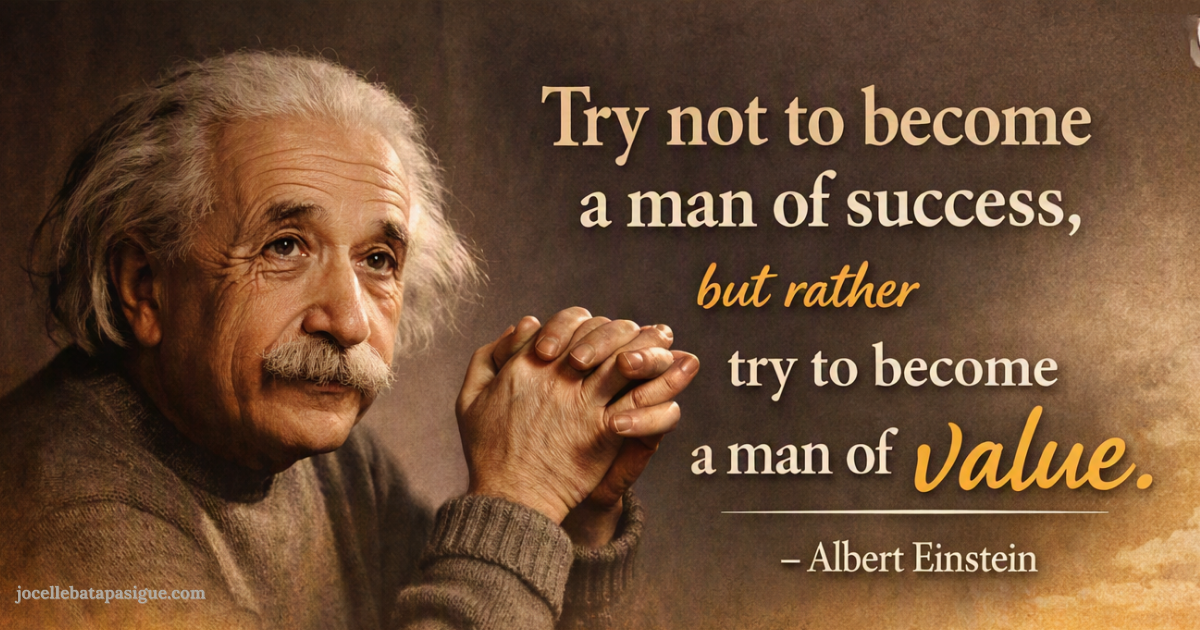
I want to retell this story so parents today can share with their children – the story about the qoute of Einstein: “Try not to become a man of success, but rather try to become a man of value.”

In the spring of 1955, as the world moved restlessly toward new scientific frontiers and geopolitical tensions, Albert Einstein spent his final days in Princeton, surrounded not by the noise of fame but by the quiet rhythm of thought. His home, modest and unassuming, had become a sanctuary where he could reflect on the arc of his life—its triumphs, its burdens, and the moral questions that had followed him long after the equations were solved. It was in this setting that journalist William Miller of LIFE Magazine arrived to document the last chapter of the scientist’s extraordinary journey, intending to capture not only the decline of a legendary mind but also the enduring clarity of his wisdom.
Miller did not come alone. He brought with him his young son, Pat Miller, a boy who as his father decribes is ambitious. He was still at the age where dreams are declared boldly, without hesitation or fear of judgment. He admired Einstein and he believed—earnestly, innocently—that success was the ultimate destination of a meaningful life.
Einstein noticed the boy’s ambition almost immediately. Despite his frailty, he remained deeply attuned to the emotional currents around him. He asked Pat about his aspirations, and the boy answered with the straightforward confidence of someone who had not yet learned to doubt himself. He wanted to be successful. He wanted to achieve. He wanted to become someone the world would recognize, but Einstein responded unexpectedly not with encouragement toward fame, but with a gentle correction that would become one of the most quoted lines of his life.
He told Pat, that success was not the goal worth pursuing. What mattered was value—the kind of value that emerges not from accolades or titles but from the substance of one’s character and the impact of one’s actions. His words were simple, but they carried the weight of a lifetime spent watching humanity chase brilliance without wisdom, progress without conscience, and achievement without empathy. The advice he offered the boy was a distillation of everything he had come to believe about the purpose of human endeavor.
For me, Einstein’s message to Pat was not a dismissal of ambition. It was a redirection. He understood that ambition, when guided by integrity, could become a force for good. But ambition untethered from values could easily become destructive, as he had witnessed in the global race toward scientific dominance and the militarization of knowledge. He had seen how success, when pursued for its own sake, could distort judgment and erode humanity. And so he urged the boy to cultivate value—to become someone whose contributions would matter not because they were celebrated, but because they were meaningful.
William Miller, observing the exchange, recognized its significance. He later included the moment in his article, not as a sentimental anecdote but as a window into Einstein’s moral philosophy. Through Miller’s writing, readers glimpsed a man who, despite his towering intellect, believed that the true measure of a life was found not in brilliance but in benevolence. The article captured Einstein’s humility, his humor, and his persistent concern for the ethical direction of the world. It revealed a man who had spent decades wrestling with the consequences of his own discoveries and who, in his final days, sought to leave behind not formulas but principles.
Pat Miller’s later life remains largely undocumented, and perhaps that is fitting. His legacy is not in what he became, but in the lesson he received.
The story endures because it speaks to a universal tension. Modern society continues to reward visibility, speed, and achievement, often at the expense of depth, ethics, and contribution. We celebrate success stories with relentless enthusiasm, yet we rarely pause to honor the quieter narratives of value—the teacher who shapes minds without recognition, the advocate who protects communities without applause, the innovator who builds solutions without seeking fame. Einstein’s advice challenges this imbalance. It invites us to reconsider what we elevate, what we chase, and what we define as meaningful.
In the end, “Death of a Genius” was not merely an article about the passing of a scientific titan. It was a meditation on legacy, on the responsibilities that accompany knowledge, and on the moral compass that must guide ambition. It preserved a moment between a frail old man and an ambitious young boy—a moment that distilled the essence of a life spent searching not only for answers but for wisdom.
Einstein did not ask Pat to abandon his dreams. He asked him to refine them. He asked him to aim not for recognition but for relevance, not for applause but for impact, not for success but for value. And in doing so, he offered a final gift to the world: a reminder that the greatest legacies are built not on the pursuit of greatness, but on the commitment to goodness.
THE DESK HE LEFT BEHIND: Inside Einstein’s Office on the Day the World Lost Its Greatest Mind
NOTE: Albert Einstein died quietly in Princeton Hospital on April 18, 1955, at the age of seventy‑six, after refusing further surgery for an aortic aneurysm that had long threatened his health, choosing instead to let nature take its course with the same calm rationality that had guided his life’s work. In the hours following his passing, the world began to absorb the magnitude of the loss, but the most poignant symbol of that moment was not found in the hospital; it was discovered in his office at the Institute for Advanced Study, where LIFE photographer Ralph Morse, having gained entry only by offering a bottle of scotch to the building superintendent, captured the haunting image of Einstein’s desk exactly as he had left it—papers scattered in mid‑thought, notebooks filled with unfinished equations, his pipe resting beside a tin of tobacco, and a chalkboard covered in symbols that hinted at questions he had still been trying to answer. The photograph, withheld from publication for decades at the request of Einstein’s son, became an enduring testament to a mind that never stopped working, a life devoted to inquiry until its final breath, and a legacy defined not by the moment of death but by the relentless pursuit of understanding that continued right up to it.

When Albert Einstein died on April 18, 1955, the world mourned not only the passing of a scientist but the extinguishing of a mind that had reshaped humanity’s understanding of the universe. Yet the most haunting image from that day was not of crowds, nor of ceremonies, nor of the hospital where he took his last breath. It was a photograph of his desk—captured mere hours after his death—still cluttered with the traces of a life devoted to thought.
The photograph was taken by Ralph Morse, a LIFE Magazine photographer who managed, through persistence and a bottle of scotch, to enter Einstein’s office at the Institute for Advanced Study in Princeton. The image was never published at the time; Einstein’s son requested privacy, and LIFE honored it. For decades, the photograph remained in the archives, unseen by the public. When it finally resurfaced, it became one of the most iconic images of intellectual legacy ever recorded.
What Morse found was not the desk of a man who had already said his final words. It was the desk of a man who still had more to say.
A Desk Frozen in Time
Einstein’s desk was a landscape of papers, notebooks, journals, letters, and calculations, scattered in a way that suggested motion rather than disorder. Nothing appeared staged. Nothing had been tidied. It was as if Einstein had simply stepped out for a moment and would return to resume his work.
Behind the desk stood a large blackboard, covered with equations and symbols—some complete, others half‑formed. To the untrained eye, the chalk marks looked cryptic, almost runic, as if they were fragments of a language only Einstein could speak. To physicists, they were evidence that even in his final days, Einstein was still wrestling with the deepest questions of the cosmos.
On the desk lay his pipe, his tobacco tin, and an ashtray, reminders of the habits that accompanied his thinking. There were books stacked in uneven piles, envelopes opened but not filed away, and sheets of paper filled with handwriting that leaned forward, as if eager to reach the next idea.
The room was quiet, but the desk was loud.
It spoke of a mind that refused to retire, a curiosity that did not dim with age, and a commitment to inquiry that persisted until the very end.
The Photograph That Almost Didn’t Exist
Morse’s journey to capture the image was itself a story of tenacity. When he arrived at Princeton Hospital, chaos made photography impossible. So he drove to Einstein’s office, stopping on the way to buy a case of scotch—knowing that people might be more willing to help if offered a bottle rather than money.
He found the building superintendent, offered him a fifth of scotch, and the door opened.
Inside, Morse took only a few photographs. He understood the gravity of the moment. He was not documenting a workspace; he was documenting the final footprint of a genius.
Later that day, Morse followed the trail of Einstein’s funeral, again using scotch to open doors and gather information. But the most powerful image he captured was the one taken in silence, in a room where Einstein’s presence lingered in every object.
What the Desk Reveals About Einstein
The photograph is often described as “haunting,” but it is also profoundly human. It shows that Einstein’s brilliance was not the product of immaculate order or pristine laboratories. It emerged from a space where ideas collided, where papers accumulated, where curiosity left physical traces.
The desk reveals:
- A mind still working — notebooks open, equations unfinished.
- A life lived in thought — tobacco tins and pipes beside manuscripts.
- A refusal to stop questioning — even at 76, even in frailty.
- A legacy not yet complete — the chalkboard filled with problems he still hoped to solve.
Einstein once said, “The important thing is not to stop questioning.” His desk, untouched after his death, is the physical embodiment of that philosophy.
A Symbol of Unfinished Work
The desk has become a symbol of the idea that genius is not a moment but a lifetime. It reminds us that Einstein’s greatest contributions were not only his theories but his relentless pursuit of understanding. The clutter is not chaos; it is evidence of engagement. The unfinished equations are not failures; they are invitations to continue the search.
In many ways, the desk is more intimate than any portrait. It is Einstein’s mind made visible.
Why This Image Still Matters
Today, in a world obsessed with productivity tools, clean workspaces, and polished presentations, Einstein’s desk stands as a counterpoint. It suggests that creativity is not neat. Discovery is not linear. Value is not measured by tidiness.
The desk captured something no portrait ever could: the humanity of genius.
The desk teaches us that:
- Great work is often messy.
- Curiosity leaves traces.
- A meaningful life is filled with unfinished ideas.
- Legacy is built not on perfection, but on persistence.
It is a reminder that the world’s greatest thinker died not in retirement, but in pursuit—still questioning, still exploring, still reaching.
It revealed a man who did not retire from thinking, who did not slow down, who did not stop exploring. It showed that Einstein’s greatness was not in the perfection of his workspace but in the persistence of his mind.

Here are other notable excerpts and paraphrased insights from the article, Death of A Genius”:
On curiosity and lifelong learning
“The important thing is not to stop questioning. Curiosity has its own reason for existing.”
2. On simplicity and truth
“Out of clutter, find simplicity. From discord, find harmony. In the middle of difficulty lies opportunity.”
3. On moral responsibility
Einstein told Miller that science without moral purpose is empty — paraphrased from the article:
“Our technology has surpassed our humanity.”
🕊️ 4. On peace and humility
Einstein spoke of his regret that humanity still resorted to war, saying he wished people would learn to live “with less arrogance and more understanding.” That line can be paraphrased for advocacy or civic leadership posts.
Today, this story about his last days continues to resonate because it speaks to a deeper truth. Legacy is not built in moments of triumph but in the quiet, consistent work that happens when no one is watching. Einstein’s desk reminds us that the most meaningful contributions often emerge from the messy, unfinished, imperfect spaces where ideas are born.
It is a testament to a life lived in pursuit—not of success, but of value.