Lawyer Jocelle Batapa-Sigue, digital Innovation leader calls for updated computing standards, wider participation of women in technology, and coordinated pathways from education to employment and entrepreneurship.
CEBU CITY — Philippine higher education institutions must strengthen their links with industry, government, and communities to prepare students for a rapidly changing digital economy, lawyer Jocelle Batapa-Sigue emphasized during her participation as a panelist at the Higher Education Partnerships Conference (HEPCON) 2026.
Batapa-Sigue, Convenor of the Philippine ICT Innovation Network (PIIN), brought an ecosystem-building perspective to the conference held on October 1–2 at Radisson Blu Cebu. Her contribution focused on updating ICT education, expanding practical learning opportunities, and ensuring that educational partnerships support employment, entrepreneurship, and inclusive economic development.

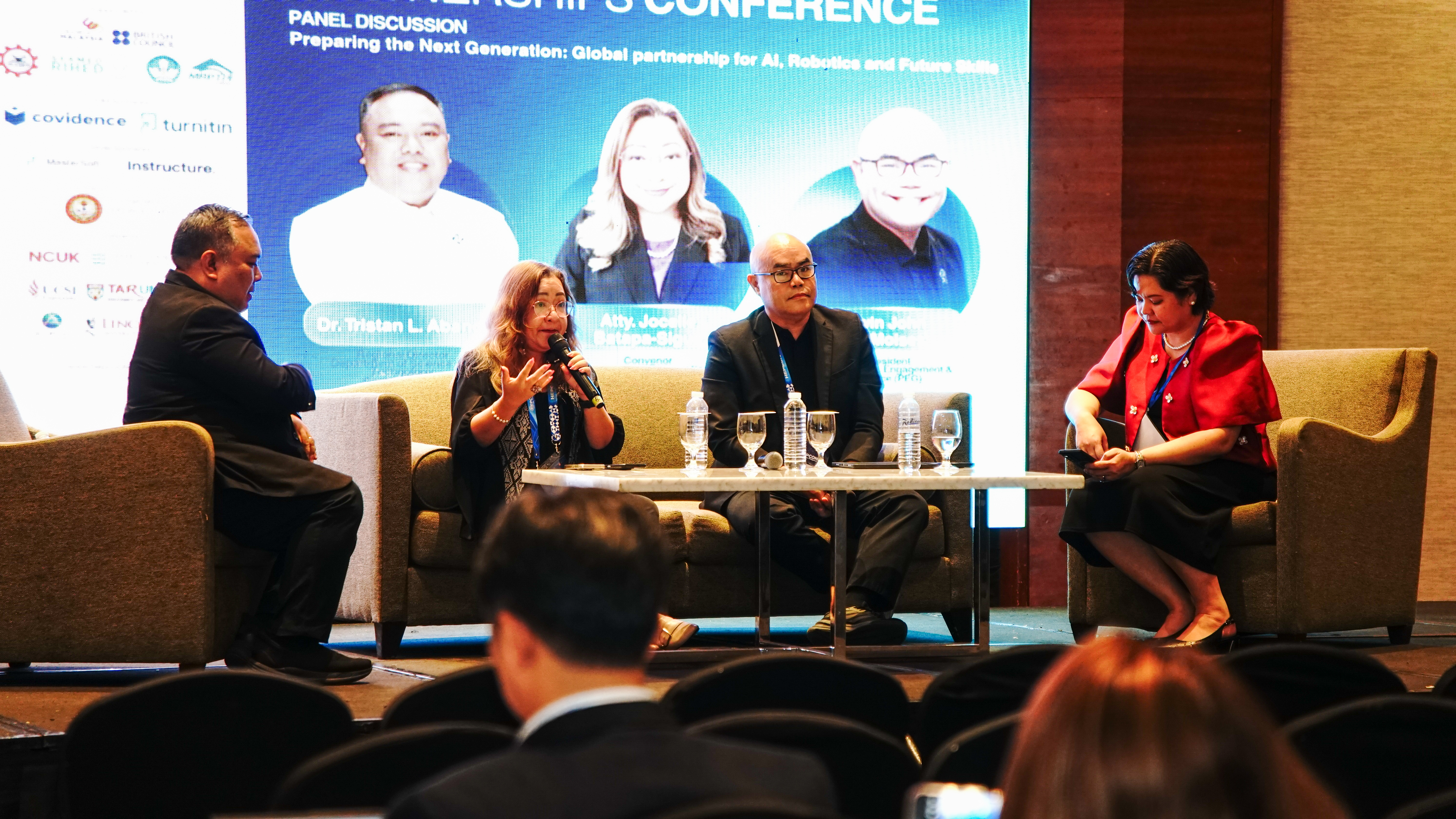
The panel discussion was moderated by Dr. Larmie S. Feliscuzo, Director of Management Information Systems and External Affairs at Cebu Institute of Technology–University (CIT-U). Joining Batapa-Sigue were Dr. Tristan L. Abando, Regional Director of DOST–Region VII, and Darwin John “DJ” Moises, Vice President for Partnerships, Engagement and Governance of the Cebu Chamber of Commerce and Industry. The session brought together perspectives from academe, government, and industry on preparing students for advances in AI, robotics, and future skills.

Connecting Philippine institutions with global partners
HEPCON 2026 connected 159 Philippine higher education institutions with partners from 13 other countries, according to the Commission on Higher Education (CHED). The gathering provided a platform for cooperation in student and faculty mobility, international research, artificial intelligence and robotics, future skills, and the evolving landscape of ASEAN higher education.
With CHED and Cebu Technological University as hosts and Jakarta-based MSW Global as organizer, the conference brought together education leaders, government officials, industry representatives, and international academic partners. Its program included presentations, discussions, and opportunities to develop institutional connections across borders.
For Batapa-Sigue, these connections must translate into experiences and opportunities that students can access. International engagement becomes more meaningful when it strengthens teaching, supports relevant research, develops practical competencies, and helps graduates participate in an increasingly competitive economy.
Updating the foundations of ICT education
A central concern in Batapa-Sigue’s contribution was the need to review and update the policy framework supporting Philippine computing education.
CHED Memorandum Order No. 25, series of 2015, sets out the revised policies, standards, and guidelines for Bachelor of Science programs in Computer Science, Information Systems, and Information Technology. Issued more than a decade ago, the order provides an important reference point for discussions about the responsiveness of computing education.
Batapa-Sigue highlighted the continuing challenge of aligning Philippine ICT courses with evolving global standards, technological developments, and industry requirements. Her call for reform extended beyond adding new subjects or introducing the latest software into classrooms.
The broader task involves reviewing graduate competencies, strengthening faculty development, improving access to appropriate tools, and expanding opportunities for students to work on actual industry and community problems.
A review of national standards should also support institutions in adapting their programs as technologies and occupational requirements change. The objective is to develop graduates with strong foundations who can continue learning throughout their careers.
Batapa-Sigue’s position on ICT education is for a coordinated review of curriculum standards, digital competencies, accreditation, and workforce readiness against international benchmarks. Her materials identify computing curriculum guidelines from global competency frameworks as references for strengthening Philippine programs. In many of her talks, she calls for alignment assessment highlights the need to connect academic standards more closely with industry and workforce requirements. She advocates competency-based curricula in which students demonstrate their ability to build, analyze, communicate, protect, and govern digital systems, supported by interdisciplinary learning, campus innovation ecosystems, and continuous upskilling. As AI becomes embedded in professional practice, she stresses that technical proficiency must include systems integration, cybersecurity, data governance, rigorous verification, and ethical accountability. For Batapa-Sigue, international alignment must produce demonstrable capabilities that prepare graduates for quality employment, entrepreneurship, and responsible innovation.
Bringing global experience to local ecosystem development
Batapa-Sigue’s perspective draws on experience across law, public policy, ICT industry development, and international digital cooperation.
She previously served as Philippine Councilor at the International Telecommunication Union (ITU) and currently sits on its Digital Innovation Board. The board forms part of the Innovation and Entrepreneurship Alliance for Digital Development, a flagship initiative of the ITU’s Telecommunication Development Bureau (BDT).
These roles provide context for her emphasis on connecting education with the wider conditions that enable innovation: institutional capacity, talent, investment, entrepreneurship, and collaboration.
Through her networks, she advocates for stronger relationships among stakeholders whose decisions influence whether digital capabilities develop into sustainable economic opportunities. For educational institutions, this means engaging employers, entrepreneurs, public agencies, and communities as active partners in developing talent.
Expanding learning beyond campus boundaries
Batapa-Sigue also raised concerns about schools that discourage or restrict students from participating in activities outside their campuses, even when those activities offer substantial learning opportunities.
These include innovation challenges, hackathons, community projects, industry engagements, and collaboration with students from other institutions. She identified particular concern for high school students whose curiosity and willingness to experiment should be encouraged early.
Her position recognizes the importance of classroom instruction while calling for broader recognition of applied learning. Students develop valuable capabilities when they investigate a problem, consult potential users, build a prototype, test assumptions, and respond to feedback.
Such experiences also expose learners to teamwork, uncertainty, and the practical constraints that shape decisions in workplaces and enterprises.
For schools seeking to develop innovators, participation in these activities should form part of a deliberate approach to learning. Institutional partnerships can help make those opportunities accessible, purposeful, and connected to educational outcomes.
Increasing women’s participation in technology
Inclusion formed another dimension of Batapa-Sigue’s contribution. She also convened Digital Innovation for Women Advancement (DIWA), which advocates for greater participation of women in technology courses, careers, and companies.
The advocacy connects educational access with professional advancement and enterprise development. Encouraging more women to enroll in technology programs must be accompanied by opportunities to gain experience, develop networks, enter technical roles, and progress into leadership.
It also means supporting women who seek to establish and grow technology businesses.
For institutions and employers, this creates a shared opportunity to widen the talent pool and build pathways through which more women can contribute to the digital economy as professionals, founders, and decision-makers.
Linking education reform with job creation
Batapa-Sigue emphasized that improving education and creating jobs require coordinated action. Relevant qualifications alone cannot guarantee employment when local ecosystems lack sufficient investment, enterprise activity, or opportunities to apply specialized skills.
Academe, government, and industry must therefore work together on both talent development and opportunity creation.
Schools contribute teaching, research, and emerging talent. Industry brings market knowledge, practical requirements, workplace experience, and potential customers. Government helps establish the policies, infrastructure, and enabling conditions that support investment and enterprise growth.
Their collaboration can strengthen the journey from education to employment and entrepreneurship through mentoring, industry projects, research partnerships, incubation, and market access.

Batapa-Sigue’s contribution at HEPCON placed these relationships at the center of education reform. The measure of a successful partnership, she emphasized, should ultimately be the opportunities it enables: meaningful jobs, viable businesses, stronger institutions, and communities equipped to participate in digital development.