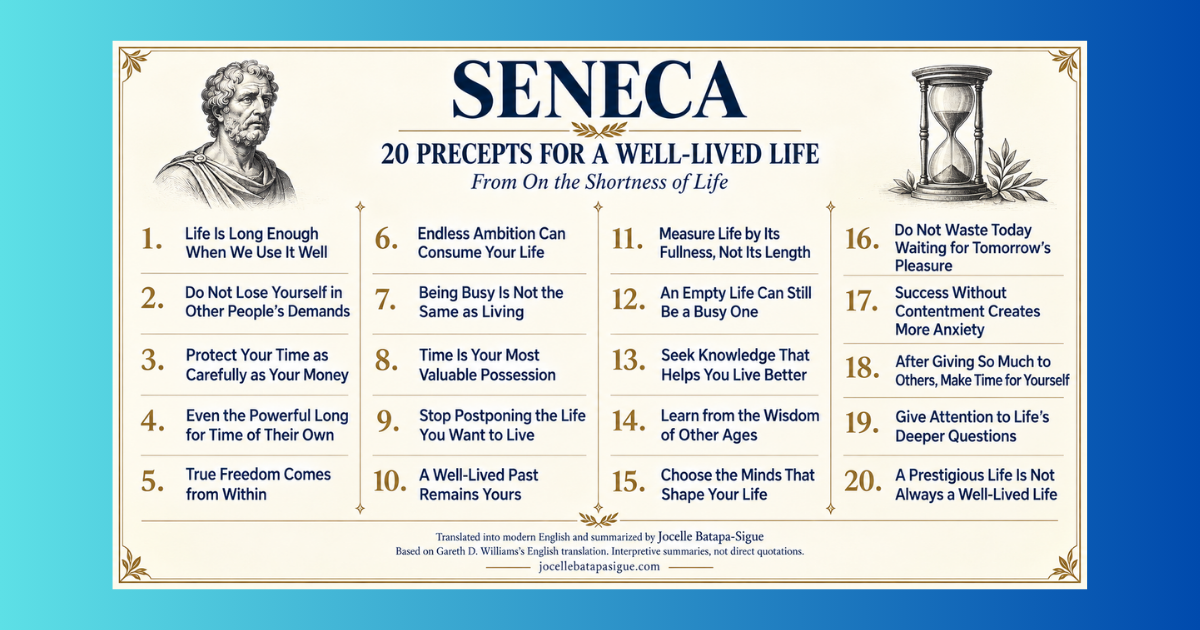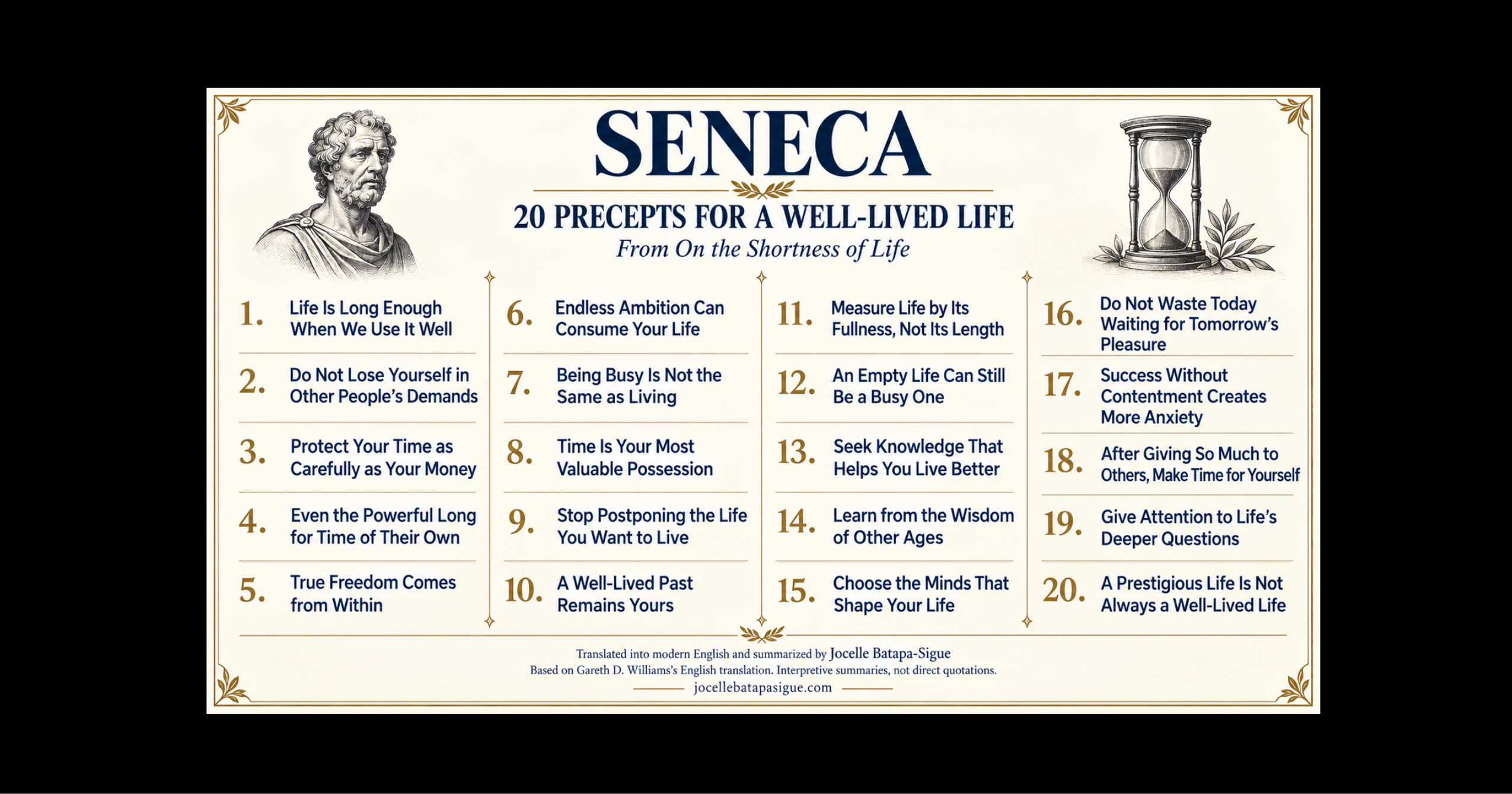
The article introduces the 20 ideas you have named as precepts and connects their lessons on time, ambition, service, wisdom, and purposeful living, with clear attribution to Seneca and Gareth D. Williams.

We often speak about time as something we do not have enough of, especially when our days are filled with responsibilities, commitments, and expectations that seem to grow faster than our ability to meet them. Yet in On the Shortness of Life, Seneca asks us to examine a more difficult possibility: perhaps the problem is not simply the length of our lives, but how much of them we allow to pass without living deliberately.
From the essay’s 20 sections, I have drawn 20 ideas that I have chosen to call precepts for a well-lived life. These are modern interpretive summaries, based on Gareth D. Williams’s English translation, rather than Seneca’s original headings or direct quotations. I use the word precepts because these ideas offer principles we can return to when deciding how to spend our time, what to pursue, and what we may finally need to release.
Taken together, they invite us to protect our time, examine our ambitions, cultivate wisdom, and recognize that a life filled with activity or public recognition is not necessarily a life filled with meaning.
Seneca’s first challenge concerns our relationship with time. We protect money, property, and possessions with considerable care, yet often surrender hours and days without asking what we receive in return. We may notice a financial loss immediately while barely recognizing how much of ourselves has disappeared into unnecessary worry, repeated distractions, or obligations accepted without reflection.
This is the connection among the precepts that life is long enough when used well, that we must protect our time as carefully as our money, and that time is our most valuable possession. The point is not that every hour must produce an achievement. It is that the time we receive deserves conscious attention, including the time we devote to rest, reflection, relationships, and learning.
A second group of precepts concerns how easily we lose ourselves in other people’s demands. Seneca describes people whose days belong almost entirely to patrons, clients, public duties, and the pursuit of approval. Their lives appear important, but their freedom to determine how they live has become remarkably small.
This observation remains useful when we examine the difference between chosen service and unquestioned availability. We can contribute to others while still asking whether every demand deserves our agreement. To give attention to our own lives is not automatically to withdraw from responsibility; it can also help us understand which responsibilities are truly ours and where our presence has the greatest value.
Seneca makes this concern especially vivid through his accounts of powerful people who longed for time of their own. Position and influence did not protect them from exhaustion, insecurity, or the feeling that their lives were controlled by circumstances. The precept that true freedom comes from within reminds us to examine what governs our choices, while the warning that endless ambition can consume a life asks whether we know when achievement has become enough.
There is a difficult question here for anyone accustomed to setting goals: are our ambitions serving a purpose we believe in, or are we simply replacing one pursuit with another? Success can create more anxiety when every accomplishment immediately produces a new fear of loss or a new demand for recognition. Without contentment, even progress can become a source of permanent dissatisfaction.
Another central thread is the difference between being occupied and being fully alive. Seneca observes that an empty life can still be extraordinarily busy, including when its activity takes the form of entertainment, social display, or apparently impressive learning. A crowded schedule tells us how much is happening, but it does not by itself tell us what any of it means.
The precepts about busyness therefore belong beside the invitation to measure life by its fullness rather than its length. A meaningful life cannot be assessed only by the number of years lived, offices held, or tasks completed. It also asks whether we have been present in our own experience, developed our judgment, and made choices we can understand and stand behind.
Seneca’s warning against postponement brings these reflections into the present. We often imagine that life will become available after the next deadline, promotion, financial milestone, or retirement. Planning is necessary, but it can become a habit of treating today as merely a waiting room for a future that remains uncertain.
To stop postponing life is to recognize that meaningful living must begin within the circumstances we already have. Similarly, the precept against wasting today while waiting for tomorrow’s pleasure challenges us to notice how anticipation can consume the days before an event, while anxiety about its ending can spoil the event itself. We can become so focused on what comes next that we fail to inhabit what is here.
The past also has a place in a well-lived life. Seneca argues that time used wisely remains available through memory and reflection, whereas a life we refuse to examine becomes difficult to claim as our own. A well-lived past does not require a flawless history, but his argument invites us to take our choices seriously enough that we can look back with understanding rather than continually avoiding ourselves.
The precepts concerning knowledge and wisdom offer a constructive response. We should seek learning that improves how we live, draw from the experience of earlier generations, and choose carefully the minds that shape us. Seneca presents philosophy as a relationship with thinkers whose insights allow us to move beyond the limitations of our immediate circumstances and our own brief experience.
For me, these precepts raise a useful distinction between collecting information and developing judgment. We can know many things without becoming more thoughtful, fair, courageous, or generous. Learning acquires deeper value when it changes the quality of our decisions and helps us give serious attention to life’s larger questions.
Near the end of the essay, Seneca addresses Paulinus directly, encouraging him to make time for himself after years of demanding public responsibility. This gives particular weight to the precept that, after giving so much to others, we must also make room for our own lives. Seneca’s idea of leisure is active and thoughtful: an opportunity to study, develop character, and consider matters that constant obligations may have pushed aside.
The final precept brings all the others into focus: a prestigious life is not always a well-lived life. Recognition can tell us that others know our name, but it cannot tell us whether we have used our years wisely. These 20 precepts ask us to look beyond the appearance of success and examine the life being lived beneath it.
The question I take from Seneca is therefore both simple and demanding: How much of the life I am working so hard to build am I actually living? Our answers will differ, but asking the question honestly may help us become more deliberate about what we protect, what we contribute, and what we choose to do with the time still before us.
Lucius Annaeus Seneca, commonly known as Seneca the Younger, was a Roman Stoic philosopher, writer, and statesman who lived from about 4 BCE to 65 CE. Born in Corduba, in present-day Spain, he became a tutor and adviser to Emperor Nero, a position that placed him close to imperial power and its dangers. His philosophical writings explore virtue, reason, emotional discipline, and the wise use of time. In On the Shortness of Life, addressed to Paulinus, he argues that people often experience life as short because they surrender so much of it to distraction, ambition, and consuming obligations, while thoughtful living gives greater value to the time available. Seneca died in 65 CE after Nero ordered him to take his own life following allegations of involvement in a conspiracy against the emperor.
Source: Lucius Annaeus Seneca, On the Shortness of Life (De Brevitate Vitae), translated into English by Gareth D. Williams, as provided in the supplied PDF. The 20 precepts were named and presented by Jocelle Batapa-Sigue as modern interpretive summaries of the essay’s 20 sections. Contemporary applications in this article are reflections on the text, not direct quotations from Seneca.