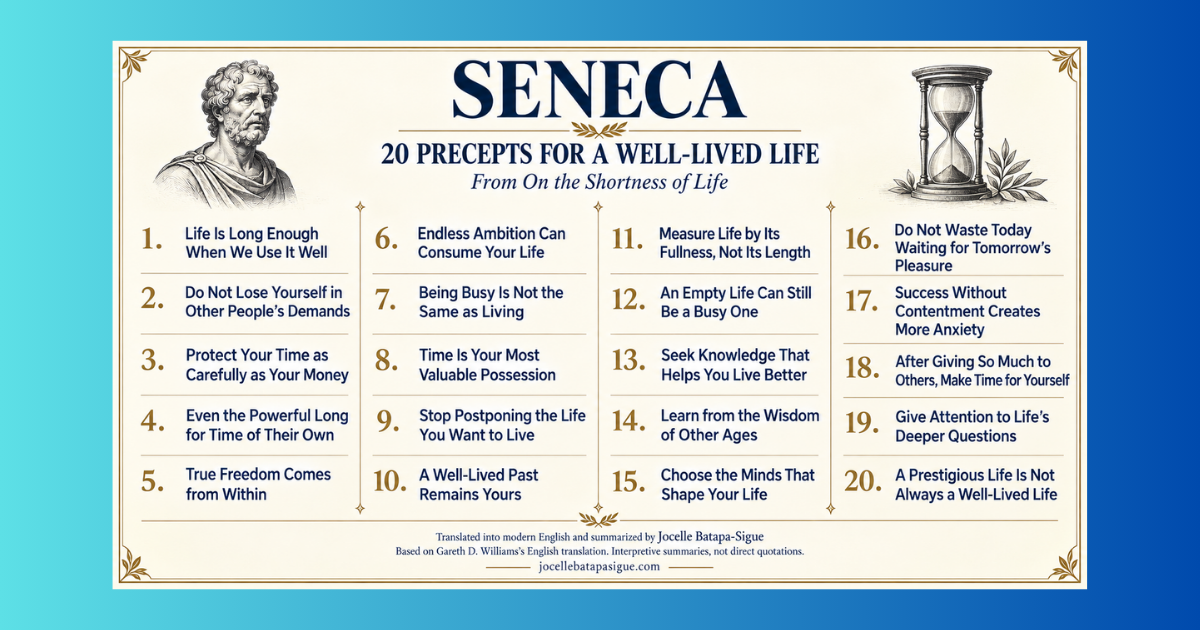
Understanding Twenty Precepts Inspired by Seneca’s On the Shortness of Life
Modern interpretations and reflections by Jocelle Batapa-Sigue
What makes a life feel too short? In On the Shortness of Life, the Roman philosopher Seneca argues that much of our distress comes from allowing our years to disappear into ambition, distraction, dependence on others, and pleasures that never satisfy us. His concern is how we live within the time available to us, and whether we give serious attention to the person we are becoming.
Seneca addresses the essay to Paulinus, a public official responsible for Rome’s grain supply. His appeal is therefore especially striking: a person can carry important responsibilities, perform them conscientiously, and still need to reclaim time for reflection and the cultivation of wisdom.
The twenty statements accompanying this collection of images are modern interpretive summaries, each corresponding to a section of the essay. Seneca did not present these exact sentences as a list of twenty precepts; “precepts” is the name I have given this collection. The explanations below follow the English translation by Gareth D. Williams in the supplied edition, while identifying applications to life today as contemporary reflections.
Two ideas guide the entire work. By leisure, Seneca means freedom for philosophical study and the development of character, rather than merely having an empty schedule. By philosophy, he means a serious engagement with how to live, judge, act, and face death. His argument is consequently more demanding than a recommendation to become efficient or make more time for entertainment.

1. Life Is Long Enough When We Use It Well
Source: Section 1, especially 1.3–1.4.
Seneca begins by challenging the complaint that nature has given human beings too little time. He compares life with wealth: a large fortune can disappear through careless management, while modest resources can be used well. Similarly, the value of our years depends on what we do with them. His claim is an ethical argument about wasted life, rather than a guarantee that everyone will have enough years to accomplish every hope. For a reader today, the challenge is to examine whether daily choices serve worthwhile purposes and develop good character, instead of assuming that a longer life would automatically become a better one.
In a world that measures productivity through deadlines, output, and constant availability, it is easy to believe that we simply need more hours. Seneca invites us to examine how we use the time already available, particularly how much disappears into distraction, comparison, and pursuits we have never seriously questioned. Applied today, this means choosing activities that strengthen our character, deepen our relationships, and contribute to something worthwhile. A meaningful life does not require completing everything on an endless list, but it does require recognizing what deserves our attention.

2. Do Not Lose Yourself in Other People’s Demands
Source: Section 2, especially 2.4–2.5.
Seneca describes people moving through chains of dependence, each seeking someone else’s attention or favor while neglecting himself. Some are overwhelmed by clients, others by their pursuit of powerful patrons, and many by their need for approval. The issue is the loss of self-direction: a person can be constantly available to others while remaining a stranger to his own mind. A contemporary application is to distinguish responsibilities we accept thoughtfully from commitments driven by status or fear of displeasing others. This is a call to examine the terms on which we give our time, rather than a rule against helping people.
Messages, meetings, family expectations, and professional obligations can make us permanently accessible while leaving little room to understand our own needs and convictions. Seneca’s concern about people who never belong to themselves finds a modern expression in the pressure to respond immediately and accommodate everyone. Setting thoughtful boundaries allows us to fulfill responsibilities with greater intention, rather than from guilt or a need for approval. We can care deeply for others while preserving the time and independence needed to make considered choices about our own lives.

3. Protect Your Time as Carefully as Your Money
Source: Section 3, especially 3.1–3.5.
People fiercely defend their property, Seneca observes, yet allow others to occupy their lives almost without resistance. He asks the reader to examine the accounts of an entire lifetime, including hours lost to needless anxiety, social obligations, and uncontrolled desire. He also criticizes postponing serious attention to life until retirement, because no one has been promised those later years. Applied today, his challenge is to treat a commitment of time as a real decision with a real cost. Protecting time creates room for reflection and deliberate living; it need not mean putting a financial price on every human interaction.
We check bank balances and question unnecessary expenses, yet often accept commitments without considering how much of our lives they will consume. In contemporary life, protecting time means evaluating meetings, managing notifications, and recognizing when an obligation has become habitual rather than necessary. It also means reserving time for rest, relationships, and reflection before the calendar fills completely. Seneca’s comparison encourages us to approach our hours with care, remembering that money can sometimes be recovered, while a day already spent cannot be returned.

4. Even the Powerful Long for Time of Their Own
Source: Section 4.
Seneca presents Augustus as an example of a ruler who could influence the fortunes of nations yet repeatedly longed for release from public affairs. Behind his visible power stood military conflict, personal dangers, and exhausting responsibilities. Seneca uses this portrait to expose the difference between the appearance of success and the experience of living with it. His point is that high position does not guarantee possession of one’s own time. For a modern reader, the useful question is what a desirable title or promotion will require in daily life, including obligations and anxieties that are less visible than its rewards.
Leadership, visibility, and professional success often come with responsibilities that outsiders rarely see, including relentless decisions, public scrutiny, and expectations of constant availability. Seneca’s account of powerful people longing for leisure reminds us that an impressive position may offer influence without much personal freedom. Before pursuing the next title or promotion, we can ask what it will require of our attention, relationships, and peace of mind. Success deserves to be evaluated through the experience of living it, including whether it leaves room for a life beyond the role.

5. True Freedom Comes from Within
Source: Section 5, especially 5.2–5.3.
Seneca contrasts his portrayal of Cicero’s troubled political life with the freedom of the wise person. Cicero appears caught between regret, dissatisfaction, and fear, while the ideal sage remains inwardly self-governing despite changes in fortune. The precept refers to moral independence: the ability to judge and act without making one’s entire worth depend on external circumstances. It should not be read as claiming that political liberty or material conditions are unimportant. Seneca is describing an ideal of character, and his account of Cicero serves that philosophical argument; the supplied edition’s notes also question aspects of that historical portrayal.
Social media, performance rankings, and public opinion can make our sense of worth depend on judgments we cannot control. Seneca’s ideal of inner freedom encourages us to develop convictions strong enough to withstand changing approval, while remaining open to correction and learning. In modern life, this means making decisions through reason and conscience rather than allowing applause, criticism, or fear of exclusion to govern us. External conditions still matter, but cultivating sound judgment helps us retain a measure of independence within circumstances we cannot fully determine.

6. Endless Ambition Can Consume Your Life
Source: Section 6.
Seneca uses the career of Livius Drusus to depict ambition that begins early and leaves almost no space for release. He also observes that people may complain bitterly about their burdens, then return to the same habits without changing anything. The deeper problem is a pattern of desire that no additional time can satisfy. For readers today, the precept invites examination of ambition’s direction and limits: what would count as enough, and what is continually being postponed? Seneca’s historical example is argumentative rather than neutral biography, and the edition’s notes dispute his suggestion that Drusus may have taken his own life.
Modern careers offer an almost unlimited succession of targets: another qualification, a higher position, a larger business, or greater public recognition. Ambition can support meaningful achievement, but it becomes consuming when every accomplishment immediately turns into another requirement for feeling adequate. Seneca’s warning asks us to examine what our ambitions serve and whether we have any understanding of enough. Setting limits does not require abandoning growth; it allows growth to remain connected to worthwhile purposes instead of becoming a pursuit that repeatedly postpones the rest of life.

7. Being Busy Is Not the Same as Living
Source: Section 7, especially 7.3–7.10.
Seneca argues that learning to live is a lifelong undertaking requiring attention, just as mastering any difficult discipline does. A mind crowded with competing demands struggles to undertake that work. He compares a person who has merely accumulated years to a ship tossed around near its harbor: much movement has occurred without a substantial journey. The distinction concerns direction and understanding, not simply the number of activities performed. A present-day reader might therefore ask whether a full schedule is helping develop judgment, character, and an examined life, or merely providing continuous movement that leaves those questions unanswered.
A calendar filled with meetings and a phone filled with notifications can create the feeling of importance without providing a clear sense of direction. Seneca’s distinction between activity and living challenges us to ask whether our efforts are developing judgment, strengthening relationships, or advancing work we consider meaningful. In the twenty-first century, an intentional pause can be more valuable than another hour of automatic activity because it allows us to reconsider where we are going. The measure of a day includes what we understood and how we acted, alongside what we completed.

8. Time Is Your Most Valuable Possession
Source: Section 8.
Time is easily undervalued because it has no visible, physical form. Seneca notes that people casually give it away, yet become willing to sacrifice their possessions when their lives are threatened. That contradiction reveals how poorly ordinary behavior reflects time’s importance. No authority can command the years to return, and no payment can restore the life already spent. Whereas Precept 3 emphasizes guarding time, this section explains why people fail to recognize its value. Its modern application is awareness: small commitments and recurring distractions consume the same finite life as the major decisions we consider carefully.
Digital services compete for attention, and small interruptions can gradually consume hours without feeling like significant decisions. Seneca’s insight about the invisible value of time helps us recognize that attention given to a screen, an argument, or a commitment is part of a finite life. This does not mean every moment must produce something measurable, because affection, rest, and quiet enjoyment can be deeply worthwhile. It means becoming conscious of where our time goes and deciding whether that use reflects what we actually value.

9. Stop Postponing the Life You Want to Live
Source: Section 9, especially 9.1–9.3.
Seneca criticizes arrangements for a future life that consume the life already available. People place their hopes in uncertain circumstances while neglecting the present, where they can actually act. The phrase “the life you want” in this modern precept needs to be understood through his wider argument: he is urging the beginning of wise living, rather than endorsing every personal desire. A contemporary application is to begin practicing worthwhile priorities now, even in limited ways, instead of making them wholly dependent on a later promotion, retirement, or perfect set of conditions. Planning becomes a problem when it replaces living.
Many people imagine that meaningful living will begin after financial security, professional recognition, or retirement, while the conditions for beginning keep moving further away. Seneca challenges the habit of sacrificing the present entirely to an uncertain future. Applied today, his insight encourages us to begin practicing our priorities in realistic ways, whether through learning, caring for relationships, serving a cause, or developing greater integrity in our work. Preparation remains necessary, but it should help us live deliberately now as well as improve the possibilities ahead.

10. A Well-Lived Past Remains Yours
Source: Section 10, especially 10.2–10.5.
Seneca divides life into the past, present, and future, describing the past as settled and beyond fortune’s power to alter. Yet people who remain preoccupied lose access to its benefits because they never reflect, or because they are reluctant to confront their conduct. A well-lived past provides something the mind can revisit without shame. This precept concerns the moral quality of experience, rather than the pleasantness of every memory or the preservation of a public reputation. A modern application is to act in ways that can withstand honest reflection, while allowing reflection on mistakes to inform better choices.
In a culture that quickly moves from one achievement to the next, we may overlook the lasting value of actions undertaken with honesty, courage, and care. Seneca’s reflection on the past suggests that what we have genuinely lived cannot be undone by a later loss of position or recognition. For contemporary readers, this encourages decisions we can examine honestly, rather than choices designed only to impress an audience. Our past also contains mistakes, and reflecting on them responsibly can help us carry forward understanding instead of merely repeating familiar patterns.

11. Measure Life by Its Fullness, Not Its Length
Source: Section 11.
Seneca contrasts people who urgently seek more years because they feel they have never lived with the wise person whose time has been meaningfully used. In his account, such a person can meet the end without believing that life has remained entirely unbegun. “Fullness” here means a life directed by wisdom, rather than one crowded with experiences, achievements, or pleasures. The precept offers a standard for examining the quality of living; it does not establish that an early death is insignificant or that grief is mistaken. Its practical question is what makes the time we have genuinely worthwhile.
Modern society counts years, milestones, followers, and achievements, but these measurements cannot fully describe the quality of a human life. Seneca directs attention toward whether our time has been guided by wisdom and used meaningfully. Applied today, fullness can involve thoughtful work, genuine relationships, continuing learning, and conduct consistent with our values, rather than a crowded collection of experiences. This perspective does not diminish the importance of health or longevity; it reminds us to give attention to the life within those years, alongside our understandable hope for more of them.

12. An Empty Life Can Still Be a Busy One
Source: Section 12.
Seneca extends his criticism beyond officials and professionals to people whose supposed leisure is consumed by display, luxury, and trivial anxieties. He depicts elaborate grooming, collecting, and banqueting as activities that can leave a person just as inwardly occupied as public business. His examples are satirical and reflect the judgments and social hierarchy of ancient Rome. Their central point is that an absence of employment does not automatically produce meaningful leisure. Applied today, the question is whether our free hours restore awareness and self-direction or simply reproduce another form of compulsive occupation. This application does not require adopting all his judgments about particular pastimes.
Even outside work, our lives can become crowded with shopping, entertainment, image management, and the pressure to document every experience. Seneca’s criticism of preoccupied leisure has a modern parallel in free time that leaves us distracted and unable to settle into our own company. Recreation can be valuable, but it helps to notice when enjoyment becomes an automatic way of avoiding reflection or discomfort. Meaningful leisure gives us room to recover, think, and engage with life more consciously, rather than simply filling every available silence.

13. Seek Knowledge That Helps You Live Better
Source: Section 13, especially 13.9.
Seneca criticizes painstaking investigations into details that, in his judgment, contribute nothing to moral improvement. His test is whether knowledge helps restrain harmful impulses or makes someone more courageous, just, or generous. He is unusually severe toward certain literary and historical inquiries, so this section should not be softened into a modern celebration of all learning. Equally, it should not be turned into a demand that every subject produce immediate financial or professional benefits. His standard is ethical. A contemporary application is to ask how learning changes our judgment and conduct, beyond increasing the amount of information we can display.
The internet and artificial intelligence make information readily available, but access alone does not produce wisdom. Seneca’s ethical test of learning asks whether it improves judgment and helps us become more courageous, fair, and generous. In contemporary life, this means going beyond collecting credentials, repeating impressive facts, or accepting convenient answers without examination. We can approach knowledge with curiosity while also asking how it affects our decisions, our treatment of others, and our understanding of responsibility. The value of learning becomes clearer when it influences how we live.

14. Learn from the Wisdom of Other Ages
Source: Section 14.
Seneca argues that philosophical study expands life beyond the limits of personal experience. Through earlier thinkers, readers gain access to questions, discoveries, and ways of living developed before they were born. He names philosophers from several traditions, including Socrates, Epicurus, and the Stoics, portraying them as companions whose works remain available when influential contemporaries will not receive us. The precept therefore concerns active engagement with inherited wisdom. Its application today is to read deeply enough to encounter another mind’s reasoning and challenges, allowing earlier thought to enlarge our understanding rather than merely collecting memorable sayings.
A culture that constantly celebrates the newest development can make older ideas seem irrelevant before they have been understood. Seneca reminds us that reading earlier thinkers gives us access to experiences and questions extending beyond our own lifetime. In the twenty-first century, this can help us approach technological change with a deeper understanding of enduring concerns such as power, justice, desire, and mortality. Learning from the past requires critical engagement rather than automatic agreement, allowing inherited wisdom to inform our choices while recognizing the limitations of its original setting.

15. Choose the Minds That Shape Your Life
Source: Section 15, especially 15.1–15.5.
Continuing the previous section, Seneca describes the great thinkers as a family we can choose. Although we cannot select our birth parents, we can enter an intellectual tradition and inherit wisdom that becomes more abundant when shared. These guides offer truthful counsel and models for shaping character. The original argument is specifically about philosophical companionship through the thinkers and their works. Extending it to mentors, media, or online influences is a contemporary application. That application is strongest when we choose voices that improve our judgment and can challenge us, rather than only those who repeat what we already believe.
Our thinking is influenced by the people we consult, the books we read, and the voices that repeatedly appear in our feeds. Seneca’s invitation to choose philosophical guides can be extended today into a deliberate examination of these influences. We can seek thinkers and mentors who offer evidence, challenge comfortable assumptions, and demonstrate intellectual honesty, rather than rewarding only those who flatter us or provoke strong emotions. Choosing good intellectual company helps us develop independent judgment, especially when algorithms and social pressures would otherwise make those choices for us.

16. Do Not Waste Today Waiting for Tomorrow’s Pleasure
Source: Section 16, especially 16.3–16.5.
Seneca describes people who find ordinary hours unbearable while waiting for a banquet, spectacle, or other amusement. They wish away the intervening days, then discover that the pleasure itself passes quickly or is disturbed by anticipation of its ending. This section addresses a particular form of lost time: treating most of life as an inconvenient interval between entertainments. A modern application is to notice when we mentally discard entire weeks while waiting for a weekend, holiday, or celebration. The challenge is to give ordinary time a worthwhile use, so that life does not become an endless sequence of waiting periods.
When life becomes a countdown to the weekend, the next holiday, or an anticipated celebration, ordinary days can begin to feel disposable. Seneca describes this pattern of wishing away the interval before enjoyment, only to find that enjoyment itself passes quickly. A contemporary response is to give everyday life more deliberate attention through meaningful work, conversation, learning, and moments of appreciation. Looking forward to something can enrich life, but we should be careful about treating most of our available time as something merely to endure.

17. Success Without Contentment Creates More Anxiety
Source: Section 17.
Seneca examines the insecurity of happiness that rests on unstable advantages. People struggle to obtain power, wealth, or distinction, then work still harder to preserve them, fearful of losing what they have gained. One fulfilled desire produces another, while the loss of time continues unnoticed. “Contentment” in the modern heading summarizes the missing inner stability; Seneca’s underlying concern is dependence on fortune. The precept is not a clinical explanation of anxiety. It describes a moral and psychological pattern in which external success cannot settle an endlessly demanding mind, because every achievement becomes something new to defend or surpass.
Recognition, wealth, and influence can bring opportunities while also creating new fears about losing what we have gained. In a world of constant comparison, success may become an unstable standard because someone else always appears to have more. Seneca’s warning encourages us to examine how strongly our peace depends on external advantages and whether our desires have any limits. Applied today, this means developing sources of worth rooted in character and purposeful action, while appreciating achievements without expecting them to provide permanent security or settle every inner dissatisfaction.

18. After Giving So Much to Others, Make Time for Yourself
Source: Section 18, especially 18.1–18.4.
Seneca directly urges Paulinus to withdraw toward a more peaceful life after years of demanding public service. He acknowledges Paulinus’s diligence and integrity, while insisting that some time should now belong to the person who has given so much to the state. Crucially, he immediately explains that he is not recommending inactivity, excessive sleep, or indulgence. The proposed change is toward serious pursuits in philosophical leisure. This is the collection’s clearest basis for reflecting on departure from public office: stepping back can become a deliberate redirection of one’s abilities, provided that the recovered time is used thoughtfully.
People who spend years serving institutions, families, or communities can become accustomed to treating their own time as whatever remains after everyone else has been accommodated. Seneca’s appeal to Paulinus recognizes the value of conscientious public service while urging him to make room for philosophical reflection. In contemporary life, stepping back from a demanding role can create space to learn, reconsider priorities, and choose how to contribute next. Reclaiming time becomes meaningful when we use it deliberately, allowing a new stage of life to develop beyond the obligations that defined the previous one.

19. Give Attention to Life’s Deeper Questions
Source: Section 19, especially 19.1–19.2.
Seneca explains what Paulinus might pursue after leaving administration: inquiry into the divine, the soul, the natural world, virtue, and how to live and die. His account includes ancient cosmological ideas, which should be understood historically rather than presented as current science. Philosophy, in this section, joins the investigation of existence with the practice of good character and the search for tranquility. For a reader today, its application is to reserve attention for questions that daily tasks can continually displace: what deserves our commitment, how we should act, and what understanding can guide us through change and mortality.
Daily administration can absorb so much attention that questions about purpose, responsibility, belief, and mortality are repeatedly deferred. Seneca encourages a turn toward inquiry that enlarges our understanding of existence and guides our conduct. In an age when technology can accelerate tasks and generate answers, we still need to decide which questions matter and what kind of lives our tools should support. Making space for serious reflection helps us examine our assumptions, clarify our commitments, and approach change with more than a series of immediate reactions.

20. A Prestigious Life Is Not Always a Well-Lived Life
Source: Section 20.
Seneca closes by exposing the cost of honors pursued at the expense of an entire lifetime. He describes people whose attachment to office survives their strength, including an elderly official who responds to retirement as though he has died. Public recognition and grand memorials cannot establish that their owner has lived wisely. His criticism is sharper than a neutral invitation to balance work and leisure: he attacks an identity so dependent on occupation and reputation that relinquishing them seems intolerable. Applied today, the precept asks whether our accomplishments have supported a meaningful life, and who we are when the title is removed.
Daily administration can absorb so much attention that questions about purpose, responsibility, belief, and mortality are repeatedly deferred. Seneca encourages a turn toward inquiry that enlarges our understanding of existence and guides our conduct. In an age when technology can accelerate tasks and generate answers, we still need to decide which questions matter and what kind of lives our tools should support. Making space for serious reflection helps us examine our assumptions, clarify our commitments, and approach change with more than a series of immediate reactions.
Taken together, these precepts ask us to examine what receives our attention and what that attention is making of us. Seneca’s answer is a life shaped by philosophical reflection, moral practice, and a clearer understanding of mortality. The invitation is to begin that work while time remains, bringing greater intention to our responsibilities, our ambitions, and the hours we can call our own.
Source and attribution: These twenty precepts and their explanations are modern interpretive summaries of Lucius Annaeus Seneca’s On the Shortness of Life (De Brevitate Vitae), based on the English translation by Gareth D. Williams in the supplied edition. The numbering follows the essay’s twenty sections. The headings are not verbatim quotations or a separately named list written by Seneca. Contemporary applications are reflections on the text, not claims that Seneca discussed modern institutions or technologies. Historical examples are presented as Seneca’s illustrations, with qualifications where the supplied edition questions them. “Modern interpretations and reflections by Jocelle Batapa-Sigue” identifies this presentation accurately; it does not claim a new translation from Latin.
Seneca’s On the Shortness of Life
In 49 AD, Rome depended on a massive and fragile system to survive: the annona, the grain supply that fed more than a million people. At its center was Pompeius Paulinus, the praefectus annonae, one of the most demanding administrative positions in the empire. His job was political by nature — securing grain shipments, managing storage, preventing shortages, and keeping public order in a city where hunger could spark unrest.
Historical records place Paulinus in this role during the reign of Emperor Claudius, a period marked by bureaucratic expansion, imperial reforms, and intense pressure on senior officials. By 49 AD, Paulinus was preparing to retire after years of service that left little time for personal reflection or intellectual life.
At the same moment, Lucius Annaeus Seneca had just returned to Rome from eight years of exile in Corsica. Recalled by Agrippina to tutor the young Nero, Seneca re‑entered political life with a sharpened awareness of how quickly time can be consumed by public obligations, court politics, and the demands of power.
Seeing Paulinus step away from office, Seneca wrote On the Shortness of Life — not as a literary exercise, but as a philosophical intervention. The treatise is addressed to a man transitioning out of government service, and its arguments reflect the realities of Roman political life:
- Public office can swallow decades without giving meaning in return.
- Political duty often replaces personal purpose.
- A life spent entirely on administration, crisis management, and state demands can leave no space for one’s own mind.
Seneca’s message was clear and historically grounded: Life is not short — but politics, bureaucracy, and constant obligations can make it feel that way.
His work became both a farewell to a respected official and a reminder that even in the most powerful empire of the ancient world, the greatest scarcity was not grain, wealth, or influence, but time.