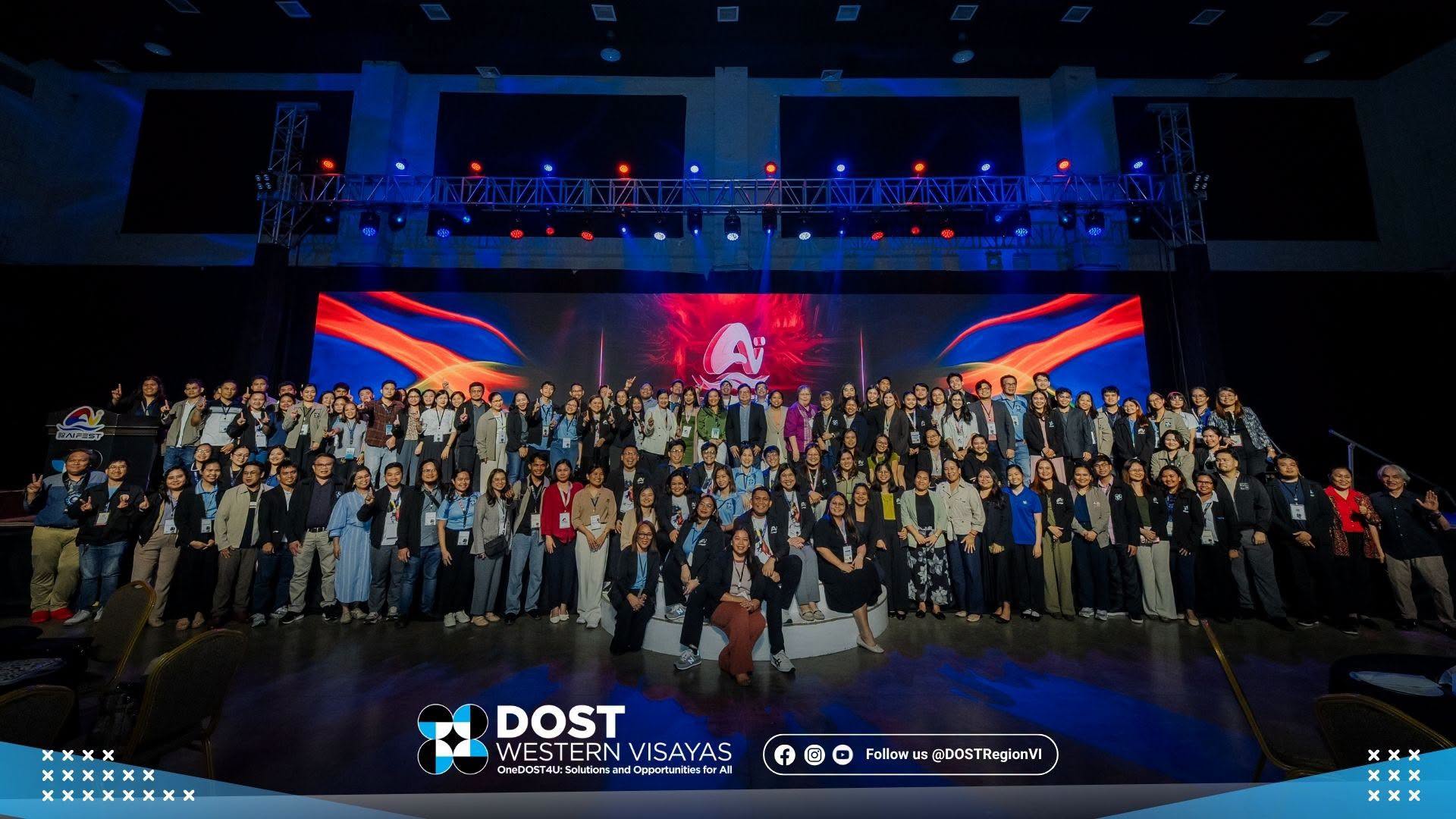
ILOILO CITY — Western Visayas is moving to position artificial intelligence as an economic and institutional capability rather than a stand-alone technology investment, with the 2026 AI Fest bringing together policy, research, industry applications, workforce development, data infrastructure and human-centered governance under a three-day program aimed at defining what an AI-ready Philippines will require.
Held from August 3 to 5 at the Iloilo Convention Center under the theme “Building an AI-Ready Future, Together,” the event was organized around a progression from national AI opportunities and ASEAN competitiveness to responsible adoption, research commercialization, data-driven development, human-centered governance and scalable industry applications.
The program suggests a deliberate shift in the AI conversation from technology acquisition toward the capabilities that determine whether artificial intelligence can translate into productivity, innovation, investment and public value.

DOST Secretary Renato U. Solidum Jr. opened the main conference with the keynote “Building an AI-Ready Future for the Philippines through Science, Technology, and Innovation,” setting the national context for a program that subsequently examined talent, enterprise competitiveness, sustainable development, research, governance and commercialization.
Talent and competitiveness frame the opening agenda
The first plenary session, “AI Opportunities for the Philippines and ASEAN,” focused on the competitive environment facing the country as artificial intelligence becomes more deeply embedded in business, government and education.
University of the Philippines Diliman professor and AI program academic head Dr. Prospero C. Naval Jr. discussed emerging AI trends and their implications for academe, industry and government, while Winston L. Damarillo, founder of DevConnect Philippines, addressed whether the Philippines can convert its existing talent base into a global advantage. ASEAN Youth Organization Program Manager Lejay Ann L. Abrigar followed with a session on building AI-ready communities in the region.
The program then moved directly into a panel asking “What Will It Take? Building a Competitive AI Ecosystem in the Philippines and ASEAN,” with representatives from analytics and AI, regional science and technology leadership and the developer ecosystem, including Ralph Vincent J. Regalado, DOST Caraga Regional Director Noel M. Ajoc, and Google APAC Developer Ecosystem Strategy Lead Marcus Foon.
For business, the strategic relevance of this framing is clear: access to AI tools is rapidly becoming more common, reducing the likelihood that technology access alone will provide a lasting competitive edge. The differentiators are increasingly likely to be the quality of talent, institutional capability, data readiness, speed of enterprise integration and ability to build commercially useful applications.
AI applications tied to inclusion, health and business transformation

The first day also placed AI within a broader development and industry context through the plenary “AI for Good: Scaling Solutions for Sustainable Development in the Philippines and Beyond.”
DOST Advanced Science and Technology Institute Director Dr. Franz A. de Leon presented an evidence-based framework for inclusive artificial intelligence, while Dr. Mideth B. Abisado discussed AI applications for health outcomes and sustainable-development challenges. Dr. Albert J. Causo, CEO and co-founder of Hand Plus Robotics Pte. Ltd., tackled business transformation through AI and robotics automation.
The combination of inclusion, health and automation illustrates one of the central business issues surrounding AI adoption: the same technology can generate very different levels of economic value and institutional risk depending on the use case.
A company automating routine back-office work faces a different risk profile from a health institution deploying AI-supported systems in diagnosis or care. This makes AI readiness increasingly dependent not only on technical capability but also on the ability to assess risk, redesign processes and establish appropriate human oversight.
Research program points to locally relevant AI applications
The festival also placed significant emphasis on research through the competition “Building an AI Innovation Ecosystem: Research Driving Solutions for Society.”
The research presentations covered higher education, Filipino reading comprehension, student performance prediction, local government document intelligence, medical assessment, aquaculture data and municipal fishery forecasting.
Among the projects was TALAAN, described in the program as a framework for offline multi-tier retrieval-augmented generation in Philippine local government document intelligence, presented by Shem Durst Elijah B. Sandig of West Visayas State University. Another project focused on a hybrid AI-supported Filipino reading-comprehension application using a human-AI adaptive learning framework.
These research topics are significant for regional economic development because they move AI away from generic applications and toward problems tied to Philippine institutions, industries and communities.
The ability of universities and research centers to develop locally relevant AI solutions could become an important source of regional competitiveness, particularly if research is connected to commercialization, startup formation and industry demand.
Human-centered governance takes center stage
The second day marked a clear shift toward the institutional requirements of AI readiness through Plenary Session 4: “Human-Centered AI Governance and Innovation.”

Atty. Jocelle Batapa-Sigue opened the plenary with “Building HumanWare for the Innovation-Driven Economy through Ethical AI Governance for Jobs, Growth, and a Competitive Philippines.” She was identified in the official program as a Digital Innovation Board Member of the ITU Innovation and Entrepreneurship Alliance for Digital Development.

Her presentation was followed by former Cultural Center of the Philippines Media Arts Division head Prof. Edward Paciano D. Cabagnot, who spoke on “The Future of Creativity is Still Human,” and Derick Ohmar M. Adil, Head of AI & Privacy Governance at Globe Telecom, whose session focused on “Building Trust at AI Speed: Human-Centered Governance for an AI-Ready Future.” The plenary also included Engr. Roi Vincent C. Perez of the Intellectual Property Office of the Philippines on managing AI innovation through intellectual-property systems.
The sequence is notable for business because it brings together four areas that companies increasingly have to manage simultaneously: workforce capability, creativity, trust and intellectual property.
As generative AI becomes more deeply integrated into operations, companies will have to determine where automation creates productivity, where human judgment remains indispensable, how intellectual property is protected, and how customers and employees are assured that AI is being used responsibly.
HumanWare frames AI readiness as an organizational capability
Batapa-Sigue’s HumanWare concept positions AI readiness around the people and institutions surrounding technology.
The framework argues that hardware and software alone cannot create sustainable economic value. AI must be supported by capable people, responsible institutions, clear values and collaborative ecosystems capable of translating technology into productivity, jobs, innovation and trust.
From a business perspective, the distinction is important.
An enterprise may acquire sophisticated AI software without improving productivity if its employees are unprepared, its workflows remain poorly designed or its data is fragmented. Similarly, a government agency may deploy AI without being institutionally ready to address accountability, privacy or high-risk decision-making.
The strategic issue therefore shifts from whether an organization has AI to whether it has the capability to integrate and govern AI effectively.
This also changes how AI investment should be evaluated. The technology itself represents only one part of the cost and opportunity. Skills development, process redesign, cybersecurity, data governance, leadership and monitoring become part of the investment required to achieve sustainable returns.
Trust, privacy and governance positioned as business infrastructure
The inclusion of Globe Telecom’s AI and privacy governance leadership in the same plenary underscored a broader market trend: trust and governance are becoming infrastructure for adoption.
Companies are more likely to scale AI when they have clear rules on data handling, acceptable use, accountability and oversight. Employees are more likely to adopt AI responsibly when they understand what tools are authorized and what information can be entered. Customers are more likely to accept AI-enabled services when they are confident that data and consequential decisions are being handled responsibly.
Poor governance, by contrast, can expose businesses to operational, legal and reputational costs through privacy breaches, inaccurate outputs, intellectual-property disputes or opaque automated decisions.
Governance is therefore increasingly relevant to commercial scale rather than being simply a compliance issue.
Data-driven development links AI to infrastructure and climate intelligence
The second day continued with Plenary Session 5: “Future-Proofing the Philippines: A Data-Driven and Science-Informed Archipelagic Nation.”
The program included Rodolfo J. Calzado Jr., DOST Assistant Secretary for Development Cooperation and GATES National Program Leader, on building the foundations of a data-driven Philippines; Dr. Nathaniel T. Servando of PAGASA on AI for weather prediction and climate insights; and Dr. Etienne Ducasse on unlocking geospatial data through Copernicus for a future-ready Philippines.
The business relevance is substantial.
AI performance is heavily dependent on data quality, access and infrastructure. Enterprises with incomplete or poorly structured data may struggle to generate value even from advanced models, while governments and researchers require high-quality datasets to develop reliable applications in areas such as climate risk, agriculture, logistics, infrastructure and urban planning.
For investors and corporate decision-makers, this means AI readiness increasingly overlaps with data readiness.
Organizations need not only computing tools but also reliable data pipelines, governance standards, cybersecurity and clear ownership and access arrangements.
Innovation colloquium highlights sector-specific applications
The festival’s Innovation Colloquium on “Advanced Technologies for Industries and Communities” showed how AI and related technologies are already being applied across a wide range of sectors.
The program included research-to-innovation work for urban spaces and agriculture, intelligent mobility systems, AI and genomics for epidemic intelligence, disaster and weather prediction, palay grain-purity assessment, natural-fiber classification, an AI-enabled sensory evaluation application for MSMEs and food innovation centers, and a website-integrated chatbot.
The diversity of applications is strategically important for Western Visayas.
The region’s opportunities in AI are unlikely to be confined to the information-technology sector. Potential applications cut across agriculture, food processing, health, mobility, disaster resilience, education, public administration and MSMEs.
The economic opportunity therefore lies in connecting research capability with actual industry and community problems.
A region becomes more competitive not simply by consuming AI tools developed elsewhere, but by building the capacity to develop and commercialize applications around its own economic strengths.
Day 3 brings focus to AI economics and scalable solutions
The final day shifted from research and governance toward market-oriented applications.
The program opened with “Global AI Economics: Two Bets, One Cake,” delivered by Romulo Gapuz Jr., Chief Technology Officer of Huawei Cloud Philippines, followed by an AI Solutions Spotlight that covered AI-powered video production, education technology, future-ready classrooms and AI-driven sustainability insights.
The event then moved into Lightning Talks: “From Ideas to Scalable Solutions,” featuring AI-powered platforms for school programming and prototyping, dental electronic health records, hormonal health, workforce intelligence and institutional AI readiness.
One of the talks was explicitly titled “Building AI-Ready Institutions: How Data, Infrastructure, and Education Enable Responsible AI Adoption,” reflecting the event’s consistent focus on the organizational conditions required to move from experimentation to scale.
For business, this shift from ideas to scalable solutions is critical.
Prototype development is only the first step. Commercial scale requires customers, financing, data, infrastructure, talent, business models and governance. Technologies that cannot move beyond pilot stage may demonstrate technical capability without generating sustainable economic value.
Proposed resolutions turn AI readiness into a multisectoral agenda
The festival concluded with the presentation of the proposed AI Fest 2026 resolutions by Ma. Luisa C. Segovia, president of the Iloilo Business Club Inc., followed by the closing message of DOST Western Visayas Regional Director Engr. Rowen R. Gelonga.
The placement of the proposed resolutions at the end of a program that moved from national strategy to research, governance, industry applications and startups suggests an effort to translate conference discussions into a broader action agenda.
The challenge now is implementation.
Government agencies will need to translate AI governance principles into operational procedures. Universities will have to connect research and training with enterprise demand. Businesses must identify use cases with measurable returns. Startups need pathways from prototype to market. Workers will need reskilling. Data systems must improve. And high-impact AI applications will require stronger oversight.
Western Visayas tests an ecosystem-based model of AI readiness
The official program shows that Western Visayas is approaching AI readiness as an ecosystem issue rather than a stand-alone technology program.
The conference architecture itself moved from AI opportunities and ASEAN competitiveness to AI for good, research-driven solutions, future AI ecosystems, human-centered AI governance, data-driven national development, industry technologies, global AI economics and finally scalable solutions.
That sequence reflects a more mature view of artificial intelligence.
AI readiness is not simply about whether businesses and institutions can access the technology. It is about whether the surrounding economy has the talent, research capability, data systems, governance, infrastructure and market mechanisms needed to turn technology into productive use.
For Western Visayas, this creates both an opportunity and a test.
The opportunity is to build an AI ecosystem that connects universities, industry, government and communities around locally relevant problems and commercially viable applications.
The test is whether those conversations result in stronger institutions, better jobs, more productive enterprises, scalable startups and measurable investment.
As AI technology becomes more widely available, that distinction will become increasingly important.
The competitive advantage will not necessarily belong to the regions and companies that acquire AI first, but to those that develop the capability to use it well, govern it responsibly and convert it into sustainable economic value.
That, more than technology adoption alone, is the strategic business significance of the 2026 AI Fest and of Western Visayas’ emerging AI-readiness agenda.