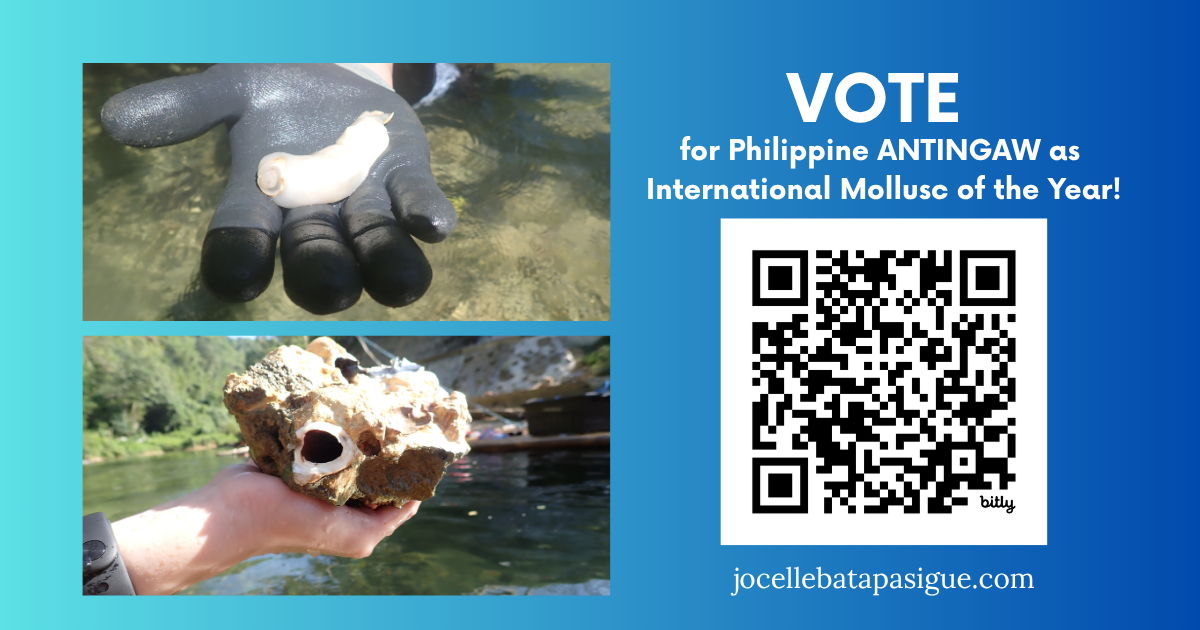
The Philippines is a finalist for International Mollusc of the Year, and representing our country is one of the strangest and rarest species in the world.
The antingaw is the first known shipworm that lives within and eats through rock. Closely related to the tamilok and ugaong, it is unique in the shipworm family because it bores through limestone rather than wood.
Despite the name, shipworms are a type of clam. Instead of being housed within their shell, shipworm evolution has resulted in a long, fl eshy body with two jagged shells on its head—shells usually dedicated for boring into wood.
What makes the antingaw distinct is that their shell has adapted to cut into stone: where other shipworms have teeth-like denticles that are small and sharp, the antingaw has denticles that are large and blunt. The 2019 paper that detailed the antingaw’s discovery also found limestone in its stomach, making it the fi rst known freshwater invertebrate that burrows through rock by ingesting it.

NOTE: This article draws on research and materials from the University of the Philippines Marine Science Institute (UP MSI) and the DOST–National Research Council of the Philippines (DOST-NRCP), particularly ongoing studies under the TAMMILOC Project, labelled as Antingaw Media Packet and sent to the author.
🇵🇭 Lithoredo abatanica: The Rock-Eating Mollusc That Could Redefine Science
When Nature Breaks Its Own Rules
In the vast and largely unexplored domain of marine and freshwater biodiversity, few discoveries challenge scientific assumptions as profoundly as Lithoredo abatanica. Locally known as antingaw, this extraordinary organism—found exclusively in the Abatan River in Bohol, Philippines—has captured global attention for one remarkable reason: it is the first known shipworm that lives within and consumes rock.

At first glance, the notion seems improbable. Shipworms, despite their name, are not worms but highly specialized bivalve molluscs—relatives of clams and oysters—traditionally known for boring into and digesting wood. For centuries, they have played a critical ecological and economic role in breaking down submerged timber structures, from mangrove roots to ship hulls. Yet L. abatanica represents a radical evolutionary departure from this well-established pattern.
Its selection as the Philippine entry to the International Mollusc of the Year 2026 is not merely a matter of national pride. It is a recognition of a scientific anomaly—one that has the potential to unlock new knowledge at the intersection of biology, geology, microbiology, and biotechnology.
Taxonomy and Discovery: A New Chapter in Malacology
Lithoredo abatanica belongs to the family Teredinidae, commonly known as shipworms. These organisms are characterized by elongated, worm-like bodies and reduced shells located at the anterior end, which function as boring tools. However, L. abatanica stands apart from its relatives in both form and function.

The species was formally described in 2019 by a team of scientists led by researchers studying the biodiversity of the Philippines. Its name reflects both its behavior and origin: “Lithoredo” meaning “rock–eater,” and “abatanica” referring to the Abatan River, its only known habitat.
The discovery was groundbreaking not only because of its unusual diet but also because limestone fragments were found in its digestive system, confirming that it actively ingests rock . This finding distinguishes it as the first known freshwater invertebrate to burrow through rock by ingesting it .
Morphological Adaptation: Engineering for Stone
The evolutionary innovation of L. abatanica is most evident in its shell morphology. Unlike typical shipworms, which possess sharp, fine denticles suited for cutting through wood fibers, L. abatanica has developed large, blunt denticles—a structural modification that allows it to grind and bore through limestone.
This adaptation represents a form of natural engineering. Limestone, primarily composed of calcium carbonate, presents a far more rigid and mineralized substrate than wood. The ability to penetrate such material suggests a combination of mechanical force and biochemical assistance.

Its body retains the elongated, soft anatomy typical of shipworms, but its interaction with its environment is fundamentally different. Instead of hollowing out wooden structures, L. abatanica creates burrows within rock formations, leaving behind visible cavities in limestone, as documented in field observations .
Feeding Mechanism: The Central Scientific Mystery
Despite advances in understanding its morphology, one fundamental question remains unresolved: how does L. abatanica derive nutrients from rock?
Limestone itself offers minimal organic content. It is not a source of carbon-rich nutrients in the way wood is. Therefore, the survival of L. abatanica suggests the presence of an alternative metabolic pathway.

Scientists hypothesize that the answer lies in symbiotic microorganisms housed within the mollusc’s gills. This hypothesis is supported by parallels in other shipworm species, such as the well-known tamilok, which relies on bacterial symbionts to digest cellulose in wood.

In the case of L. abatanica, these microorganisms may:
- Facilitate the breakdown of inorganic material
- Extract trace nutrients from mineral substrates
- Produce enzymes capable of processing otherwise indigestible compounds
As noted in the research initiative described in the uploaded document, the mechanism of nutrient acquisition remains a mystery, but microbial symbiosis is considered a leading explanation .

The TAMMILOC Project: Science at the Frontier
To investigate these questions, researchers from the University of the Philippines Marine Science Institute, with support from the Department of Science and Technology National Research Council of the Philippines, have launched a comprehensive research initiative known as the TAMMILOC Project.


Formally titled “Teredinids and Associated Microbes: A Multi-level Investigation of Lifestyles and Outstanding Compounds as Sources of Novel Therapeutics,” this project aims to explore:
- The biological and ecological diversity of shipworms
- The role of microbial symbionts in digestion
- The potential discovery of novel biochemical compounds
The implications of this research are profound. If L. abatanica indeed relies on unique microbial processes to survive, these mechanisms could inspire:
- New classes of enzymes for industrial applications
- Breakthroughs in biodegradation and materials science
- Development of novel therapeutic compounds
Moreover, as highlighted in the document, the grand prize for the International Mollusc of the Year includes full genome sequencing, which would significantly accelerate research into its biological and biotechnological potential .
Ecological Significance: A Species and Its Habitat
Lithoredo abatanica is endemic to a single location: the Abatan River in Bohol. This geographic restriction makes it both scientifically valuable and environmentally vulnerable.

The river ecosystem provides the specific conditions necessary for its survival:
- Limestone-rich substrates
- Freshwater conditions with specific chemical properties
- Microbial communities that may be integral to its life cycle
The burrowing activity of L. abatanica may also play a role in shaping its environment. By breaking down rock, it could contribute to:
- Sediment formation
- Microhabitat creation for other organisms
- Nutrient cycling within the river ecosystem
However, its limited distribution also underscores the importance of conservation. Any disruption to the Abatan River—whether through pollution, habitat degradation, or climate change—could threaten the survival of this unique species.
Cultural and Local Context
Interestingly, antingaw is not only a subject of scientific inquiry but also part of local knowledge systems. Like other shipworms, it is known and even consumed in certain communities, reflecting a longstanding relationship between people and marine resources.
This dual identity—as both a scientific curiosity and a cultural artifact—adds depth to its significance. It highlights the importance of integrating local knowledge with scientific research in understanding biodiversity.
Global Recognition: The International Mollusc of the Year
The International Mollusc of the Year competition, organized by leading scientific institutions including the Senckenberg Society for Nature Research and Unitas Malacologica, seeks to highlight remarkable mollusc species from around the world.
As one of the finalists, L. abatanica competes with entries from countries such as Italy, Australia, Seychelles, and the United States . The competition is determined through public voting, making global awareness and engagement crucial.
Winning the competition would not only bring recognition to the species but also provide critical scientific resources, including genome sequencing, that could accelerate research and innovation.
Broader Implications: Nature as a Source of Innovation
The story of Lithoredo abatanica is more than a tale of biological curiosity. It is a powerful example of how nature can inspire technological and scientific breakthroughs.
In an era where sustainability and innovation are global priorities, organisms like antingaw remind us that:
- Solutions to complex problems may already exist in nature
- Biodiversity is a reservoir of untapped knowledge
- Protecting ecosystems is essential for future innovation
The Philippines, as one of the world’s biodiversity hotspots, is uniquely positioned to contribute to this global knowledge base. Discoveries such as L. abatanica reinforce the country’s role in advancing scientific understanding and innovation.
Conclusion: A Call to Science, Conservation, and Pride
Lithoredo abatanica stands at the intersection of mystery and potential. It challenges established biological paradigms, opens new avenues for research, and underscores the importance of preserving natural ecosystems.
As the Philippine representative to the International Mollusc of the Year 2026, it embodies not only the richness of the country’s biodiversity but also the promise of Filipino science.
Supporting antingaw is more than casting a vote in a competition. It is an affirmation of the value of scientific discovery, the importance of environmental stewardship, and the belief that even the most unexpected organisms can shape the future.
In the quiet waters of the Abatan River, a small mollusc continues to bore through stone—silently advancing the frontiers of knowledge, one grain at a time.
#AntingawIMOY2026 #IMOY #SciencePH #BiodiversityPH #MarineScience #PhilippineScience #DOSTPH