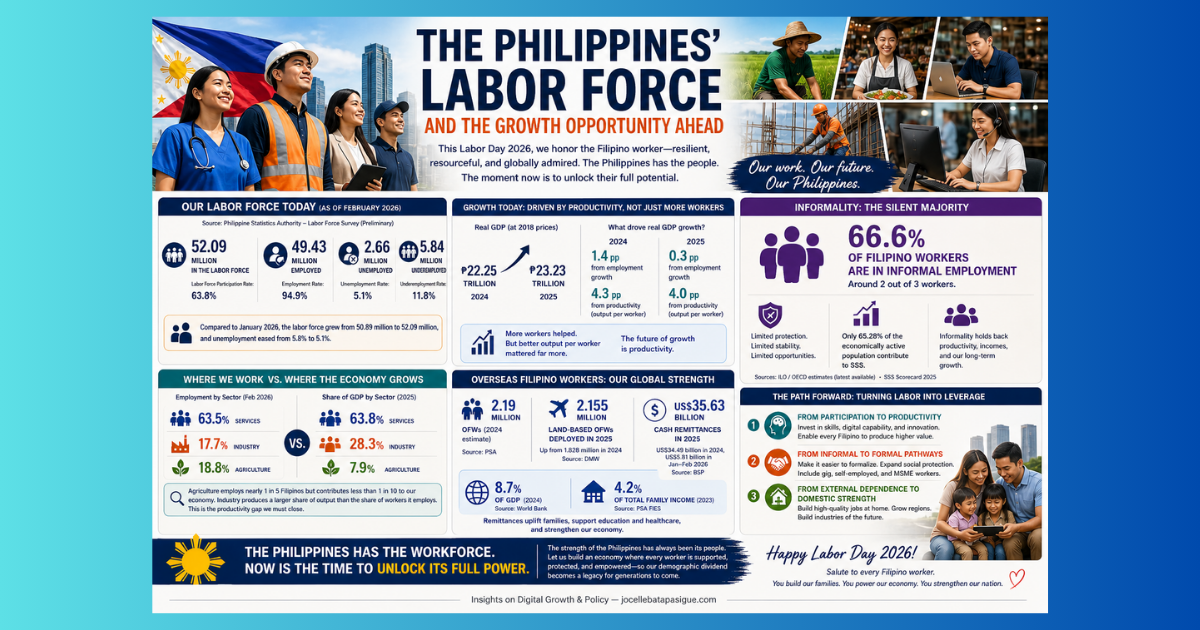
This Labor Day, the Philippines is not just celebrating work. We are standing on the strength of over 52 million Filipinos in its labor force—one of the largest engines of human capital in Southeast Asia today.
That number alone tells a powerful story. But what matters more is what lies beneath it. Because this is not just a large workforce. It is a workforce at a turning point.

A Nation at Work—But Not Yet at Full Power
Out of those 52 million Filipinos actively participating in the economy, nearly 49.5 million are employed. On the surface, this reflects resilience.
But if we look closer – around 2.6 million Filipinos remain unemployed and nearly 6 million are underemployed, meaning they have jobs—but not enough income, hours, or stability
This is the quiet reality of the Philippine labor market: Work is present—but quality is uneven. And that distinction defines the country’s demographic moment.
The Demographic Dividend Is Still Here—But Changing
The Philippines remains within its demographic dividend window, with a labor force participation rate close to 64%—a sign that a large share of working-age Filipinos are active contributors to the economy.
But the nature of growth has already shifted. Between 2024 and 2025, the economy continued to expand steadily, but employment growth slowed significantly, while productivity per worker continued to rise strongly.
In fact, recent data shows that most of the country’s economic growth is now coming from productivity—not from adding more workers. And this is a critical transition.
It means the Philippines is moving from a labor-driven economy to a productivity-driven economy. And that requires a very different policy mindset.
Productivity is not automatic. It is built through skills, technology, capital, innovation, formalization, stronger industries, and global connections. A worker becomes more productive when the system around that worker improves—better education, better tools, better infrastructure, better firms, and better access to markets. This is why Labor Day must also be a call to build the conditions that allow Filipino workers to earn more, produce more, and participate in higher-value work.

Where Filipinos Work—and What That Means
Today’s Filipino workforce is overwhelmingly concentrated in services:
- Around 63% of workers are in services
- About 18% remain in agriculture
- Another 18% are in industry
But here’s where it becomes more interesting -agriculture employs nearly one in five Filipinos—
yet contributes less than one-tenth of national output.
Industry, on the other hand, produces a far larger share of economic output than the number of workers it employs.

The data shows a clear mismatch: agriculture employs 18.8% of workers but contributes only 7.9% of output, while industry employs 17.7% but generates 28.3% of output. The issue is not where Filipinos work, but how much value each sector is able to create. The priority must be twofold: raise productivity in agriculture through technology, logistics, financing, and market access, while also enabling workers to move into higher-value sectors such as industry, advanced services, digital work, and innovation-driven enterprises.
This imbalance reveals a structural truth: Not all jobs contribute equally to growth.Which means the real challenge is not just employment. It is economic transformation—moving workers toward higher-value sectors where their efforts translate into greater productivity and income.
Informality: The Majority Reality
Around 2 out of 3 Filipino workers are in informal employment.
Perhaps the most defining statistic of the Philippine labor force today is that around 66% of Filipino workers are in informal employment. That is roughly two out of every three workers.
This means millions of Filipinos are working—but without stable contracts, without social protection, and often without clear pathways to higher income.
Informality limits access to healthcare and pensions, income stability, opportunities for skills upgrading, and contributions to national tax and social systems.
Informality is not just a labor issue. It is a growth issue, because when most workers operate outside formal systems, the country loses not only protection—but also productivity, savings, and long-term economic capacity.

These are Filipinos who work without stable contracts, have limited or no access to social protection and often operate outside tax and regulatory systems.
Even among wage earners, only about 60% contribute to social protection systems. This creates a gap between effort and security.
Filipinos are working hard— but not all are working within systems that protect them. And that gap has real consequences – lower productivity, limited upward mobility, and weaker fiscal capacity for the state
In many ways, informality is the single biggest constraint to maximizing the demographic dividend.
The Filipino Worker—A Global Force
Beyond the domestic economy, the Filipino workforce extends across the world.
As of the latest data, around 2.19 million Filipinos are working overseas. Annual deployment continues to grow, exceeding 2.1 million in recent flows
Millions of Filipinos continue to work overseas, sending home billions in remittances each year. Remittances reach over US$35 billion in 2025 These flows account for nearly 9% of the country’s GDP, supporting families, education, healthcare, and everyday consumption, or equivalent to roughly 8–9% of the Philippine economy.

At the household level, they account for over 4% of total family income nationwide. This is not just economic—it is deeply human.
It pays for education, healthcare, housing and daily survival of Filipino families in the Philippines. Remittances are a lifeline. But they also carry a message: The Philippine economy still depends significantly on opportunities outside its borders. This is one of the Philippines’ greatest strengths – a globally competitive workforce, a steady source of foreign exchange, and a stabilizer for household incomes
Growth Is Strong—But the Next Phase Is Clear
The Philippine economy has grown consistently in recent years. Real GDP expanded by over 5% in 2024. Continued growing in 2025, though at a slightly slower pace, but the composition of growth tells the real story.
In 2025, only a small fraction of growth came from more workers. The vast majority came from higher output per worker. This signals a shift.
The Philippine economy continues to expand. But growth is becoming increasingly concentrated in productivity gains, rather than broad-based labor inclusion.
At the same time, labor income remains a modest share of the economy and social protection coverage is still incomplete. Many worker remain in low-value or vulnerable employment
This creates a paradox: The Philippines is a country of hardworking people— but not all work translates into security, mobility, or long-term prosperity.
The future of Philippine growth will depend less on how many Filipinos are working— and more on how much each Filipino worker can produce.
A Labor Force Ready for Its Next Chapter
The Philippines has what many countries are already losing – a large, active workforce, still-open demographic window, and strong global labor competitiveness. But the window is narrowing. And the next phase is clear.

Related Article: The Run-up to 2028: Preparing the Philippines for Its Demographic Turning Point
The True Meaning of Labor Day
This Labor Day, the story of the Filipino worker is not one of scarcity. It is a story of abundance. An abundance of talent, effort, potential and also a reminder that potential alone does not create progress. It must be matched with opportunity, systems, and direction.
The Philippines already has the workforce. Now comes the harder—but more important—task is turning that workforce into sustained, inclusive, and high-value growth. Because when every Filipino worker is not just employed—but empowered— that is when the demographic dividend becomes not just an opportunity, but a legacy.
The Real Opportunity: Turning Labor into Leverage
The Philippines is still within its demographic window. But this window will not stay open forever. To fully capture the demographic dividend, three strategic shifts are critical.
From Participation to Productivity:It is no longer enough to have a large workforce. The priority must now be skills development, digital capability and industry upgrading.
Every Filipino worker must be enabled to produce higher value—not just participate.
From Informal to Formal Pathways: Formalization is not about regulation alone—it is about inclusion. This means easier compliance for MSMEs, portable benefits for gig and self-employed worker, and better alignment between contributions and actual worker capacity
When workers enter the formal economy, everyone benefits- -orkers gain protection, government gains fiscal capacity and rhe economy gains stability.
From External Dependence to Domestic Strength: Overseas work will remain important. But the long-term goal must be clear and that is to build an economy where Filipinos do not have to leave to succeed.
This means creating high-quality jobs locally, strengthening regional and countryside economies, and investing in innovation and digital industries
My prayer for Labor Day 2026: May the Philippines move beyond counting workers to empowering workers—through skills, technology, and innovation. May we workers into formal systems is not just about regulation—it is about protection, productivity, and national resilience. And may we not solely be dependent on our oversears workers but also create a Philippine economy where opportunity is built at home.
Sources
This article uses the latest officially released data from the Philippine Statistics Authority and supporting institutions:
- Philippine Statistics Authority (PSA),
Labor Force Survey – February 2026 - Philippine Statistics Authority (PSA),
Labor Force Survey – Official Releases - Supporting validation from:
GMA News – February 2026 Labor Market Report
Additional analysis is based on official datasets from PSA National Accounts, Bangko Sentral ng Pilipinas (BSP), Department of Migrant Workers (DMW), World Bank, OECD, and ILO as reflected in consolidated research.