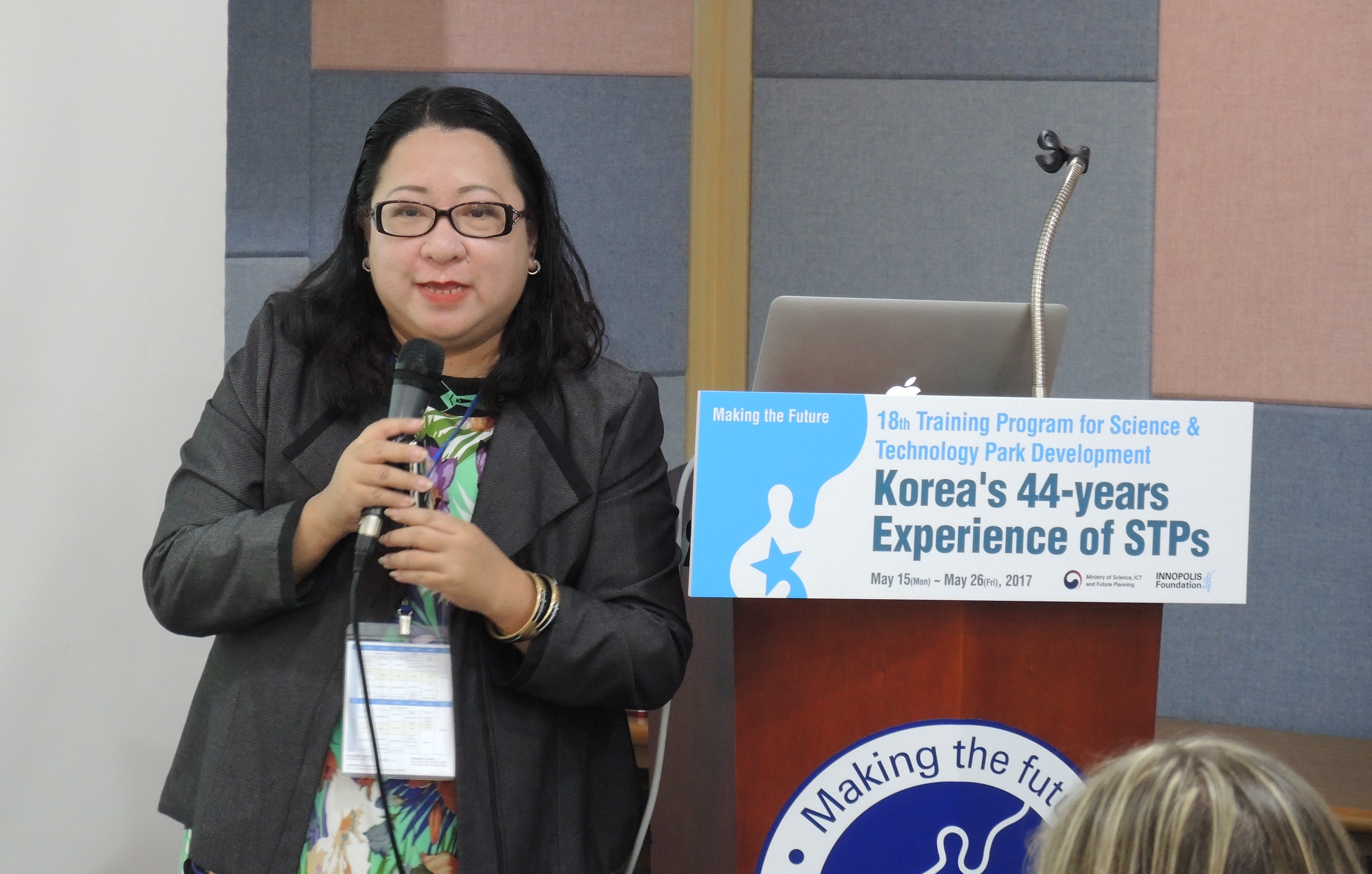
Long before the rise of many incubators and accelerators in the Philippines, I was already designing the Negros First CyberCentre in 2014. By 2017, my perspective was further forged through the Korea cience and technology parkls (STP) management training—an unforgettable experience that sharpened my thinking and strengthened my commitment to innovation ecosystem building.

There are moments in one’s professional journey that do not immediately reveal their full significance. They arrive as opportunities—to learn, to observe, to engage—but only later do they unfold into something far more consequential. Looking back at 2017, when I was chosen among numerous applicants around the world to participat in the Korea Science and Technology Park (K-STP) Program, I now recognize that it was not simply a training. It was a defining experience that quietly but decisively honed the way I think, design, and build innovation ecosystems—particularly at a time when I was conceptualizing what would become the Negros First CyberCentre.
At that point, the Philippines was steadily strengthening its digital economy footprint. The IT-BPM sector was expanding, startups were beginning to emerge, and there was a growing awareness of the need to bring opportunities beyond Metro Manila. Yet, the challenge was clear: how do we move from scattered initiatives into a cohesive, functioning innovation ecosystem?
A Nation That Designed Its Own Future
The training was anchored in the experience of the Republic of Korea—a country whose transformation from poverty in the 1960s to global technological leadership today remains one of the most studied development models in the world.
At the heart of this transformation is Daedeok Innopolis, a research and innovation district established in 1973 to consolidate national scientific capabilities into one strategic location. What began as a research complex evolved into a dynamic ecosystem hosting hundreds of research institutions, universities, and corporate R&D centers, forming a powerful engine for innovation and economic growth.
Daedeok INNOPOLIS is not just infrastructure—it is a system. It embodies how policy, research, talent, and industry converge. It demonstrates how innovation can be intentionally cultivated—not left to chance.

As I walked through this ecosystem, I began to see clearly: This is what we needed to build—not just buildings, but systems.
Where Learning Became Personal
At the time of the training, I was already actively involved in promoting digital development in the Philippines, particularly in the Visayas. The vision of the Negros First CyberCentre was already taking shape—a hub that would create jobs, attract investment, and provide opportunities for Filipinos in the countryside.

But the K-STP Program refined that vision. It helped me understand that a CyberCentre is not simply a location—it is a node in a larger ecosystem. It honed my thinking in three critical ways:
- From infrastructure to ecosystem
- From programs to systems
- From local ambition to global competitiveness
Learning Inside the World’s Innovation Engine
The program immersed us in Korea’s most important institutions—each representing a layer of the innovation architecture.
We had the opportunity to visit key institutions that together form the backbone of Korea’s innovation ecosystem, including Daedeok INNOPOLIS (International Science and Business Belt and Korea’s flagship innovation cluster), the Korea Advanced Institute of Science and Technology (KAIST), the Electronics and Telecommunications Research Institute (ETRI), the Korea Institute of Machinery and Materials (KIMM), the National NanoFab Center (NNFC), the Korea Development Institute (KDI), and Hannam University, as well as various innovation and startup hubs—each demonstrating how government, academe, research, and industry are strategically integrated to drive science, technology, and economic development.

At the Korea Advanced Institute of Science and Technology (KAIST), we saw how a university can serve as the core engine of innovation. Established in 1971, KAIST was designed specifically to produce the scientists and engineers needed for national development (Wikipedia). It demonstrated how talent development, research excellence, and startup creation can be deeply interconnected.

At the Electronics and Telecommunications Research Institute (ETRI), we witnessed how government-led research can produce globally competitive technologies—such as Korea’s early breakthroughs in telecommunications, including CDMA.

At the Korea Institute of Machinery and Materials (KIMM), we saw the role of industrial R&D in strengthening manufacturing capabilities—an essential pillar of economic growth.
At the National NanoFab Center (NNFC), we experienced firsthand the infrastructure required to support cutting-edge research in nanotechnology—demonstrating that innovation requires not just ideas, but highly specialized facilities.

At the Korea Development Institute (KDI), we understood the importance of policy. Here, innovation is not accidental—it is guided, measured, and continuously refined through economic strategy and data-driven governance.

At Hannam University, and various startup hubs within the ecosystem, we saw how academia supports entrepreneurship and how innovation is nurtured at the grassroots level.
Each visit added a layer of clarity. Each institution reinforced a simple but powerful idea:
Innovation succeeds when every part of the system is aligned.

A Global Exchange of Ideas
What made the experience even more profound was the diversity of participants. The 18th batch included representatives from the Philippines, Brazil, Dominican Republic, Ecuador, Ethiopia, Georgia, Ghana, Indonesia, Iran, Kenya, Kuwait, Mexico, Nigeria, Pakistan, Panama, Peru, the Philippines, South Africa, and Thailand.


This was not just a training—it was a global dialogue. We shared challenges, compared approaches, and explored solutions. In doing so, I realized that while contexts differ, the core challenge remains universal:
How do we design systems that enable innovation to thrive?
The Lectures That Built the Framework
The lectures provided a strong foundation on how innovation ecosystems are intentionally built and sustained through policy, planning, and institutional coordination. Sessions such as INNOPOLIS Supporting Programs for Technology Commercialization, Global Trends of Innovation Clusters, and Regional Industrial Policy in Korea explained how Korea developed a coherent framework for Science and Technology Parks, innovation clusters, and regional growth. These discussions showed that innovation does not happen in isolation; it requires enabling laws, long-term government support, regional strategies, and strong collaboration among industry, academe, and the public sector.
A second group of lectures focused on the operational and strategic side of ecosystem-building. Business Plan Practice for Science and Technology Parks and Technology Commercialization emphasized the importance of structured planning, clear vision, commercialization pathways, and the ability to translate research into enterprises and jobs. Technology Financing in the Context of the Korean Economy added another crucial dimension by explaining how innovative firms and technology-based ventures can be supported through financing models tied to intellectual property, commercialization potential, and growth stages. Together, these sessions highlighted that innovation hubs must be managed not only as spaces, but as engines of value creation.
The program also offered broader development lessons through lectures such as Korea’s Economic Development: Looking for New Sources of Growth, KAIST and Startup Ecosystem in Korea, and Lao-Korea Science and Technology Center for Sustainable Energy, Bio and Agri-food Technologies. These sessions connected Korea’s national development story with the role of universities, startups, research institutions, and technology transfer in creating long-term competitiveness. Overall, the lectures reinforced a clear message: successful Science and Technology Parks are built through a combination of vision, policy, talent, financing, research, and sustained ecosystem collaboration.
The lectures in the program were not isolated topics—they were carefully designed components of a complete innovation architecture. Each one contributed to how I approached the design of the Negros First CyberCentre:
I began to see STPs as:
- A platform for talent development
- A hub for industry collaboration
- A gateway to global markets
- A node in a future innovation network
The training had sharpened my ability to ask the right questions:
- Where does talent come from?
- How do we support startups?
- What policies enable growth?
- How do we connect to global value chains?
More importantly, it gave me the confidence to think bigger.
The Long-Term Impact of Being Honed
Looking back nearly a decade later, I can say with clarity:
That training did not just inform me—it honed me. It refined:
- My strategic thinking
- My policy perspective
- My ecosystem approach
- My global outlook
It strengthened my belief that innovation is not accidental—it is designed.
A Training That Stays With You
There are many trainings one attends in a lifetime. Some are informative. Some are useful. But a few are transformative. The 2017 K-STP Program is one of those.
Because it did not just teach me what innovation is.
It showed me how to build it. And more importantly, it made me realize:
The future of the Philippines depends on how well we design our innovation ecosystems today.
If you are interested in building Science and Technology Parks, innovation hubs, or digital ecosystems—feel free to reach out.