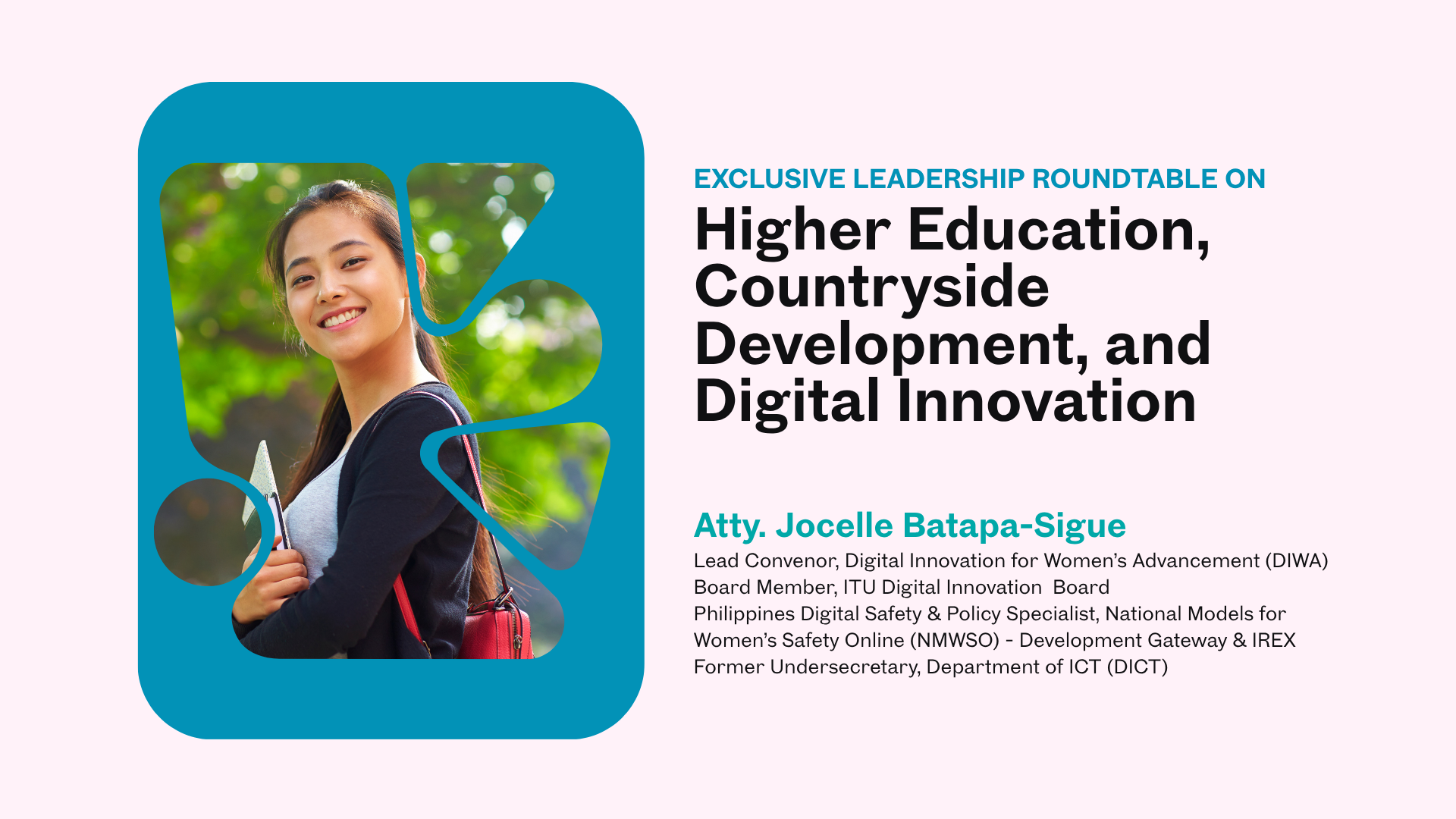
Keynote Speech of ATTY JOCELLE BATAPA SIGUE
October 9, 2025
Exclusive Leadership Roundtable on Higher Education, Countryside Development, and Digital Innovation at the Manila Marriott, Newport World Resorts
Good afternoon, esteemed academic leaders, partners from Mastersoft, and fellow advocates for innovation.
It is a privilege to be part of this roundtable on Higher Education, Countryside Development, and Digital Innovation.
I started teaching law subjects in 1997 at the University of St. La Salle – since then I have never stopped teaching. For me – education is not just a pillar of the state—it is the innovation machine of the nation. It is the foundation, the seedbed, the engine in which talent, creativity, research, and ideas are forged.
If our country were an ecosystem, education would be its innovation machine—the dynamic core that fuels talent, creativity, research, and nation-building. When that machine runs smoothly, we generate invention, inclusion, and growth. When it lags, so does our national competitiveness.
Education is the innovation engine

Education is the innovation engine of the nation. It presents the ecosystem of elements that education powers and connects: entrepreneurship, research, policy, technology, talent, and leadership. Each gear in the system represents how learning institutions drive innovation — from nurturing critical thinkers and innovators to shaping forward-looking policies and advancing scientific discovery. By linking research and technology with leadership and entrepreneurship, education becomes not just a sector, but the core mechanism that propels national progress. Schools and universities are not passive repositories of knowledge but active innovation engines that translate intellectual capital into economic and social growth — building a Philippines where innovation is not imported, but homegrown.
Today, I invite you to see yourselves not just as educators, but as engineers of innovation—building the systems that power the Philippines’ knowledge economy.
The Current Landscape: Where We Stand

According to the World Economic Forum’s Future of Jobs Report 2025, 39 percent of core job skills will change by 2030, reshaping how people learn and work.
Here in the Philippines, 68 percent of our workforce will need reskilling or upskilling within the decade—well above the global average of 59 percent.
A LinkedIn 2025 study adds that half of the skills required in Philippine jobs will shift in just the next five years.
Meanwhile, 67 percent of Philippine organizations already cite skills gaps as their biggest barrier to transformation.
Across Southeast Asia, 62 percent of workers will require additional training by 2030, while 49 percent of Filipinos point to inadequate data and technical infrastructure as major obstacles to digitalization. Yet the WEF predicts a net global gain of 78 million jobs between 2025 and 2030—if countries invest in future-ready skills.
This is both our warning and our opportunity.
From Digitization to Digital Transformation

Let us clarify our language, because leadership begins with precision.
- Digitization means converting analog data into digital form—scanning grades, digitizing records.
- Digitalization uses technology to redesign processes—automated enrollment, electronic payments, predictive analytics for student retention.
- Digital Transformation goes further: it aligns people, policy, and technology to produce new value, enabling continuous innovation.
Simply put: Digitization changes the format, Digitalization changes the flow, and Digital Transformation changes the future.
World Economic Forum’s Future of Jobs Report
The World Economic Forum’s Future of Jobs Report 2025 highlights the top skills for 2025 to 2030, emphasizing how education must evolve to cultivate three major competency clusters — interpersonal, cognitive, and technological. Interpersonal skills like resilience, flexibility, empathy, leadership, and lifelong learning remain essential as collaboration grows more cross-disciplinary. Cognitive skills such as analytical, creative, and systems thinking, along with complex problem-solving, form the mental agility that allows learners to thrive amid change. Meanwhile, technological competencies — AI and big data literacy, programming, cybersecurity, and data analysis — are the engines that drive participation in digital and AI-powered economies. Altogether, these skills define the blueprint for the innovation-ready graduate, one who can think critically, adapt quickly, and create responsibly in the era of intelligent technologies.
Digital Careers and Workforce Competitiveness
Let me share that since 2018 – I have started the crusade of connecting academe with industry by starting Digital Careers Expo which I brought inside DICT and this year I have scaled as DigiWork Expo 2025, a national platform for Digital Careers and Workforce Competitiveness AS CONVENOR OF by the Philippine ICT Innovation Network. We actively bridging education, innovation, and employment through technology-driven collaboration and harness global opportunities through local talent.
The Expo underscores the vision of transforming the Philippines into a digital workforce hub, where educators, industry leaders, and innovators co-create pathways for upskilling, entrepreneurship, and inclusive participation in the global digital economy.
Philippine Digital Workforce Competitiveness Act
In the program, I highlight Republic Act 11927, also known as the Philippine Digital Workforce Competitiveness Act, which lays the policy foundation for building a future-ready Filipino workforce. It underscores five key pillars: first, to equip Filipino workers with digital and 21st-century skills that meet global standards; second, to enhance digital and entrepreneurial competencies nationwide; third, to support digital transformation and innovation so the workforce can thrive amid AI and automation; fourth, to promote digital inclusion for persons with disabilities, Indigenous Peoples, senior citizens, and those in remote communities; and finally, to expand access through co-working spaces, concessional loans, and incentives that nurture a sustainable digital ecosystem. This law embodies the country’s vision of empowering every Filipino to participate meaningfully in the digital economy—making education, technology, and inclusion the backbone of national competitiveness.
Digital Workforce Competitiveness Week
Republic Act 11927 also highlights the mechanisms that will operationalize the nation’s digital workforce agenda. It emphasizes Public–Private Partnerships (PPPs) where local government units collaborate with private companies and training institutions to deliver programs in web development, e-commerce, animation, digital marketing, and virtual assistance—ensuring that digital skills development reaches every region. The law also institutionalizes Public Awareness by declaring the third week of June as Digital Workforce Competitiveness Week, promoting nationwide recognition of the digital workforce’s role in inclusive growth. Finally, it strengthens Innovation Infrastructure by transforming public libraries into digital access hubs and creating co-working and shared service facilities across communities—concretizing the vision of a connected, collaborative, and innovation-driven Philippines.
Philippine Demographic Dividend
We also need to articulate Philippine Demographic Dividend – we need to highlight the energy and promise of our nation’s young, skilled, and ambitious workforce—our greatest innovation asset. The Philippines stands at a turning point: with a median age of just over 25, we have a unique window to transform our large working-age population into a productive innovation force. Education, technology, and enterprise can convert our demographic advantage into sustainable economic growth. But this dividend will only pay off if we equip our people with the digital skills, creativity, and lifelong learning opportunities needed to thrive in an innovation-driven economy.
We need to have comprehensive vision for inclusive and future-ready workforce development in the Philippines – four things we need to
First slide, “Educate and Skill the Youth,” we highlight the foundational role of equipping young Filipinos with digital and 21st-century skills—ensuring they can thrive in a data-driven and innovation-based economy.
Second, “Provide Quality Jobs,” – we emphasize the need to create meaningful, technology-enabled employment that sustains both personal growth and national productivity.
Third, “Support Innovation and Entrepreneurship,” we call for nurturing creativity, startups, and digital enterprises that will drive the country’s competitiveness and self-reliance.
Fourth, the DIWA – Digital Innovation for Women Advancement – we underscores the importance of empowering women through digital upskilling, entrepreneurial support, and inclusive opportunities that close gender gaps in technology and work. Together, these slides present a strategic framework for transforming education and workforce systems into engines of innovation, inclusion, and shared prosperity.
Policy and Leadership Agenda

As academic leaders, you can catalyze this transformation by:
- Crafting a Digital Innovation Roadmap per campus;
- Ensuring data interoperability and governance;
- Deploying ERP + early-alert systems to support retention; – Automation and Enterprise Resource Planning (ERP) systems are the gears of the innovation machine. A modern ERP integrates admissions, finance, HR, academic records, outcomes-based education analytics, research management, and even alumni relations—providing data visibility across the institution. Through automation, we reduce duplication, strengthen transparency, and enable administrators to make evidence-based decisions. Most importantly, automation frees educators to focus on what technology cannot replace: teaching, mentoring, and human connection.
- Embedding future skills and interdisciplinary learning in curricula;
- Institutionalizing faculty digital-immersion programs;
- Creating shared infrastructure clusters for rural universities; and
- Enforcing AI ethics and data-privacy standards by design.
These are not futuristic ideals—they are actionable now.
I thank Mastersoft for enabling solutions across the Philippines which have modernized university operations, enhanced student experiences, reduced dropouts, and improved employability by aligning academic outcomes with industry needs. They have helped institutions operationalize Outcomes-Based Education, integrate analytics, and measure learning in real time.
Education as the Foundation of the Innovation Ecosystem
Education is not just an academic pursuit—it is the engine room of every national innovation strategy.
Our universities produce the human capital that drives research, entrepreneurship, and governance. They are the first factories of innovation, transforming learners into creators and problem-solvers.
When we strengthen education, we strengthen every sector—agriculture, health, manufacturing, technology, governance.
When we digitalize education, we future-proof the nation. With partners such as Mastersoft other digital platforms – and with your leadership as educators, we can ensure that our innovation machine runs on efficiency, equity, and excellence—powering a smarter, more inclusive, and globally competitive nation.
Maraming salamat po, and let us continue to engineer the future—together.