What the World Bank’s 2025 report reveals about the Philippines’ early AI momentum, rising structural risks, and the urgent policy actions needed to move from adoption to higher-value innovation, talent retention, and long-term economic competitiveness.
The World Bank’s Digital Progress and Trends Report 2025: Strengthening AI Foundations should be read in the Philippines not as a distant global survey, but as a strategic warning and a strategic opening. Its findings place the Philippines in a striking position: the country is already showing unusually strong signs of AI adoption, especially in generative AI, yet it is also one of the countries most exposed to the downside of AI if it remains trapped in lower-value digital work. The real issue, then, is no longer whether the Philippines should engage with AI. It already is.
The more urgent question is whether the country can convert adoption into innovation, productivity, higher-value exports, and more locally captured economic gains.
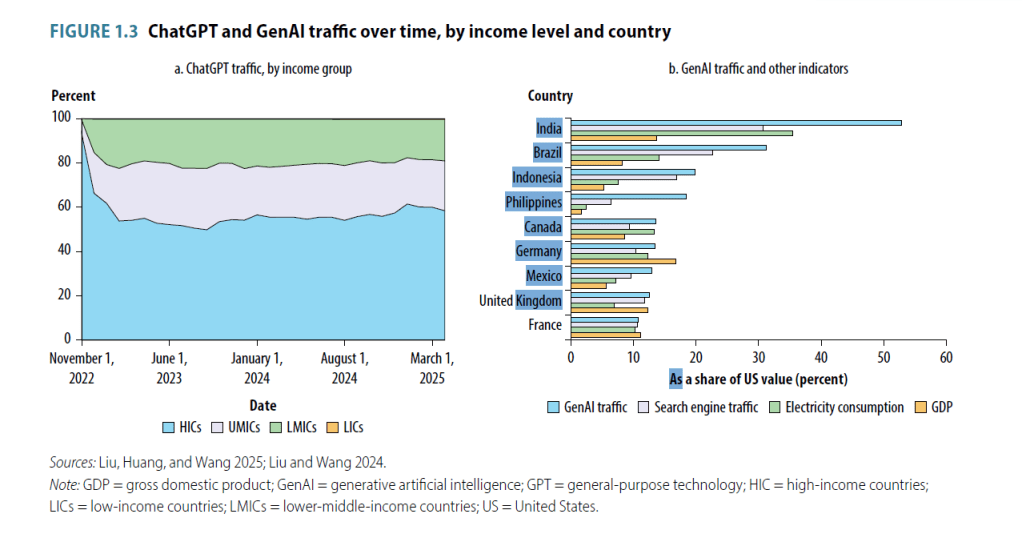
The report’s Philippines-related findings are unusually strong for a country that is not a frontier model builder. By March 2024, the Philippines was already among the world’s top five economies for ChatGPT traffic, alongside Brazil, India, Indonesia, and the United States.
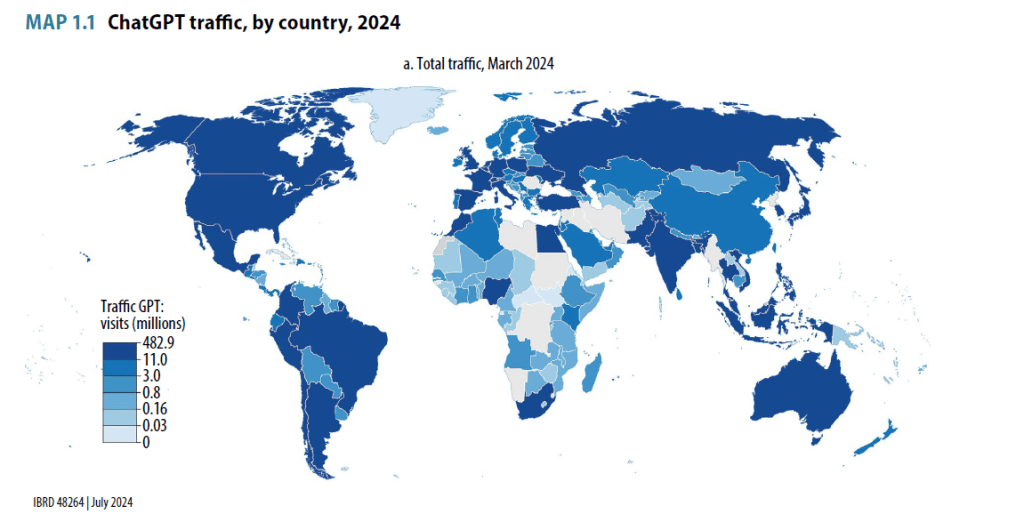
The report also places the Philippines in a group of middle-income economies showing disproportionately high GenAI adoption relative to economic size, with broad usage associated globally with strong digital infrastructure, specialization in digitally deliverable services, higher human capital, English fluency, digital skills, and a young population. These are not trivial signals. They suggest that the Philippines has entered the AI era not from the sidelines, but from an active consumer and worker base already experimenting with the technology at scale.
At the same time, the report is careful not to confuse high traffic with full readiness. It notes that while total ChatGPT traffic from middle-income countries has become very large, usage per internet user in most developing countries remains much lower than in highly connected economies such as Singapore. That distinction matters.
For the Philippines, the current moment should not be read as evidence that the country has already solved the AI problem. It should be read as evidence that public interest and early adoption are ahead of institutional readiness, and that policy now needs to catch up with behavior.
One of the report’s most useful contributions is that it refuses to treat AI as an abstract technology debate. It documents practical use cases already visible in developing countries, including the Philippines. Teachers are using AI for lesson planning, nurses for patient tracking, contact center agents for coaching, and farmers for agronomic advice. In the report’s broader case-study discussion, these applications are described less as magical replacements for people and more as “co-workers” or “coaches” that streamline tasks, support communication, and improve training and service workflows. This is an important framing for the Philippines.
In a country that has long relied on people-intensive sectors, the first economically meaningful wave of AI is likely to be augmentation before it is full automation, but only if institutions intentionally shape it that way.
The labor-market signals in the report are equally significant. AI-related vacancies in the Philippines doubled from 2021 to 2024. Even more dramatic, the Philippines recorded a 115-fold increase in GenAI vacancies over the same period, one of the most remarkable expansions cited in the report. The report also notes that among middle-income countries, the Philippines is one of the leaders in the surge of GenAI vacancies. This tells us two things at once. First, Philippine firms and employers are beginning to demand AI-related capabilities at a much faster pace than many people in policy circles may realize. Second, the adjustment window is short. When vacancies move that fast, education systems, industry associations, and labor-market institutions cannot update on a leisurely timetable.
The report adds an important nuance here: globally, AI vacancies have a much higher skill threshold than other digital roles, with 51 percent requiring at least a master’s degree and more than 7 percent requiring a PhD. It also notes that GenAI vacancies in middle-income countries are concentrated heavily in ICT professions. For the Philippines, this means AI demand will not be met by generic digital literacy alone. The country needs more serious layers of capability: software development, systems analysis, data work, AI integration, model customization, workflow redesign, and sector-specific deployment skills.
Put bluntly, this is no time to confuse familiarity with AI tools with readiness to build value from them.
A more hopeful dimension of the report concerns gender. It notes that ICT specialists are predominantly male in most countries, but also highlights that several middle-income countries have a more gender-balanced ICT workforce. The Philippines stands out here: the male-to-female ratio among ICT specialists is 1.9 in the Philippines, compared with 2.3 in China and 2.8 in India. This is not a decorative statistic. It is one of the country’s most strategic assets. In an AI era in which inclusion and talent scale are both competitive variables, a relatively stronger base of women in ICT can become a major advantage if the Philippines chooses to deepen it. Yet the report also reminds readers that women account for only about one-third of ChatGPT users globally. That means better representation in the ICT workforce does not automatically translate into equally broad participation in AI use, leadership, or entrepreneurship. The Philippines has an edge here, but it is an edge that still needs to be deliberately widened.
If the report is especially important for the Philippines, it is because it does not merely cite the country in passing. It uses the Philippines as a case-study country in its discussion of how AI is transforming digitally deliverable services. That matters because digitally deliverable services are not peripheral to the Philippine economy. They are central to its recent development story, its export base, and its employment structure. The report notes that global exports of digitally deliverable services exceeded US$4.25 trillion in 2023 and that developing countries increasingly rely on this sector for jobs, foreign exchange, investment, and growth. In that context, the Philippines becomes a highly relevant test case for whether an established services exporter can move up the AI curve or be dragged down by it.
The case-study language is blunt. The report calls the Philippines a “mature low-skilled exporter” facing a “more urgent threat.” Its logic is clear: the Philippine economy has long depended on large-scale customer support and back-office processing, precisely the kinds of tasks most vulnerable to AI-driven automation.
The report notes that while firms are already adopting AI for internal efficiency gains, the country’s ability to move up the value chain is limited by gaps in skills, innovation, and intellectual property ownership. This is one of the most important sentences in the report for Philippine policymakers. It means the challenge is not just to use AI faster than others. It is to avoid remaining stuck in the least defensible layer of the global AI-enabled services economy.
The scale of exposure is also enormous. The report describes the Philippines as a global leader in contact center services, employing 1.6 million workers, or even higher currently. It says firms are already using AI to train agents faster, analyze customer sentiment, and automate basic queries. These are not small adjustments around the edges. They are changes to the operating core of one of the country’s biggest globally traded service industries. And the report goes further: although layoffs are still described as modest, some Philippine firms expect AI to take over up to half of simple customer service tasks within three years, and labor-market data already show steep declines in job postings for IT and BPO roles since the launch of ChatGPT in late 2022, with few signs of recovery. That is not a theoretical threat horizon. That is the early phase of restructuring.
Yet the report does not paint only a grim picture. It also shows why firms are moving quickly. AI is already delivering measurable productivity gains in digital services. Call summarization tools reduce handle times in contact centers by up to 10 percent. AI-powered medical coding tools automate parts of billing workflows. GitHub Copilot and similar tools have generated time savings of more than 50 percent for developers, especially those with lower baseline skills. In other words, the pressure to adopt AI is not driven by hype alone. It is driven by visible gains in speed, efficiency, customer experience, and training outcomes. For the Philippines, this means resistance is not a strategy. The more realistic strategic choice is whether the country will shape AI adoption to lift worker productivity and move firms into higher-value services, or allow the market to use AI mainly to compress labor costs and thin out routine jobs.
The report’s warning on value capture is especially important. It says that the shift to software-based services risks transferring value creation outside the Philippines because few IT departments are based in the country. It adds that health-care outsourcing faces a similar challenge: AI can improve efficiency in medical coding and patient coordination, but value may still be redistributed to the locations where AI systems are actually built and managed. This is the core strategic issue for the Philippines.
A country can adopt AI, train workers to use AI, and even become more productive with AI, yet still lose the highest-value parts of the chain if the intellectual property, model control, product design, and systems ownership remain elsewhere. In that scenario, the Philippines becomes a more efficient service node without becoming a stronger AI economy.
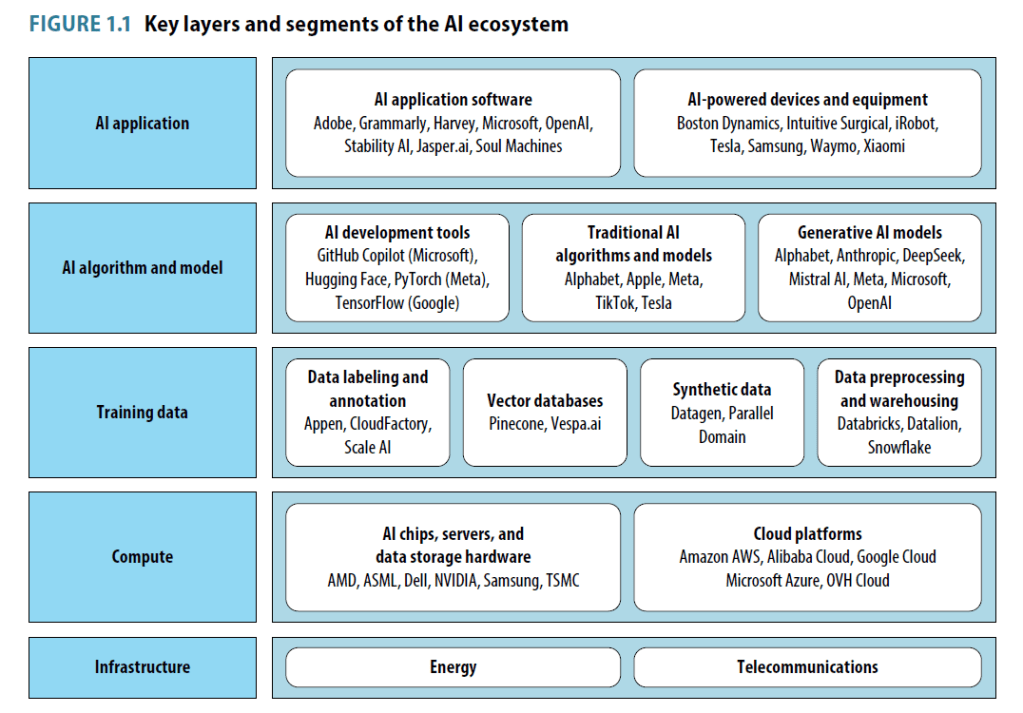
This is why the report’s broader framework matters so much. Rather than treating AI as a race to build frontier models, the World Bank argues for strengthening four foundations: connectivity, compute, context, and competency. Connectivity covers reliable energy, broadband, and device access. Compute refers to affordable and accessible cloud services, AI chips, data centers, and high-performance computing. Context refers to local data, local language and domain relevance, and applications suited to national needs. Competency refers to digital skills, AI talent, and the institutional ability to integrate AI into actual work. The report emphasizes that balanced investment in these four pillars is a practical framework for countries deciding how to participate meaningfully in AI.
For the Philippines, that 4C framework is more useful than any temptation to chase headline-grabbing frontier ambitions. The report explicitly notes that most developing countries do not need to build foundational AI models and can benefit more from localized innovation and the practical adaptation of existing open-source platforms. It also provides a policy table showing that countries with lower or medium readiness should focus first on adoption and adaptation: improving connectivity, relying largely on cloud and foreign data centers where appropriate, building local datasets in selected domains, customizing open-source models, and strengthening digital skills and talent retention. The report does not assign a clear visible rank to the Philippines in the country-readiness figure available to us, but based on its middle-income profile, strong services specialization, and evident gaps in value capture, a sensible reading is that the Philippines should prioritize becoming an exceptionally strong adopter and adapter of AI, while building selective innovation depth in niches where it has sectoral advantage. That is an inference, but it is one strongly supported by the report’s framework.
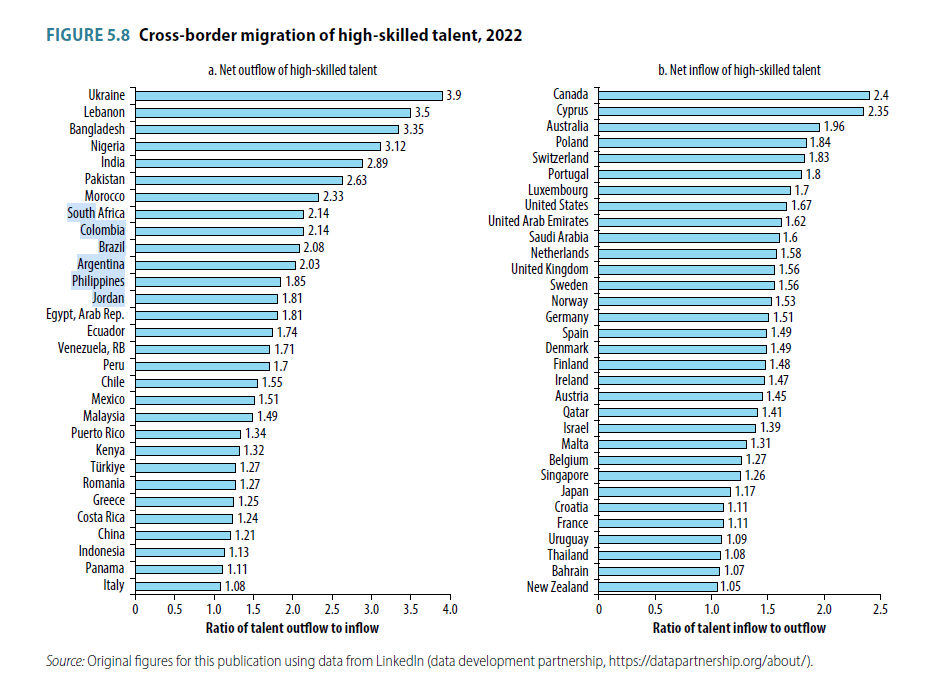
The report also helps explain why talent must sit at the center of the Philippine response. It notes that developing countries face major barriers in cultivating and retaining digital talent: limited access to high-speed internet and modern computing infrastructure; weak coordination between universities and the private sector; high training costs; and underinvestment by firms afraid that trained employees will be poached. It adds that financial constraints, lower education levels, and sociocultural norms restrict women’s access to technology and training, while brain drain persists as skilled professionals seek better wages and career opportunities abroad. The Philippines appears in the figure on net outflow of high-skilled talent. That means the country is confronting a double problem: it needs more AI-capable talent just as valuable digital workers remain globally mobile.
The compute side of the story matters too, even if it receives less public attention in the Philippines than talent or outsourcing. The report argues that the AI compute supply chain is concentrated, expensive, and difficult for developing countries to access. Data centers consume large amounts of power and water, and countries relying on foreign cloud and data-center infrastructure can expose citizens’ and firms’ data to foreign jurisdictions. At the same time, the report notes that open-source and lower-compute models can help democratize access and reduce costs for more resource-constrained countries. For the Philippines, the practical implication is not that it should immediately try to become a frontier compute power. It is that it should use a disciplined compute strategy: cloud-first where sensible, regional or domestic infrastructure where economically justified, and targeted support for research and start-ups that need access to serious computing resources.
Context may be even more important. The report repeatedly stresses that AI without local relevance is weak AI. It warns that many global systems are poorly calibrated to local languages, local dialects, local farming conditions, local data environments, and local workflows. It also points to weak data quality and fragmented systems as common constraints, especially in public-service environments such as health and education. This has direct significance for the Philippines. If the country wants AI that is useful in public services, agriculture, education, health, MSMEs, and regional economies, it needs datasets, workflows, interfaces, and governance rules adapted to Philippine conditions. Otherwise, adoption will remain shallow, imported, and concentrated among users who can already navigate tools designed for high-resource environments.
That local-context issue connects directly to inclusion. The report notes that advanced digital skills are scarce even in richer countries and that gender and urban-rural disparities widen at higher skill levels. It explicitly calls for targeted interventions to improve digital skills among women and rural populations. For the Philippines, this is not just a social-equity question. It is a competitiveness question. A country that allows AI capability to concentrate only in Metro Manila boardrooms, elite universities, or the biggest firms will narrow its own talent base and reduce its own innovation capacity. The Philippines has a chance to make inclusion productive, not merely symbolic, especially given its comparatively better gender balance among ICT specialists.
So what should the Philippines do now? Here are some of my recommendations based on the findings of the report.
First, the country should treat AI as industrial strategy, not as a side conversation under ICT modernization alone. The report’s case-study findings show that AI is already changing the economics of digital services, one of the Philippines’ core export sectors. That means the national response cannot be limited to scattered pilots, motivational speeches, or generic digitalization programs. It needs a clear economic objective: move Philippine firms from labor-intensive, routine outsourcing into higher-value services such as analytics, cloud operations, domain-specific AI integration, software-enabled services, and productized solutions. That recommendation follows directly from the report’s warning that mature low-skilled exporters face the greatest risk and from its observation that technology-driven firms are moving up the value chain while labor-intensive firms become more vulnerable.
Second, the Philippines should redesign its skills strategy around three layers, not one.
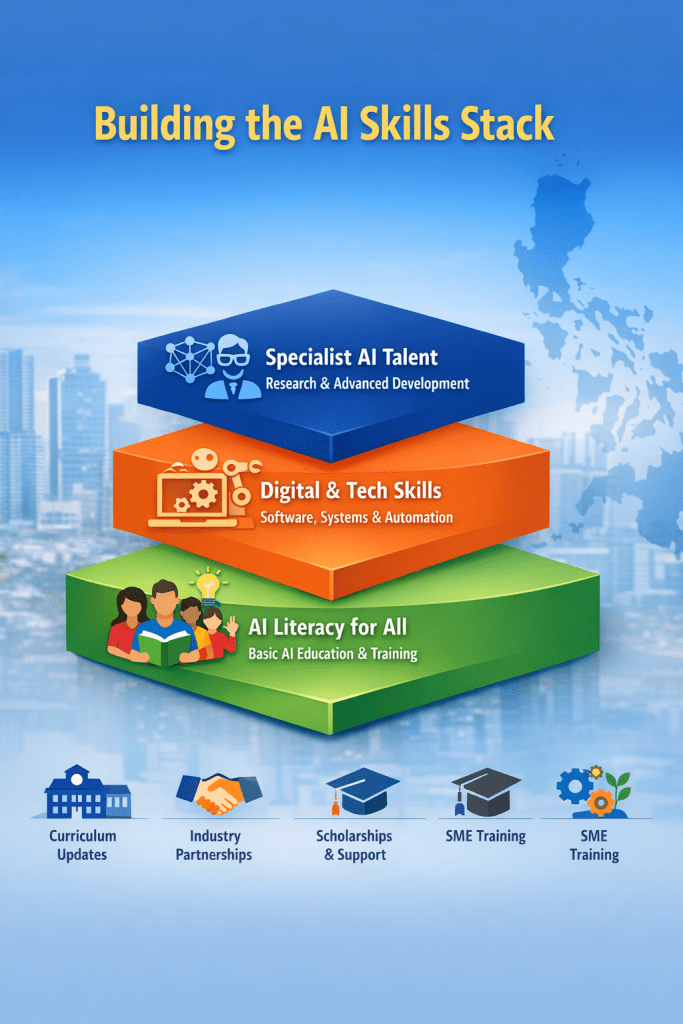
- The first layer is broad AI literacy for workers, teachers, public servants, students, and MSMEs.
- The second layer is intermediate and advanced digital capability for software, systems, analytics, automation, and sector-specific workflow redesign.
- The third layer is specialist AI talent for researchers, start-ups, universities, and firms doing model customization and higher-value development.
The report recommends embedding digital skills in compulsory education, making SME training more affordable, improving coordination between industry and educational institutions, creating mechanisms for regular curriculum updates, expanding faculty training, and offering scholarships and targeted support for advanced AI education and research. That is exactly the kind of stack the Philippines needs.
Third, the country should begin a deliberate transition strategy for the BPO and contact-center workforce now, not after displacement deepens. The report’s warning that some Philippine firms expect AI to take over up to half of simple customer service tasks within three years should be treated as an economic transition signal. The right response is not to defend every low-complexity task as if nothing is changing. It is to redesign work. Workers in routine roles should be supported to move into higher-value customer experience, escalation handling, sales enablement, data quality, AI oversight, workflow management, health-information services, and specialized back-office functions that combine domain knowledge with AI use. Lifelong learning and transition support must be built before job loss becomes widespread, not after.
Fourth, the Philippines should make SMEs central to its AI agenda. The report warns that smaller firms and lower-skilled workers often use only the most basic off-the-shelf AI tools, while larger and more technologically mature firms capture the deeper benefits of workflow customization and client-facing solutions. It also recommends public support for SME upskilling.

If the Philippine AI conversation is left to large multinationals and the top domestic firms, productivity gains will concentrate narrowly and inequality will deepen. A better path is to create sector-level adoption programs, shared technical assistance, vouchers or matching grants for SME training and deployment, and procurement pathways that let smaller firms adopt AI responsibly without carrying all the experimentation cost alone.
Fifth, the country should build local context as a competitive asset. This means investing in domain-specific datasets, government data quality, local-language interfaces where needed, and practical AI applications in sectors that already matter to the Philippine economy: education, health, agriculture, public administration, logistics, creative services, and export-oriented services. The report’s discussion of context is one of its most overlooked strengths. Countries that only consume generic tools remain dependent. Countries that adapt models to local data and use cases begin to create defensible advantage. For the Philippines, local context may be a more realistic near-term source of AI competitiveness than frontier model development.
Sixth, the Philippines should use gender inclusion as an economic strategy, not just a social aspiration. The report already shows that the country compares relatively well on gender balance among ICT specialists. That advantage should be extended into AI leadership, AI entrepreneurship, technical scholarships, faculty pipelines, and workforce upskilling.
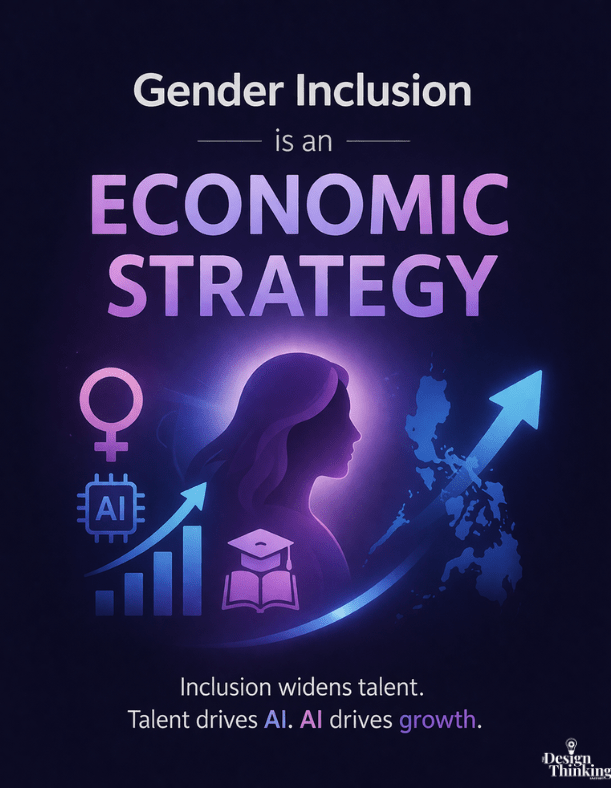
If the country can widen women’s participation not only in ICT jobs but in applied AI, it can expand its usable talent pool at precisely the moment when talent constraints threaten growth. It should also pair gender inclusion with regional inclusion, because the report is explicit that digital-skill gaps widen outside major urban centers and among marginalized groups. In other words, inclusion is not separate from competitiveness. It is part of the production function.
Gender inclusion as an economic strategy strongly aligns with the vision behind Digital Innovation for Women Advancement (DIWA)—which recognizes that empowering women in ICT and emerging technologies is not only a matter of equity, but a critical driver of national competitiveness. DIWA advances this by building pathways for women to participate meaningfully across the digital value chain—from skills development and leadership to entrepreneurship and innovation. By expanding women’s access to AI, digital tools, mentorship, and opportunities, DIWA helps unlock a broader and more diverse talent pool at a time when the demand for digital skills is rapidly accelerating. This approach reflects a forward-looking strategy: that inclusive participation in technology—especially among women and those in underserved regions—is essential to shaping a more resilient, innovative, and globally competitive Philippine digital economy.
Seventh, the country needs a more serious talent-retention agenda. The report recommends competitive salaries in research institutions, research grants, tax incentives, career-development opportunities, streamlined visas, and measures to attract as well as retain digital talent. For the Philippines, the simplest message is that talent will not stay for patriotic sentiment alone. It will stay where there is interesting work, upward mobility, research support, credible institutions, and the possibility of building something meaningful. Stronger universities, better links between academia and industry, research funding in practical AI domains, start-up support, and visible career ladders in both public and private sectors are not luxuries. They are defensive necessities in a market where high-skilled digital workers can increasingly leave.
Eighth, the Philippines should adopt a pragmatic compute and cloud strategy. The report’s Table 6.1 suggests that countries not yet at the frontier can rely significantly on cloud infrastructure while selectively investing in domestic or regional data-center capacity and partnering strategically with foreign providers. That seems sensible for the Philippines. The country should not waste scarce resources trying to mimic the capital intensity of the largest AI economies. But it should ensure access to reliable cloud services, modern data infrastructure, and specialized computing resources for universities, start-ups, and high-value industry applications. It should also weigh the national-security and data-governance implications of excessive dependency on foreign infrastructure, especially in sensitive public-sector domains.
Ninth, governance has to move from vague principle to operational rule. The report repeatedly flags uncertainty over data privacy, AI governance, and cross-border data restrictions as barriers to deeper AI integration. It also stresses the need for robust governance frameworks, especially in education and health, where vulnerable populations and sensitive data are involved. For the Philippines, this means getting more practical about data protection, procurement standards, accountability, informed consent, model evaluation, sector-specific safeguards, and transparency. Good governance should not be constructed as a brake on AI. It should be designed as the trust infrastructure that allows wider and more responsible adoption.
Tenth, the Philippines should stop measuring success mainly by adoption headlines and start measuring value capture. Being in the top five for ChatGPT traffic is interesting. It is not enough. The country needs to know whether AI is increasing domestic productivity, improving export sophistication, supporting higher wages, creating more resilient firms, widening access outside major urban centers, and growing the share of higher-value digital functions that are based in the Philippines rather than merely serviced from it. A country can be popular on AI tools and still underperform economically. What matters is not just usage, but the location of capability, ownership, and value. That is the lesson running through the World Bank report, even when it is not phrased so directly.
The deeper strategic message of the report is that AI will not reward countries simply for showing up. It will reward countries that build the foundations to adopt, adapt, and selectively innovate. For the Philippines, that means the future does not lie in choosing between optimism and fear. Both are too easy.
The real task is harder and more practical: use the country’s evident strengths in digital services, English-language capability, early AI uptake, and relatively stronger gender inclusion to build a more sophisticated AI-enabled economy, while moving workers, firms, and institutions out of the vulnerable layers of routine service work. The Philippines does not need to win the frontier model race to become more competitive. It does need to become much more intentional about where it wants to stand in the AI value chain.
The encouraging part is that the report does not suggest the Philippines is starting from zero. Far from it. It shows real momentum: broad adoption, rapidly rising demand for AI skills, concrete use cases, measurable productivity gains, and a potentially important inclusion advantage. But it also shows that momentum is not the same as strategy. Left alone, the market may produce a more efficient version of the same structural weaknesses: imported tools, shallow adoption, narrow value capture, talent outflow, and pressure on routine jobs. Managed well, however, the same momentum can be used to create a different outcome: stronger local capabilities, smarter public services, more competitive digital firms, and a broader base of high-value work. That is the real choice before the Philippines. And that is why the World Bank report deserves to be read here not as a technical document, but as a call for strategic economic action.
SOURCE: World Bank. 2025. Digital Progress and Trends Report 2025: Strengthening AI Foundations. Washington, DC: World Bank. doi: 10.1596/978-1-4648-2264-3.
Glossary of direct mention of the Philippines:
Data labeling, part of the broader business process outsourcing industry, thrives in low-income countries (LICs) and middle-income countries (MICs) because of low labor costs. Data labeling refers to marking or classifying data, such as identifying objects in images or transcribing speech, to enhance machine learning model performance. Data labeling typically requires an intermediate level of education and provides employment opportunities for women, youth, and disabled workers. The earnings are often comparable to, or even more than, those in traditional industries, and these jobs offer flexible work arrangements, driving rapid growth of data labelers in countries such as India, Kenya, and the Philippines. (Page 60)
In LMICs, demand for advanced digital skills rose in 2023 but returned to 2021 levels in 2024, whereas other vacancies grew faster. This trend was largely driven by India, where demand contracted by 30 percent in 2024 after a 2023 increase. Conversely, Kenya, Nigeria, and the Philippines saw a tripling of vacancies by mid-2023, maintaining levels above those of early 2021 despite recent moderate declines. (Page 77)
Among LMICs, India maintained a stable AI skills demand, consistently hovering around 230,000 vacancies every year. From 2021 to 2024, AI vacancies doubled in the Arab Republic of Egypt, Pakistan, and the Philippines. Demand grew fourfold in Kenya, albeit from a very low base. (Page 78)
Among MICs, Brazil, China, India, Malaysia, Mexico, and the Philippines have been leading the surge in GenAI vacancies. Before the release of ChatGPT, UMICs registered fewer than 3,000 GenAI vacancies, but by 2024, vacancies had soared sixfold to nearly 18,000, largely excluding China.
LMICs experienced a 23-fold increase, reaching around 46,000 vacancies by 2024 (refer to figure 5.3, panel b). India experienced a near 22-fold growth in GenAI vacancies between 2021 and 2024, contributing 80 percent of all GenAI vacancies among LMICs. Notably, Brazil and the Philippines saw the most-remarkable expansion, with 82-fold and 115-fold increases, respectively, from 2021 to 2024, significantly propelling growth in East Asia and Pacific (EAP) and Latin America and the Caribbean. Beyond the leading nations, Colombia, Malaysia, Mexico, Pakistan, and South Africa all recorded more than 1,000. (Page 79)
The availability of ICT specialists is heavily concentrated in a few countries, with China (21 percent), the United States (21 percent), and India (15 percent) leading, followed by the United Kingdom (5 percent), the Russian Federation (5 percent), and Germany (4 percent) as of 2023. LICs account for less than 1 percent of ICT specialists. ICT specialists also are predominantly male. Switzerland has the highest gender disparity, with a male-to-female ratio of 5.84, followed by Belgium, the Netherlands, Russia, Germany, and Italy, all of which have a ratio above 4.5. Several MICs have a more gender-balanced ICT specialist workforce. The male-to-female ratio among ICT specialists is 1.9 in the Philippines, 2.3 in China, and 2.8 in India. (Page 82)
Case Study 3—Prosperity (Page 108)
Co-worker, Coach, or Competitor? How AI Is Transforming the Future of Digitally Deliverable Services
• AI is reshaping digital services by enhancing productivity and enabling higher-value work, but its benefits remain uneven across firms, sectors, and workers.
• Firms report modest signs of AI-driven job displacement in digital services jobs focused on simple tasks, especially in mature service-exporting economies.
• Without proactive policy action, AI adoption could deepen divides between large and small firms, high- and low-skilled workers, and advanced and emerging economies.
DDS—including software development, information technology (IT), customer support, creative services, and specialized back-office tasks—have become critical drivers of economic transformation in developing countries. Global exports of DDS surpassed US$4.25 trillion in 2023, with developing countries increasingly relying on this sector to generate good jobs, drive economic growth, and attract foreign exchange and investment. The rapid emergence of AI—especially GenAI—is reshaping the sector’s structure, workflows, and competitive dynamics. This case study examines how AI is being adopted by digital services firms in the Philippines and Uzbekistan, the ways in which it is transforming firm operations and worker experiences, and the broader risks and opportunities it presents for inclusive development and global competitiveness.
Mature low-skilled exporters such as the Philippines face a more urgent threat. Their economies have long depended on large-scale customer support and back-office processing—precisely the types of jobs most vulnerable to AI-driven automation. Although firms in these countries are adopting AI for internal efficiency gains, their ability to move up the value chain is limited by gaps in skills, innovation, and intellectual property ownership. Emerging builders such as Uzbekistan are still developing their digital services industries, with limited current exposure to AI disruption. Yet this issue also presents an opportunity: These countries can support the development of AI-driven digital services sectors from the get-go, without the burden of legacy systems. By investing in foundational digital infrastructure, digital literacy, and local innovation, they can position themselves for future growth in AI-enabled services. (Page 109)
The case of the Philippines illustrates both the promise and the perils of this transformation. The country is a global leader in contact center services, employing 1.6 million workers. Firms are adopting AI tools to train agents faster, analyze customer sentiment, and automate basic queries. However, the shift to software-based services risks transferring value creation outside the country because few IT departments are based in the Philippines. Health care outsourcing faces a similar challenge: Although AI is improving efficiency in medical coding and patient coordination, jobs may be reduced and value redistributed to regions in which AI systems are built and managed. (Page 109)
AI is increasingly integrated into education, digital services, agriculture, and energy. The case studies from India, Nigeria, the Philippines, and Uzbekistan and the overview of cases in the agriculture and energy sectors show that AI is already generating tangible benefits. These include improvements in efficiency, learning outcomes, service quality, and productivity. However, the scale, equity, and sustainability of these benefits depend on the readiness of local ecosystems, the capacity of institutions, and the governance frameworks guiding AI development and use (Page 110)
Job vacancies requiring AI skills are rising faster in developing countries than in HICs, growing by 16% in UMICs, 11% in LMICs, and just 2% in HICs from 2021 to 2024. Vacancies doubled in the Arab Republic of Egypt, Pakistan, and the Philippines, and grew fourfold in Kenya, albeit from a very low base. Job vacancies requiring GenAI skills surged ninefold globally from 2022 to 2024.(Page 136)


 Jocelle Batapa Sigue
Leave a comment