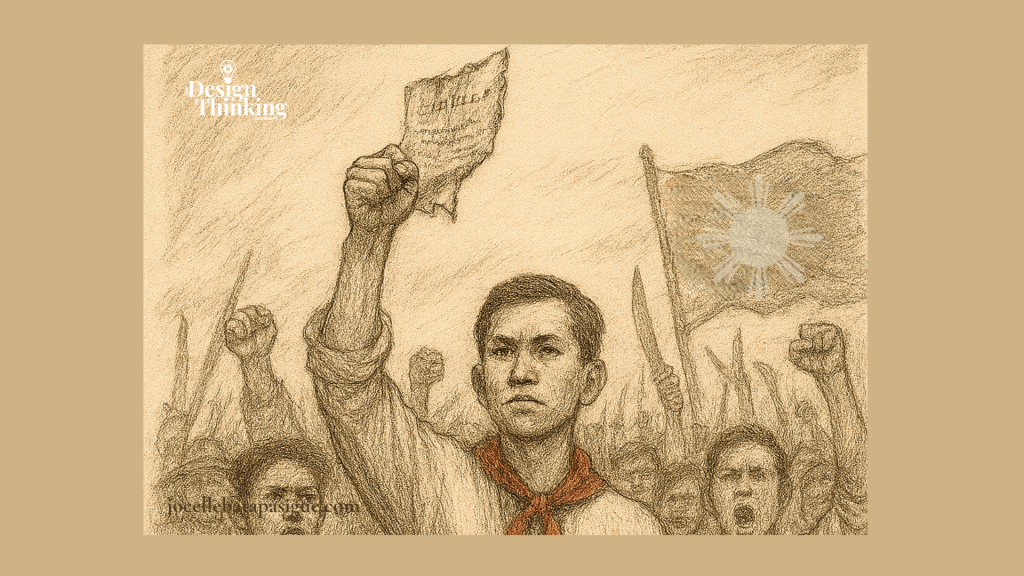
As we look back on the life of Andrés Bonifacio, we are reminded that true heroism is not born from the pursuit of glory, but from the depth of love for one’s country and people. Bonifacio and his brothers did not set out to be heroes — they were ordinary Filipinos who chose to act in extraordinary times. Amid hardship and oppression, they carried the torch of courage, unity, and selfless service. Today, as our nation and the world face new challenges, their story calls us to rekindle those same values — conviction, compassion, and integrity — in building a just and resilient future. This timeline honors Bonifacio’s journey, not merely as a historical account, but as a living reminder that every generation has its own revolution to fight — for freedom, dignity, and hope.
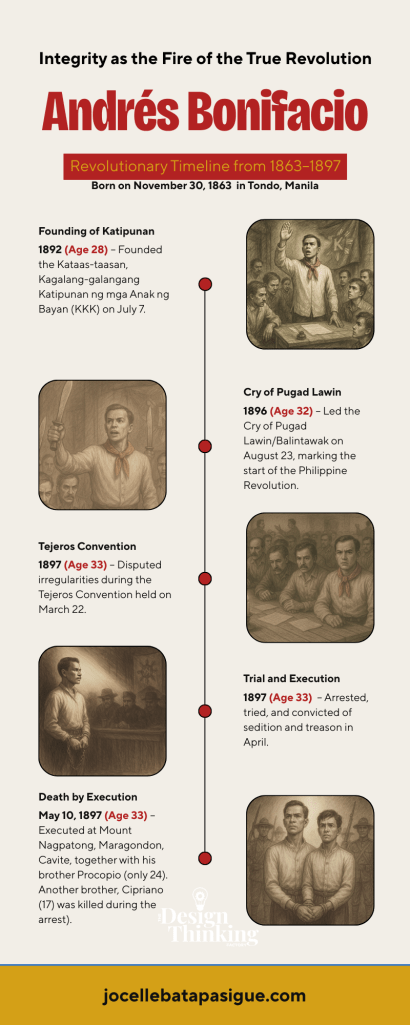
Andrés Bonifacio (born November 30, 1863, in Tondo, Manila) was a Filipino revolutionary leader often hailed as the “Father of the Philippine Revolution.” He spearheaded the movement against Spanish colonial rule by founding a secret society called the Katipunan and uniting Filipinos in armed struggle. Through the 1890s, Bonifacio played a central role in key events that ignited and shaped the revolution. The timeline below outlines the major milestones of his revolutionary journey, illustrating how a courageous young man in his twenties launched a fight for independence that would eventually cost him his life by age 33.
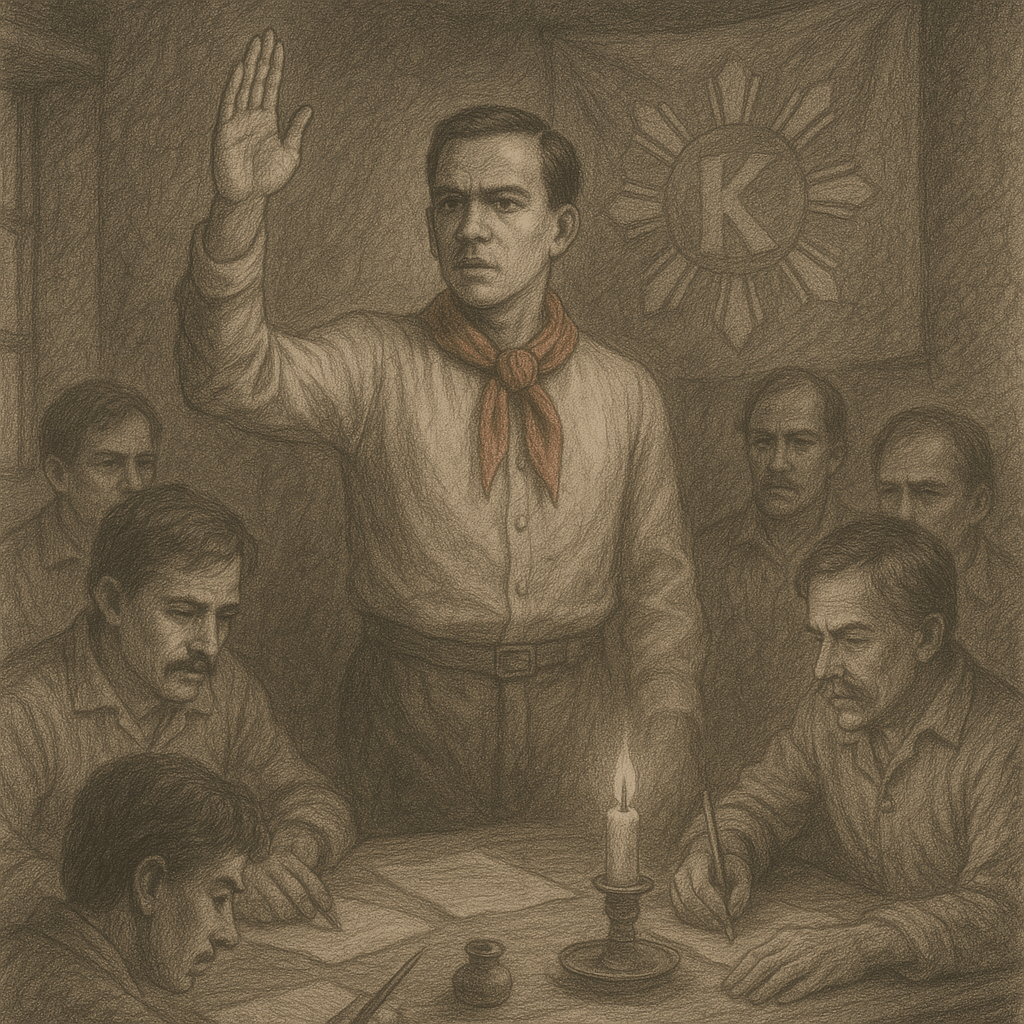
Founding of the Katipunan — July 7, 1892 (Age 28)
In 1892, at just 28 years old, Bonifacio took a bold step toward revolution. On the night of July 7, 1892, he and a small group of patriots founded the Kataas-taasan, Kagalang-galangan Katipunan ng mga Anak ng Bayan (KKK), popularly known as the Katipunan. This secret society was established in Tondo, Manila with the aim of gaining independence from Spanish colonial rule through armed uprising. The founding of the Katipunan marked the beginning of Bonifacio’s revolutionary journey, as it created the organization that would rally Filipinos to the cause of freedom.
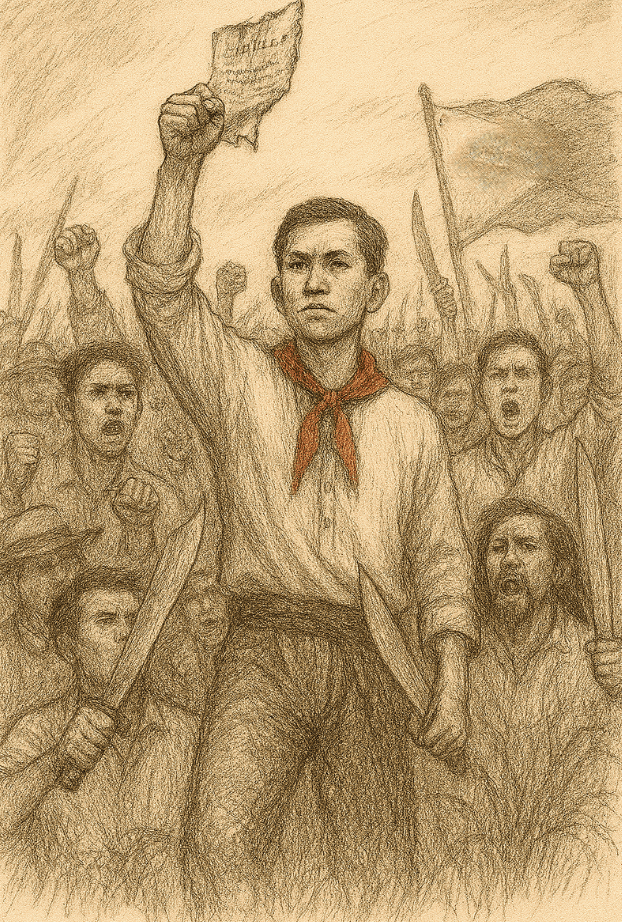
Cry of Pugad Lawin — August 23, 1896 (Age 32)
By 1896, the Katipunan had grown in strength, and Bonifacio, now 32, prepared to openly revolt against Spain. On August 23, 1896, he led the event known as the Cry of Pugad Lawin (also associated with Balintawak). Bonifacio gathered Katipunan members at Pugad Lawin, where they dramatically tore up their cedulas (Spanish-issued community tax certificates) as a sign of defiance against Spanish authority. This act of tearing the cedulas was a bold declaration of independence – effectively the start of the Philippine Revolution. The Cry of Pugad Lawin galvanized Filipino patriots, marking the point where secret planning turned into a public fight for liberty under Bonifacio’s leadership.
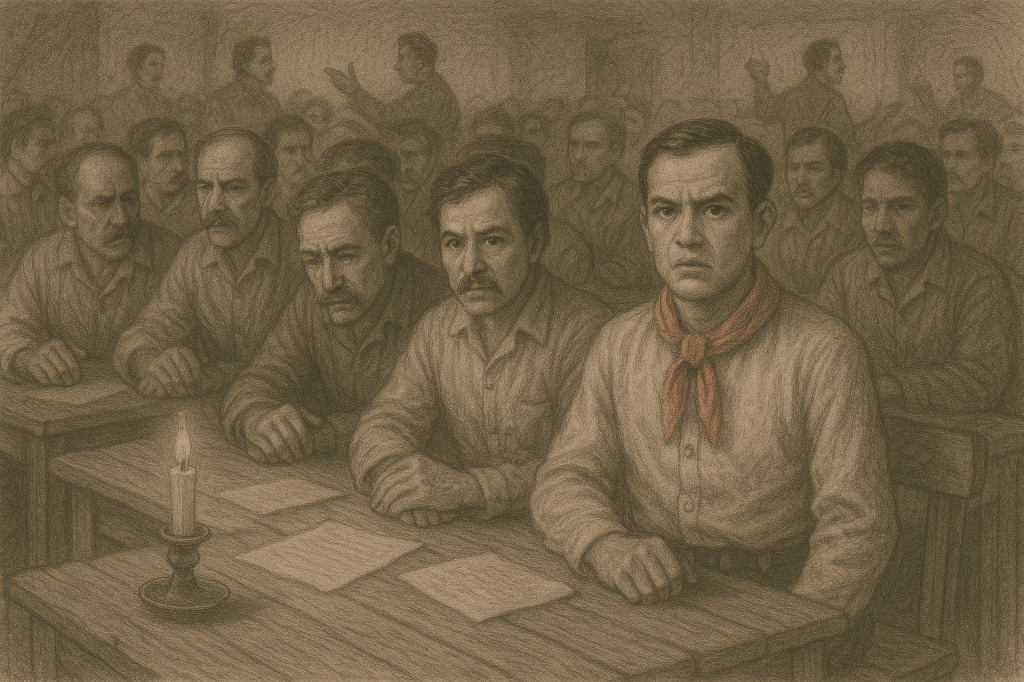
Tejeros Convention — March 22, 1897 (Age 33)
In early 1897, internal challenges emerged within the revolutionary ranks. On March 22, 1897, a meeting of revolutionaries was held in Tejeros, Cavite to unify the Katipunan factions (notably the Magdiwang and Magdalo groups) under a single revolutionary government. Bonifacio, then 33 years old, presided over this assembly. However, during the Tejeros Convention, an election was conducted that drastically changed the leadership. General Emilio Aguinaldo was elected President of the new revolutionary government, while Bonifacio was elected to a lesser post (Director of the Interior). When one attendee questioned Bonifacio’s qualifications for that position, he felt deeply insulted. In response, Bonifacio annulled the results of the Tejeros election, citing alleged irregularities. This incident was a turning point: the power struggle at Tejeros undermined Bonifacio’s authority and created a rift in the revolutionary movement’s leadership.

Trial and Conviction — April 1897 (Age 33)
Bonifacio stands trial before a military court in 1897. In April 1897, not long after the Tejeros Convention, Bonifacio was arrested by forces of the new revolutionary government under Aguinaldo. He and his younger brother Procopio were charged with sedition and treason for refusing to recognize the authority of the Aguinaldo-led government and allegedly plotting against it. The 33-year-old Bonifacio was subjected to a swift court-martial by his fellow Filipinos. After a closed trial, he was found guilty of treason against the revolution. This conviction by a military tribunal — organized by the very revolutionaries he once led — marked the tragic downfall of the Katipunan’s founder.
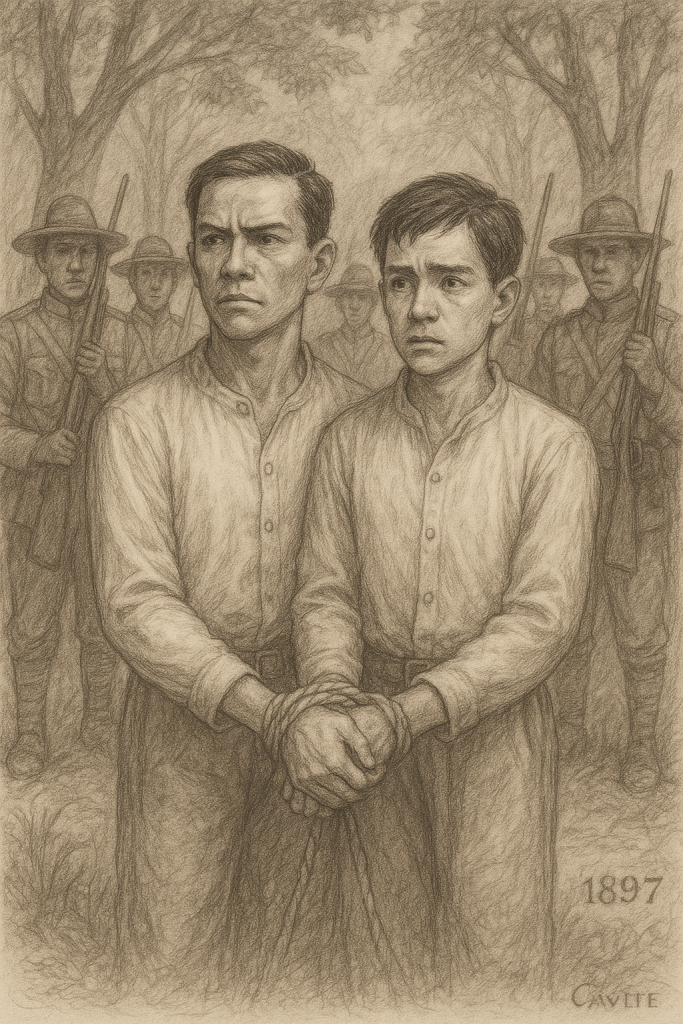
Execution — May 10, 1897 (Age 33)
Illustration of Andrés and Procopio Bonifacio’s execution on May 10, 1897. On May 10, 1897, Andrés Bonifacio met a tragic end at the hands of his own countrymen. Following the orders of Aguinaldo’s government, Bonifacio and his brother Procopio were taken to the remote mountains of Maragondon in Cavite. At a site called Mount Nagpatong, the two brothers were executed by a firing squad composed of fellow Filipino revolutionaries. Bonifacio was only 33 years old at the time of his death. This grim finale turned Bonifacio into a martyr for the cause of Philippine independence. Though he did not live to see the success of the revolution, Andrés Bonifacio’s leadership and sacrifice have made him a national hero. Today, he is remembered and honored for igniting the Filipino struggle for freedom and for his unwavering integrity and courage in the pursuit of liberty.
Lessons from the Life of Andrés Bonifacio
The life of Andrés Bonifacio reminds us that leadership is not a title to be worn, but a truth to be lived. It is not measured by wealth, position, or pedigree — but by conviction, courage, and integrity. Despite having little formal education, no inherited privilege, and no position of power, Bonifacio possessed something greater — an unyielding belief in freedom and the Filipino spirit. He did not simply dream of a free nation; he dared to act upon that dream.
Bonifacio’s story teaches us that revolutions are not born in grand chambers or gated halls alone. They begin in the hearts of ordinary people — in humble homes, on crowded streets — wherever citizens refuse to accept injustice as permanent. He reminds us that patriotism is not mere passion; it is sacrifice. It is the willingness to give one’s time, comfort, and even life for a better tomorrow that one may never personally witness.
He also warns us that the deepest wounds of a nation often come not from its enemies, but from its divisions. Bonifacio’s life calls us to unity — to recognize that every Filipino, from every province and every walk of life, has a role in building this nation.
As we navigate today’s digital age — where revolutions are powered not by bolos, but by ideas, innovation, and technology — Bonifacio’s legacy remains alive. His courage inspires us to use our voices and tools not to destroy, but to build; not to divide, but to connect; not just to dream of freedom, but to design a future where every Filipino can thrive.
In honoring Bonifacio, we honor the spirit of the Filipino — resilient, visionary, and forever ready to rise.
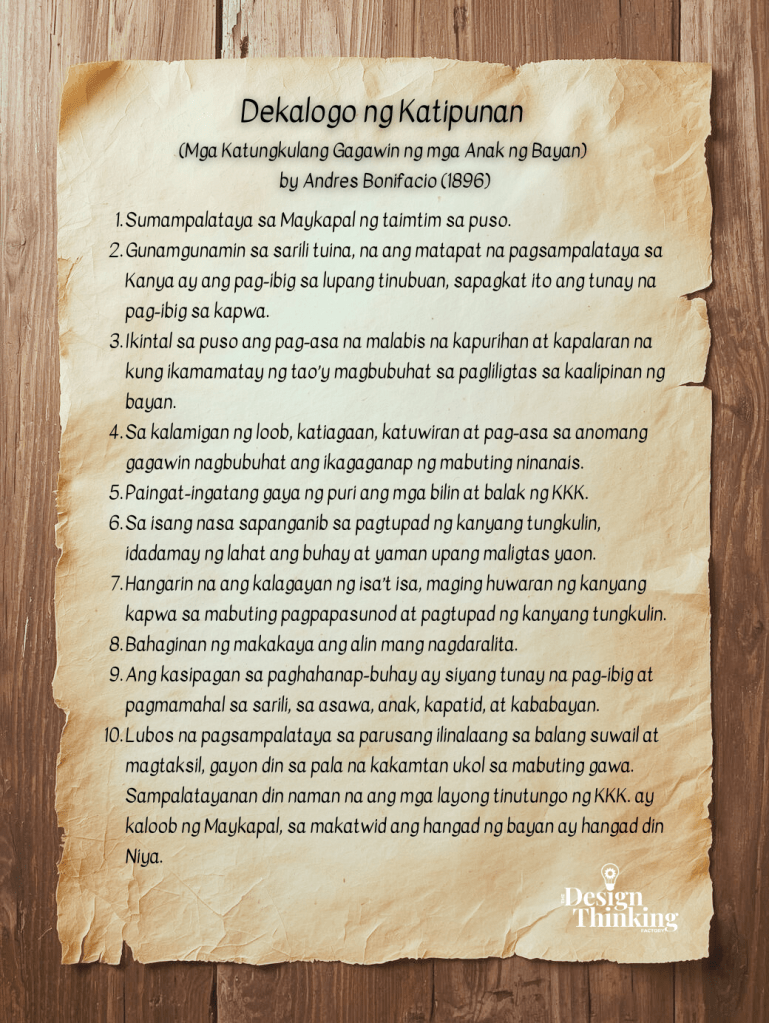
The Katipunan Decalogue, written by Andrés Bonifacio, serves as a moral and patriotic guide for members of the Kataas-taasan, Kagalang-galangang Katipunan ng mga Anak ng Bayan (KKK) — the secret revolutionary society that fought for Philippine independence from Spanish rule. Composed of ten principles, the Decalogue emphasizes love of God, love of country, unity, equality, courage, and self-sacrifice. It reminds every Filipino that true freedom is not achieved through words alone but through righteous deeds and unwavering dedication to the nation. Bonifacio envisioned it as a code of conduct — a call to integrity, discipline, and service, ensuring that the revolution would be rooted not in hatred, but in honor and love for the Filipino people.



 Jocelle Batapa Sigue
Leave a comment