
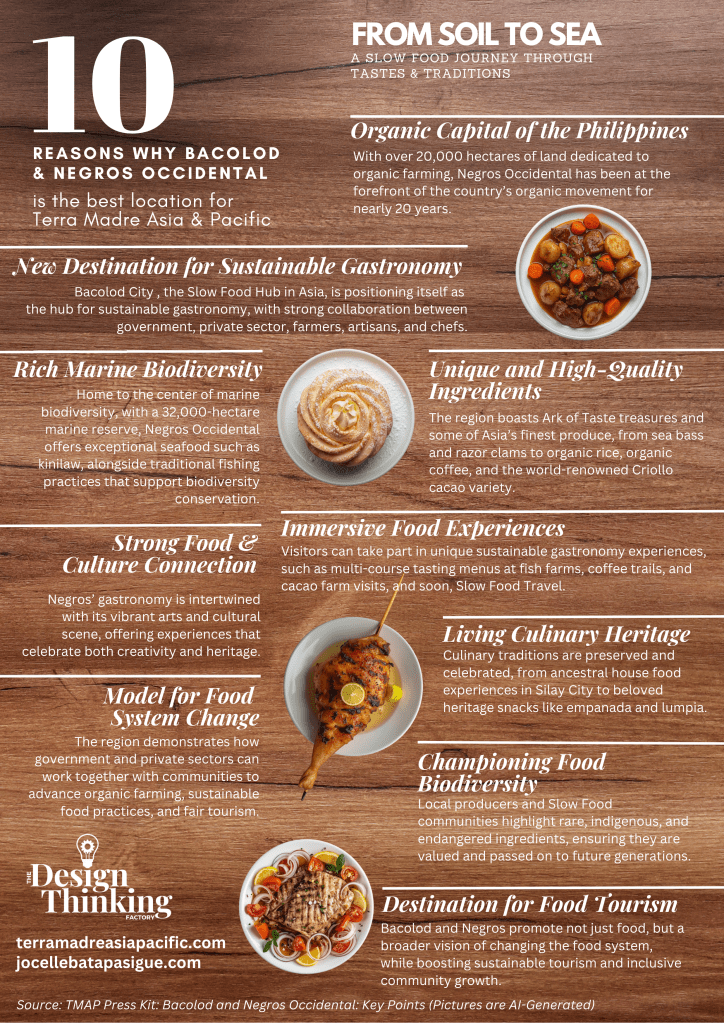
For the first time ever, the world’s most passionate community of chefs, farmers, and food visionaries will gather in the Asia-Pacific region — and the honor of hosting Terra Madre Asia & Pacific 2025 belongs to Bacolod City, Philippines. It’s a choice that surprises outsiders but feels destined to those who know this region’s flavor, rhythm, and heart. Because in Bacolod and Negros Occidental, food isn’t just eaten — it’s lived, protected, and celebrated.
Here, more than 20,000 hectares of farmland thrive without synthetic chemicals, earning Negros its title as the Organic Capital of the Philippines. For nearly two decades, this island has led the country’s organic movement, driven by communities that see agriculture not as production but as preservation. From mountain slopes to coastal villages, farmers cultivate food with care — not haste — proving that sustainability can be both practical and profitable.
That commitment is why Bacolod has emerged as Asia’s new destination for sustainable gastronomy, a city where the Slow Food ethos breathes in every partnership between government, private sector, and local artisans. Its growing reputation as the Slow Food Hub of Asia reflects a model of collaboration that the rest of the region is now studying: food as diplomacy, gastronomy as governance.
But it’s the ingredients that tell the story best. Negros is a pantry of unique, high-quality produce — home to Ark of Taste treasures like heirloom rice, organic coffee, the delicate Criollo cacao, and the world’s richest muscovado sugar. Its coastal waters, part of a 32,000-hectare marine reserve, yield sea bass, razor clams, and the freshest kinilaw, prepared by local fisherfolk using centuries-old traditions that preserve both flavor and biodiversity.
For the traveling gourmand, Bacolod offers experiences found nowhere else. Imagine multi-course tasting menus served at fish farms, coffee and cacao trails that lead you to stories as complex as their aromas, and ancestral kitchens in Silay City, where recipes have outlived colonial borders and modern trends. These are not tourist attractions — they are acts of cultural preservation, part of the island’s evolving identity as a Slow Food Travel destination.
It’s also a place where culinary heritage is a living force, not a museum piece. Empanadas and lumpia aren’t simply street food; they’re memory in motion, handed down through families who see food as heritage, not commerce. Every bite connects the diner to an ancestral table, every ingredient whispers of lineage and land.
That’s because in Negros, food and culture are inseparable. The province’s gastronomy is entangled with its creative pulse — art galleries in old houses, music spilling from heritage cafes, and chefs who plate their food like poetry. The local table isn’t only a meal — it’s a stage where craft, story, and emotion converge.
This creative energy has turned Negros into a model for food system change — a real-world example of how local governments, social enterprises, and citizens can co-create sustainable futures. Policies promoting organic agriculture have intertwined with tourism programs that celebrate food provenance. Here, economic development isn’t an abstract term; it’s what happens when a cacao farmer, a chef, and a policymaker share the same table.
Every meal also champions food biodiversity, a value that resonates deeply with Terra Madre’s global mission. From native black rice to rare sugarcane varieties and indigenous greens, the province’s producers ensure that endangered flavors are not forgotten but reintroduced — revived, respected, and reinvented for new generations.
Ultimately, Bacolod and Negros offer not just a destination for food tourism, but a vision for the planet’s edible future. A place where sustainability is rooted in heritage, where innovation honors nature, and where every dish tells the same story — that food, done right, can heal people, communities, and the earth.
Bacolod City is preparing to host one of the most significant international events ever held in the Philippines — the first-ever regional edition in Asia and Pacific of Terra Madre, taking place from November 19 to 23, 2025, a global gathering created by Slow Food and known for its biennial Terra Madre Salone del Gusto event in Turin, Italy
Terra Madre Asia and Pacific which will run from from November 19 to 23, 2025, is organized by Slow Food International in partnership with Slow Food Philippines. The global event taking place at the Negros Occidental Provincial Capitol Lagoon in Bacolod City will bring together more than 2,000 delegates from over 20 countries across Asia and the Pacific — including Japan, South Korea, Australia, New Zealand, Indonesia, Thailand, India, Sri Lanka, and Pacific Island nations.
Under the theme “From Soil to Sea: A Slow Food Journey Through Tastes and Traditions,” Terra Madre Asia & Pacific 2025 will unite farmers, fishers, chefs, Indigenous leaders, academics, entrepreneurs, and policy makers to discuss and experience food systems that are fair, sustainable, and culturally rooted.
“This is a turning point not just for Slow Food in the Philippines, but for the entire region. Terra Madre Asia & Pacific is a space where grassroots wisdom can shape policy, tradition can spark innovation, and the lived experiences of communities take their rightful place in shaping our global food future,” said Ramon “Chin Chin” Uy Jr., Slow Food Councilor for Southeast Asia. “It’s time for Asia and the Pacific to take center stage in the global sustainable food conversation.”
For Bacolod City, long known as the City of Smiles and a center of creative entrepreneurship, the event represents both cultural pride and economic potential. It positions the city as a regional hub for sustainable gastronomy, innovation, and inclusive development.
When Slow Food Meets Fast-Changing Economies: The Global Movement Expands East
Founded in Italy, the Slow Food movement began as a reaction against fast food and industrialized agriculture, advocating instead for food that is “good, clean, and fair.” Its flagship event — the Terra Madre Salone del Gusto in Turin — is now one of the world’s most influential forums on food sovereignty, biodiversity, and sustainable consumption.
In 2025, the movement brings its first regional edition to Asia and the Pacific — a testament to the region’s rising leadership in food innovation and climate-resilient agriculture.
“The first edition of Terra Madre Asia & Pacific marks an exciting new chapter for the global Slow Food movement,” said Paolo Di Croce, General Director of Slow Food. “This gathering celebrates the shared products and traditions that unite Asian and Pacific communities, while showing how food can connect people, pass on knowledge, inspire solutions, and help safeguard the planet for future generations. Starting with the next edition, the event will be held every two years, a milestone for our movement and for the Philippines. It also offers a unique opportunity to strengthen our global network through the creation of a new Slow Food Hub for Asia and the Pacific, and the launch of strategic initiatives such as Slow Food Travel.”
The event will also launch the creation of the Slow Food Hub for Asia and the Pacific, a new network for cross-border collaboration, capacity building, and market access for local producers.
Negros Occidental: Where Organic Heritage Becomes Economic Power
Negros Occidental has earned its title as the Organic Capital of the Philippines, with more than 20,000 hectares of land devoted to organic farming. For nearly two decades, it has championed organic conversion, biodiversity, and farmer empowerment through public-private partnerships and progressive local governance.
The province’s 32,000-hectare marine reserve complements its terrestrial abundance, making Negros a complete model of land-to-sea sustainability. Here, farmers and fisherfolk work hand-in-hand to produce organic rice, sugar, cacao, coffee, and seafood that embody the principles of slow production and fair trade.
Local products such as batuan (Garcinia binucao), kadyos (pigeon pea), criollo cacao, muscovado sugar, and tultul salt are part of Slow Food’s Ark of Taste, a global catalogue of endangered but culturally significant ingredients. Their inclusion reflects how Negros connects heritage preservation with innovation and market development.
Governor Eugenio Jose Lacson describes the province’s vision: “Negros Occidental has proven that sustainability and economic growth can go hand in hand. Hosting Terra Madre Asia & Pacific will show how local producers can thrive by investing in quality, integrity, and community.”
The province is now developing integrated food tourism zones and creative industry clusters that link farmers, chefs, artisans, and digital entrepreneurs — a policy framework that aligns with the Philippine Development Plan’s emphasis on the green and creative economy.
From Soil to Sea: Designing a Global Experience Rooted in Local Wisdom
Over five days, the Provincial Capitol Lagoon in Bacolod will transform into a multisensory marketplace of ideas, tastes, and technologies. Delegates and visitors will navigate a series of zones representing the diverse foodways of Asia and the Pacific:
- Foodways Exhibition: A centerpiece showcasing four iconic staples of the region — rice of Southeast Asia, spices of South Asia, soy of East Asia, and taro of Australia and the Pacific Islands. Through interactive displays and storytelling, visitors will see how these foods shape cultural identity and biodiversity.
- Education Pavilion: Programs for children and adults centered on taste education and sensory experiences, helping participants understand biodiversity and make informed food choices.
- Slow Food Coffee Coalition: An interactive journey from farm to cup, with tastings, workshops, and stories highlighting the region’s coffee traditions and the push for fair and transparent practices.
- House of Slow Food: A central hub introducing the philosophy of Slow Food and its global and regional projects.
- Public Talks and Conferences: Open forums where farmers, Indigenous leaders, cooks, youth, and policy makers discuss issues such as climate resilience, food justice, and sustainable agriculture.
- Terra Madre Kitchen and Taste Workshops: Guided tastings, chef collaborations, and cooking demonstrations showcasing regional ingredients and techniques.
- Slow Drinks, Market, and Street Food: Spaces dedicated to organic farmers, producers, sustainable drinks, and diverse regional street foods. These will highlight local ingredients while also featuring the Ark of Taste, Slow Food’s international online catalogue of endangered heritage ingredients that are sustainably produced, unique in taste, and rooted in distinct eco-regions. Sample Ark of Taste products from Negros Occidental and Western Visayas include batuan (Garcinia binucao), kadyos (pigeon pea), criollo cacao (such as Bago City’s heirloom cacao), artisanal muscovado sugar, and traditional salts like tultul and budbud.
- Community Kitchen: A communal dining area where representatives from all 61 barangays of Bacolod will cook and share traditional dishes, turning the event into a living expression of local heritage.
Complementing these will be signature events such as the Opening Ceremony, Mayor’s Lunch, Governor’s Night, and a Department of Tourism Welcome Dinner — each curated to feature local ingredients and talents.
The Artisans of Asia: Chefs and Mixologists Redefining Taste and Sustainability
Bringing together 58 distinguished professionals from across the globe, Terra Madre Asia & Pacific 2025 in Bacolod City will showcase an extraordinary convergence of culinary artistry and beverage innovation. The roster includes 10 international chefs, 29 local chefs, and 3 Negrense-based chefs, alongside 8 international mixologists and 8 local mixologists — each one representing a commitment to sustainability, creativity, and cultural authenticity. Together, they form a diverse collective that defines the spirit of the event: From Soil to Sea, connecting global excellence with local ingenuity.
The Global Masters – International Chefs
Leaders of sustainability, heritage, and innovation who bring global acclaim to the Terra Madre table.
Johanne Siy (Asia’s Best Female Chef 2023 – Singapore / Philippines)
Wes Kuo (Michelin Green Star Chef – Taipei)
Hafizzul Hashim (Fiz & Green Michelin Star Chef – Singapore)
Lordfer Lalicon (Kaya, Michelin Green Star Chef – USA)
Christina Rasmussen (Fura – Singapore / Denmark / USA)
Melissa Miranda (Musang – USA)
Romy Dorotan (Purple Yam – USA / Philippines)
William Wongso (Indonesia’s Culinary Ambassador)
Chef Ross Serai (Serai – Australia)
Ardika Dwitama Tjandra (August – Jakarta)
The Homegrown Innovators – Local Chefs
Chefs redefining Filipino cuisine through creativity, sustainability, and regional pride.
Jordy Navarra (Toyo & Panaderya Toyo – Manila)
Thirdy Dolatre and John Kevin “Nav” Navoa (Hapag & Aya – Makati)
Miko Calo (Taqueria Franco – Manila)
Chele González (Gallery by Chele and Asador Alfonso – Manila / Cavite)
JP “Jepe” Cruz (Inatô – Makati)
Stephan Duhesme (Metiz – Manila)
Yuichi Ito (Crosta Pizzeria – Makati)
Don Patrick “Don” Baldosano (Linamnam – Parañaque)
Antonio “Tony Boy” Escalante (Antonio’s Group – Tagaytay / Manila)
Aaron Isip (Kasa Palma – Manila)
Patrick Go (Your Local – Makati)
Angelo Comsti (Offbeat Bistro – Manila)
Rhea Rizzo (Mrs. Saldo’s – Cavite)
Bettina Arguelles (Manila)
Tina Legarda (Bamba Bistro – Parañaque)
Inés Castañeda and Filippo Turrini + Roots Team (Roots – Siargao)
Charles Montañez (Mamacita – Taguig / BGC)
Datu Shariff Pendatun III (Manila / Mindanao)
David Amoros (El Born – Manila)
David del Rosario (CEV – Siargao)
Dedet de la Fuente (Lechon Diva – Manila)
Erwan Heussaff + FEATR (Manila)
Miguel “Cabel” Moreno (Palm Grill – Quezon City / Mindanao)
Chef Waya Araos-Wijangco (Baguio, Manila)
Gerald Montelibano (Cibo di Marghi – Manila)
Andre Malarky (Wild Siargao – Siargao)
Rhea Sycip (Cavite)
JayJay Sycip (Cavite)
The Heart of Negros – Negrense-Based Chefs
Champions of the province’s organic heritage and countryside innovation.
Don Colmenares (SAUMA – Negros Occidental)
Nico Millanes (Portiko Cafe – Bacolod)
Mark Lobaton (Enting’s – Sagay, Negros Occidental)
The Global Alchemists – International Mixologists
Pioneers blending craft, science, and sustainability into the global drinks narrative.
Danny Childs (Slow Drinks – USA)
Danny Park (Zest – South Korea)
Agung Prabowo (The Old Man & PENICILLIN – Hong Kong / Indonesia)
Sasha Wijidessa (FURA – Singapore / Denmark)
Daniel Nguyen (Sông Cái Distillery – Vietnam / USA)
Renate Spurlock (Kaya & Bayani Bar – USA)
Anna Ye (Anna Ye Tea – Vietnam / USA)
Rishot Laloo / Sagar Neve (Shad Skye – India)
The Local Craftsmen of Flavor – Local Mixologists
Artists leading the next wave of Filipino beverage innovation.
Niko Tiutan (Ito – Manila)
Ron Cruz (Fat Cat – Manila)
Jessie Qi (Last Chance – Siargao)
Kalel “Liquido Maestro” Demetrio (Agimat & Alamat – Manila)
Ken Alonso (Proudly Promdi – Ilocos Norte / Manila)
Frances “Janelle Frances” Ang (Manila)
Alyssa “Aly” Lorenzo (Xi by Cafe Guilt – Manila)
Arcadius Rybak (Pampanga)
Together, they form an unprecedented culinary collective — not a competition, but a collaboration that redefines the region’s gastronomic identity.
Manila Sets the Table: A Prelude to Asia’s Most Anticipated Food Gathering
The Manila pre-launch, held on September 9, 2025 at North Forbes Pavilion, provided a preview of the artistry that will define Bacolod’s main event.
Chefs served Ark of Taste–inspired dishes such as Kadios Miso Piaya with Prawn Salad (Hapag), Mini Cheesecake Tart with Negros Cheese and Asin Tibuok (El Born Manila), Negros Blue Crab on Black Broas (Offbeat Bistro), Pili Braised Pork Belly with Barako Coffee Sauce (Bamba Bistro), Beef Pares Osso Bucco with Molo Crisp (Your Local), Tanigue with Marang Miso (Mamacita), and Lechon with Batwan Jelly and Tultul Salt (Pepita’s Kitchen).
Drinks by Arcadius Rybak, Kalel Demetrio, and Ken Alonso featured flavors like Green Mango and Coconut Daiquiri, Terra Madre Sour, and Tapuey Pomelo Spritz.
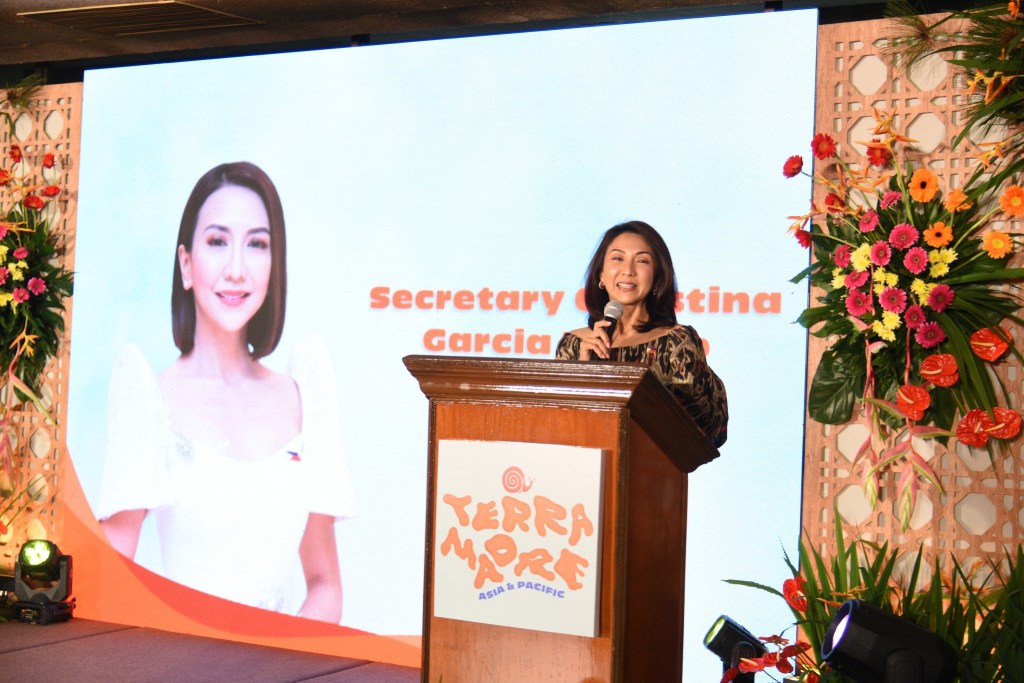
In her remarks, Tourism Secretary Christina Garcia Frasco affirmed:
“This partnership between food sustainability and tourism ensures that the Philippines not only feeds visitors but also nourishes the planet.”, Tourism Secretary Christina Garcia Frasco officially affirmed. “We aim to promote the Philippines not just on the deliciousness of its food and the variety and diversity of what we have to offer, but also in terms of the principles and values by which we pursue our food.”
Beyond the Plate: Policy, Design, and the Economics of Sustainability
The event’s visual identity, created by Dan Matutina, draws inspiration from archipelagic landscapes and handcrafted clay forms — a metaphor for biodiversity and resilience.

TMAP 2025 is supported by a strong partnership between Slow Food International, Slow Food Philippines, the City Government of Bacolod under Mayor Greg Gasataya, and the Provincial Government of Negros Occidental under Governor Eugenio Lacson, with support from the Departments of Tourism, Agriculture, Trade and Industry, TESDA, and congressional leaders Albee and Javi Benitez.
The event is projected to generate significant economic impact, with increased tourism arrivals, employment opportunities, and trade exposure for local MSMEs. It will also highlight Negros as a destination for sustainable investments in agribusiness, food innovation, and creative industries.
For the national government, TMAP 2025 aligns with the country’s Digitalization and Green Growth agenda, demonstrating how cultural heritage, digital storytelling, and community-based tourism can drive inclusive economic development.
Bacolod to the World: Building the Blueprint for Asia’s Sustainable Food Future
As preparations intensify, Terra Madre Asia & Pacific 2025 is emerging as a milestone not only for the Slow Food movement but also for the Asia-Pacific’s sustainable economy.
By bringing together global experts, local producers, and creative leaders, the event aims to strengthen policy frameworks that support smallholder farmers, ethical trade, and climate adaptation. It also showcases how food diplomacy and regional cooperation can advance sustainable development goals.
“Food is the bridge between people and the planet,” says Paolo Di Croce. “Together, we can build that bridge stronger than ever.”
From the fertile fields of Negros to the shores of the Pacific, the Terra Madre spirit continues to expand — reminding us that innovation and heritage can coexist.
An Invitation to Co-Create: Shaping the Future from Soil to Sea
Bacolod and Negros stand ready to welcome the world. Terra Madre Asia & Pacific 2025 is not just an event — it is a movement for inclusive growth, a showcase of how food, policy, and culture can converge to build a better tomorrow.
Delegates, partners, and advocates from across the region are invited to join this journey — to share, to collaborate, and to shape the future of sustainable gastronomy.
For delegate applications, contact nichole@slowfoodnegros.com.
For partnerships and sponsorships, reach frauline@slowfoodnegros.com.
From soil to sea, from tradition to transformation — the Philippines is ready to lead Asia’s sustainable food revolution.

 Jocelle Batapa Sigue
Leave a comment