
The World Economic Forum’s Future of Jobs Report 2025 highlights the Philippine private sector’s strategic resolve in addressing the twin challenges of digital disruption and talent scarcity. With 96% of employers committed to reskilling their workforce for AI integration and a strong push toward diversity, equity, and inclusion (DEI), Philippine businesses are demonstrating operational grit and foresight. As global labor markets shift rapidly, the country’s private sector emerges as a key driver of transformation—investing in skills, embracing emerging technologies, and fostering inclusive growth to build a resilient, future-ready workforce.
Amidst political chaos, the country is at a defining moment in its labor transformation, shaped by global disruption and local opportunity. According to the Future of Jobs Report 2025, technological innovation, climate action, and demographic shifts are reshaping the future of work across 55 economies. For the Philippines, the convergence of these trends offers both promise and urgency.
The country is poised to ride the wave—if it can adapt quickly and strategically. The report offers a sweeping analysis of emerging job roles, declining occupations, and the evolving skills ets that will define the next decade of work. While the report provides a global overview, its insights are especially relevant to developing economies like the Philippines, where demographic momentum, digital transformation, and climate resilience are converging to reshape employment.
With a growing working-age population and a vibrant service sector, the Philippines has the potential to become a regional leader in future-ready jobs. However, the country also faces challenges: automation threatens clerical roles, climate change demands new skill sets, and the digital divide risks leaving segments of the population behind.
As one of the lower-income economies with a rapidly expanding working-age population, the country holds a powerful demographic dividend—a chance to accelerate inclusive growth by harnessing the potential of its youth. But this opportunity hinges on one critical factor: digital workforce competitiveness. The report identifies broadening digital access as the most transformative global trend, with 60% of employers worldwide expecting it to reshape their business by 2030.
This article explores how the Philippines can convert global labor shifts into national advantage—by investing in digital skills, expanding access to education, and building a future-ready workforce that thrives in a rapidly evolving economy.
Philippines Future of Jobs 2025 – Workforce Transformation Insights
Workforce Reskilling Projections (By 2030)
The World Economic Forum (WEF) Future of Jobs 2025 report outlines how Philippine employers expect their workers’ training needs by 2030, in comparison to global averages:
- No training needed: Only 32% of workers in the Philippines would not need any upskilling by 2030, versus a higher 41% globally.
- Upskilling in current role: About 28% of Filipino workers will be upskilled on the job (in their current roles), roughly on par with 29% globally.
- Upskilling with role change (redeployment): An estimated 27% of workers in the Philippines will require upskilling and be moved into new roles, significantly above the 19% global average.
- Unlikely to be trained: 13% of the Philippine workforce is unlikely to receive upskilling, slightly more than the 11% global share.
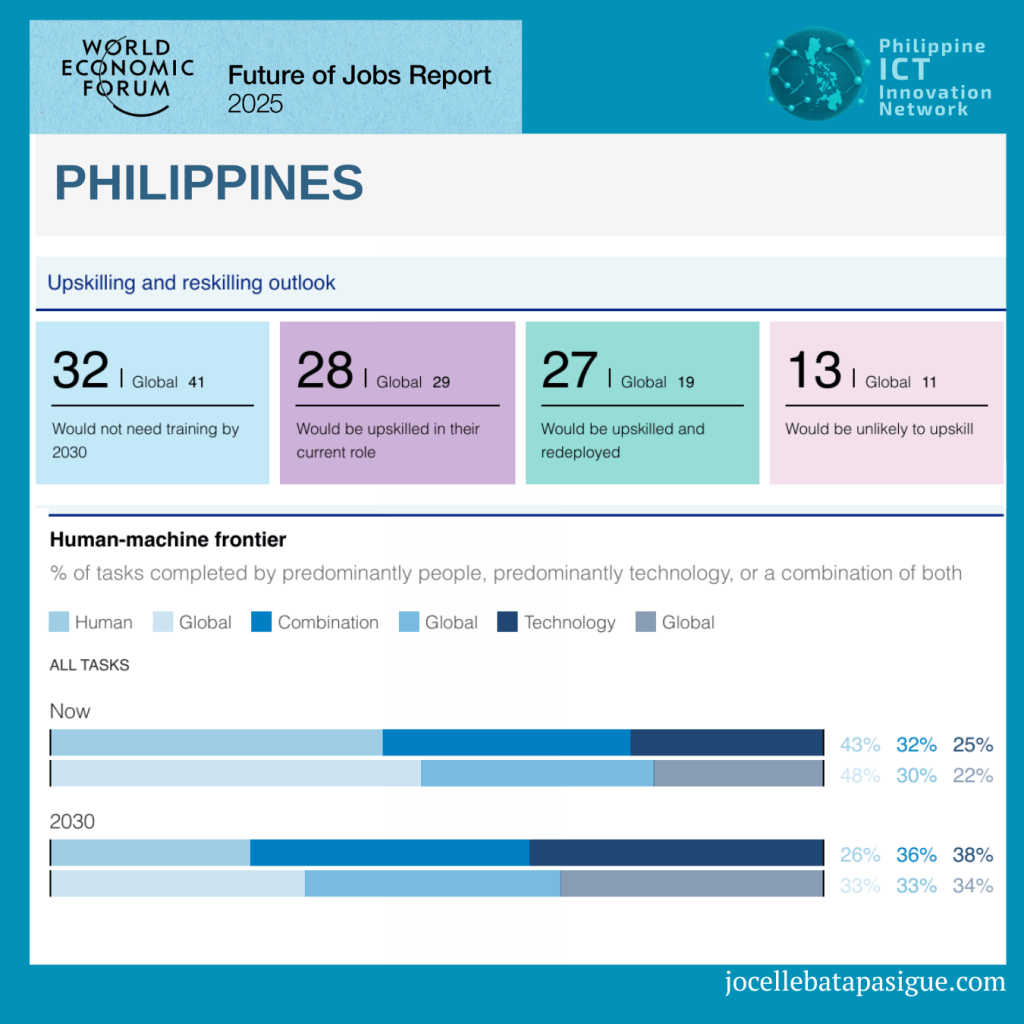
These figures suggest a greater reskilling imperative in the Philippines than globally. A much smaller share of Filipino workers can get by without new training (about one-third, compared to two-fifths globally), while a larger chunk will need to transition to new roles after upskilling. In other words, Philippine businesses anticipate more extensive job role changes, highlighting the depth of skill transformation required. The slightly higher percentage of workers not expected to receive training (13% vs 11% globally) is a concern – it points to a segment of the workforce at risk of being left behind if reskilling efforts don’t reach them. This underscores the urgency for broad-based training programs to ensure most workers can adapt to future job demands.
Human–Machine Task Distribution (Current vs. 2030)
The report details how work tasks are split between humans and technology in the Philippines now (2023) and how that is projected to shift by 2030, compared to global averages:
- Current: In the Philippines, humans currently perform roughly 43% of all tasks, and 25% of tasks are handled by technology (with the remaining ~32% done by a mix of both). This means automation already accounts for one-quarter of work tasks in the country. Globally, by comparison, about 48% of tasks are done by humans vs 22% by machines (30% hybrid).
- Projected (2030): By 2030, Philippine employers expect the human share of work to drop to 26%, while tasks done predominantly by technology will rise to 38% (36% remaining hybrid). In other words, technology is forecast to handle over a third of work tasks in the Philippines by 2030. Globally, the 2030 outlook is more balanced at 33% human vs 34% technology (33% hybrid).
The Philippines anticipates a faster shift toward automation than the world at large. Today, Filipino workplaces already rely slightly more on technology for tasks than the global average (25% vs 22% of tasks). By 2030, this gap widens: Philippine firms project only about a quarter of tasks will be done by people, significantly lower than the one-third global average, with machines taking up a larger share of work. This points to an aggressive adoption of technology and AI in Philippine workplaces, potentially outpacing global automation trends.
The implication is that Filipino workers will need to adapt quickly – developing digital skills and the ability to work alongside machines – to remain effective. Companies and workers in the Philippines must prepare for this accelerated human–machine transition, ensuring that the workforce is ready for highly technology-centric roles.
Reskilling at Scale: WEF Report Underscores Private Sector’s Commitment to Talent Competitiveness
Talent Availability Outlook (Next 5 Years)
This reflects employer expectations on whether their ability to access skilled talent will improve or worsen, In terms of reskilling the workforce, around 33% of Philippine employers expect worsening talent availability in this area. There’s limited optimism around workforce readiness for reskilling, suggesting possible systemic barriers or resource constraints.
In terms of upskilling existing workforce, roughly 65% expect improvement.This indicates stronger confidence in internal capacity-building—possibly due to accessible learning platforms or active training programs.
In terms of accessing external talent, only 22% foresee improvement. The low confidence in accessing external talent (e.g., hiring from outside organizations or globally) may reflect regulatory barriers (e.g., labor law rigidity, immigration policy) or regional competition.
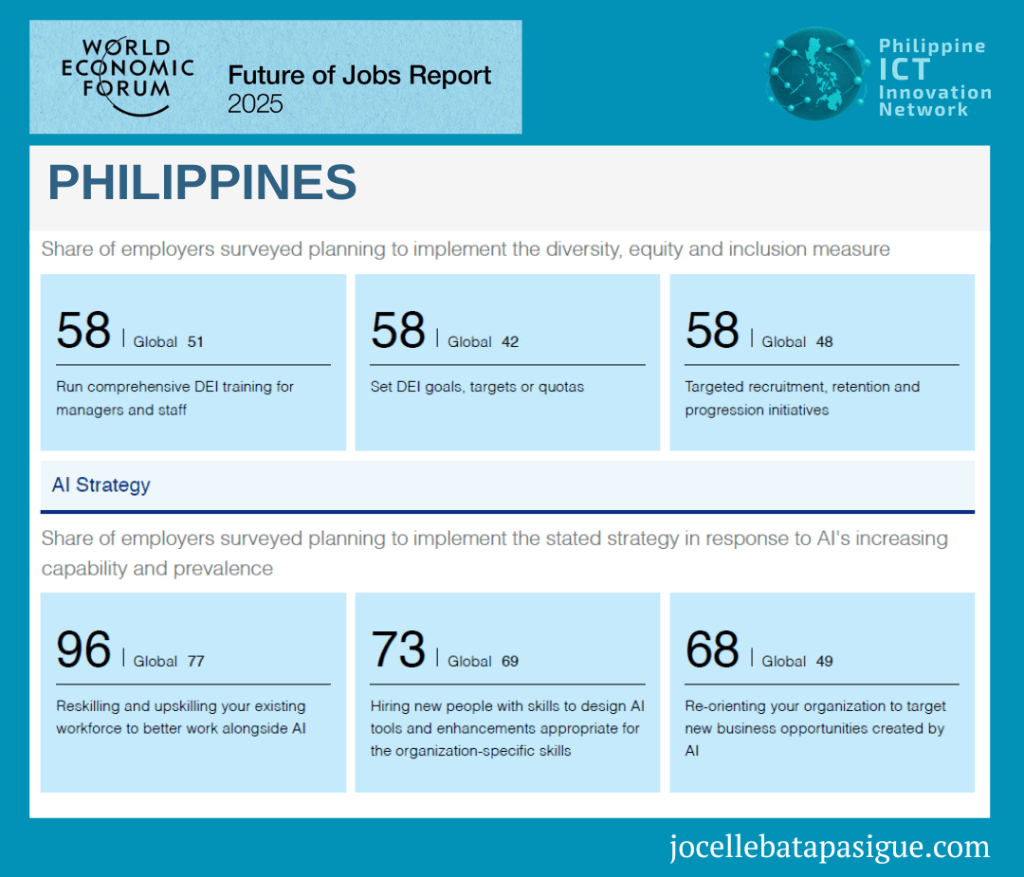
DEI (Diversity, Equity, Inclusion) Implementation
Philippine employers are more committed than global peers to all three core DEI actions. This suggests a growing national focus on inclusive workplaces, especially in the context of digital and remote job growth. The uniformity across all three categories (58%) also reflects broad organizational alignment on equity-related priorities.
AI Strategy Adoption
The Philippines shows very high alignment with AI transformation, especially in preparing current employees (96% vs 77% globally). A strong commitment to workforce reskilling and job transformation reflects national urgency in adapting to AI. The relatively high scores across all three categories suggest that AI readiness is not just technological—but strategic and human-centered in the Philippine context.
The data paints a clear picture. The Philippines is ahead of global benchmarks in DEI and AI workforce strategy—showing readiness to align human capital with future-of-work demands. However, external talent access remains a weak spot, implying the need for policy reforms in labor mobility, international recruitment, or inter-industry transition support. With such high AI strategy adoption (96% for internal reskilling), the challenge now lies in executing inclusive and scalable programs to match intent with impact.

Filipino employers see AI, data, and cybersecurity as the biggest drivers of skill demand by 2030. Interestingly, the highest growth is projected in AI and Big Data (85%), reflecting national ambitions to leap into the digital economy.
In addition, creative thinking and technological literacy are gaining ground, suggesting that Philippine employers are not only preparing for automation—but also for innovation and problem-solving in digital environments.
The Philippines is heavily prioritizing soft and cognitive skills, such as analytical thinking, resilience, and adaptability. Employers expect these traits to remain essential even as AI adoption rises. Compared to global trends, Filipino employers show stronger emphasis on emotional intelligence and customer-facing service orientation—likely due to the country’s strength in BPO and service sectors.
Filipino employers see AI, data, and cybersecurity as the biggest drivers of skill demand by 2030. Interestingly, the highest growth is projected in AI and Big Data (85%), reflecting national ambitions to leap into the digital economy.
In addition, creative thinking and technological literacy are gaining ground, suggesting that Philippine employers are not only preparing for automation—but also for innovation and problem-solving in digital environments.
Talent Availability as a Policy Priority
To address skills gaps and talent shortages, the report highlights which public policy measures Philippine companies see as most beneficial for improving talent availability, compared to global peers:
- Labor law flexibility: 57% of employers in the Philippines prioritize more flexibility in hiring and firing practices, well above the 44% global average.
- Provision of training opportunities: 52% of Philippine companies call for greater provision of reskilling/upskilling programs, essentially the same as the global rate (52%).
- Funding for training: 48% of Philippine employers prioritize increased funding for reskilling/upskilling, slightly below the 55% globally who see funding as key.
- Improving education systems: 48% highlight the need to improve public education systems (e.g. curricula, quality), very similar to the 47% globally.
- Easing immigration rules: 44% of Philippine employers favor changes to immigration laws to attract foreign talent, a share much higher than the 26% global average
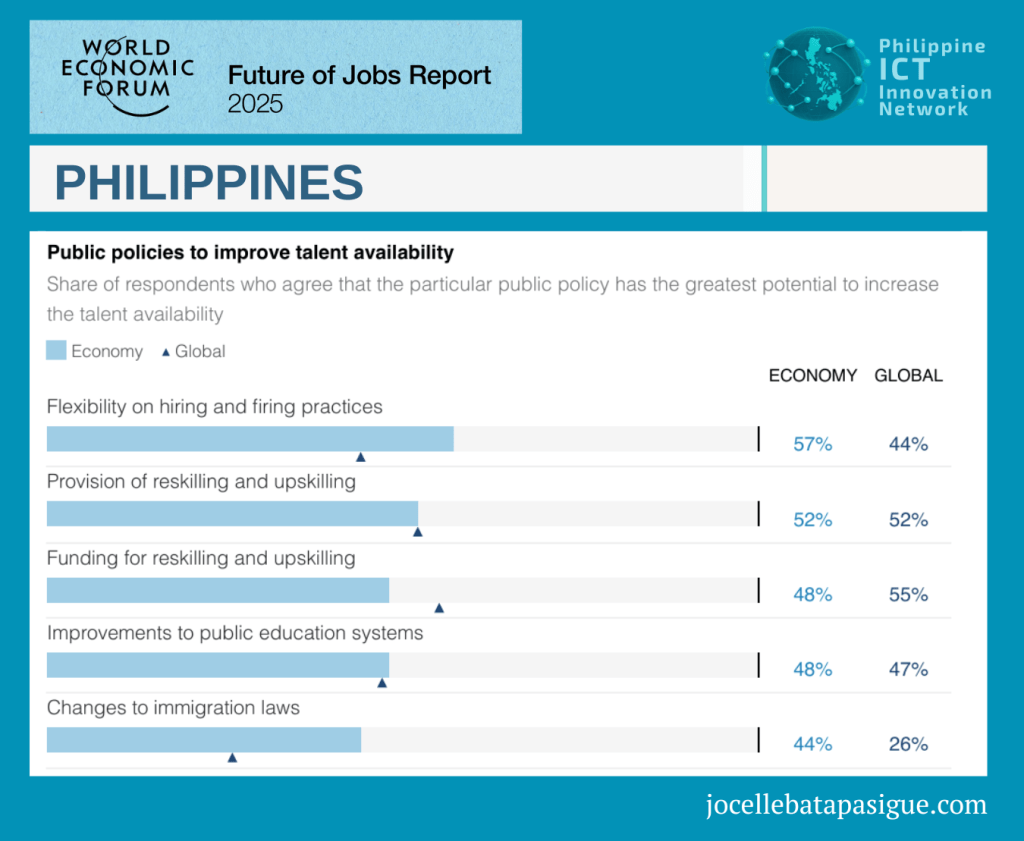
Philippine firms are signaling a strong desire for enabling policies to expand their talent pool. In particular, local employers put greater emphasis on labor market flexibility and immigration than their global counterparts, suggesting that current regulations and local talent supply may be constraining hiring. Over half of Filipino companies (57%) want streamlined hiring/firing rules to more easily acquire or adjust talent, and they are almost twice as likely as global firms to view immigration reform as crucial (44% vs 26%).
This highlights a recognition that domestic skill shortages could be eased by accessing global talent and by modernizing labor laws. At the same time, employers in the Philippines align with global peers on the importance of providing training opportunities and improving education – core long-term solutions for skills development. Notably, slightly fewer in the Philippines stress direct funding for training compared to the global average (perhaps indicating that beyond funding, structural reforms are seen as equally important).
Overall, the policy priorities paint a picture of Philippine companies seeking both immediate and systemic fixes – from pragmatic regulatory changes to sustained investments in skills – to boost the talent available in the labor market.
Implications for Philippine Labor Transformation and Readiness
Bringing these numbers together, it’s clear the Philippines faces a transformative workforce shift in the coming years. Employers foresee that by 2030, a large majority of workers will need some form of upskilling or even complete role changes, and they project an automation leap that will put technology in charge of over one-third of tasks. This dual pressure – the need to reskill workers and the rapid adoption of technology – means the country must dramatically step up training and education efforts.
With only about one-third of Filipino workers not requiring retraining (versus two-fifths globally), the Philippines has relatively fewer “safe” jobs and more roles in flux. However, the country’s young median age of 25.7 years—the youngest in ASEAN—offers a critical advantage: a youthful, trainable population that can be molded into a digitally fluent, tech-savvy workforce. This demographic edge, if paired with robust development programs, positions the Philippines to not only keep up with technological change but to lead in preparing a next-generation workforce.
Encouragingly, Philippine companies are aware of the challenge: about 67% cite skills gaps in the labor market as a key barrier to business transformation (slightly above the global rate). Their calls for policy action – from modernizing labor regulations to investing in education and skills – reflect an understanding that both public and private sectors must collaborate to meet future talent needs.
The higher prioritization of hiring flexibility and immigration reforms suggests that, in the near term, companies need access to a broader talent base to fill urgent skill gaps. In the longer term, equal emphasis on upskilling programs and better education indicates a strategy to cultivate talent from within the country. The Philippines’ demographic window, unlike aging neighbors such as Thailand or Singapore, gives it time and potential—but only if institutions act swiftly and inclusively to convert youth into capability.
Overall, the Philippines’ labor market is poised for significant change. The data implies that the nation’s readiness for the future of work will hinge on how proactively it can retrain its workforce at scale and integrate technology. If Philippine stakeholders succeed in scaling up reskilling initiatives (as 68% of workers are expected to need training) and adopt supportive policies (flexible hiring, education upgrades, etc.), the country can turn this challenge into an opportunity – boosting productivity and innovation with a tech-augmented, highly skilled, and demographically advantaged workforce.
Failing to do so, however, could leave a portion of young workers disconnected from opportunity—and waste a rare window of demographic strength. The WEF findings thus serve as a call to action: invest in people while the population is young, and adapt systems now, so that the Philippine labor force is resilient, inclusive, and ready for the demands of 2030 and beyond.
The greatest challenge the Philippines faces today is not a lack of talent, innovation, or opportunity—but the persistent entanglement in political theatrics that distract from long-term development. As global markets evolve and digital transformation accelerates, the country must confront a hard truth: progress is being slowed not by capability, but by a national discourse dominated by spectacle over substance.
At the heart of overcoming this challenge is the urgent need for principled, visionary leadership—leaders who prioritize nation-building over noise, and who are grounded in competence, integrity, and a long-term vision for inclusive growth. Good leaders create the conditions for trust, stability, and innovation to thrive. Without them, even the most promising initiatives risk stalling in the shadow of political distraction. To unlock the Philippines’ full potential, we must rise above partisan noise and empower leaders who lead not for applause, but for impact.
Sources: World Economic Forum – The Future of Jobs Report 2025 (Philippines Economy Profile)



 Jocelle Batapa Sigue
Leave a comment