
In an era where artificial intelligence (AI) is reshaping societies and economies at unprecedented speed, the Philippines must rise to the challenge of governance with strategic clarity, ethical foresight, and cross-sectoral collaboration. The proposed AI Governance Policy and Strategy Development Framework offers a forward-thinking model that aligns with international norms while responding to the country’s unique developmental context.
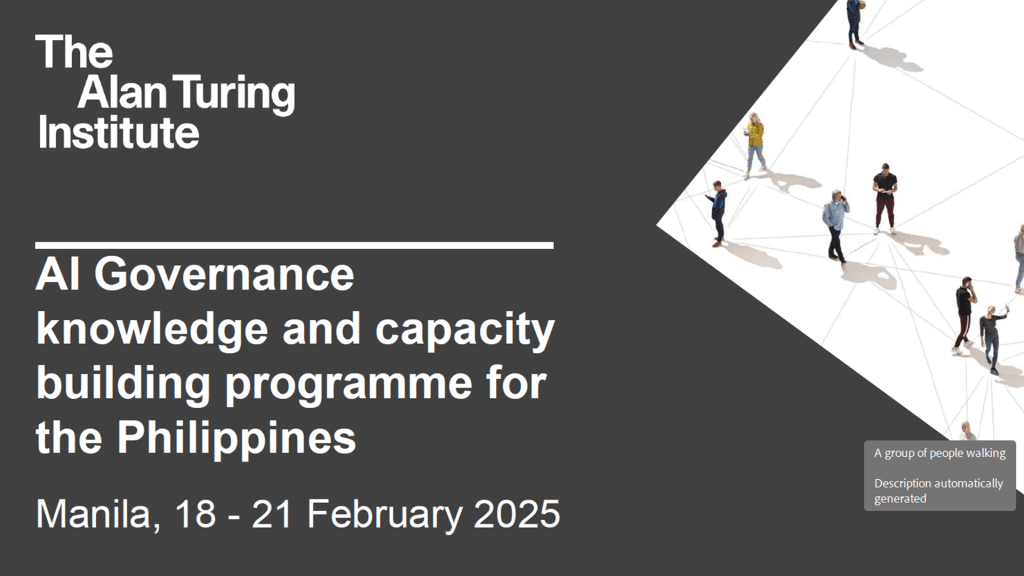
Jocelle Batapa-Sigue is advancing this AI Governance Policy and Strategy Framework as a direct outcome of key learnings from the AI Ethics and Governance in Practice Programme conducted by the Alan Turing Institute in the Philippines last March 2025. As one of the select Filipino leaders who engaged in this capacity-building initiative, she recognized the urgent need for a clear, multi-layered approach to AI governance that combines enforceable national policy with domain-specific standards and voluntary best practices. This framework reflects her deep commitment to transforming global insights—such as those from the UK’s leading AI research body—into actionable, locally relevant strategies that empower government, industry, and civil society to co-create a trusted, inclusive, and future-proof AI ecosystem in the Philippines.
At the core of this strategy is the need for a dual-axis approach to governance—one that recognizes both the horizontal (cross-sectoral) and vertical (domain-specific) dimensions of AI development, and balances hard regulation with soft, voluntary mechanisms.
Why AI Governance Matters Now More Than Ever
AI is no longer a distant frontier. It is a present force impacting education, health, agriculture, justice, transportation, finance, and the public sector. Left unguided, the deployment of AI systems may perpetuate bias, increase inequality, and undermine public trust. Without a solid governance framework, we risk innovation without accountability—efficiency without equity.
To lead responsibly in the Fourth Industrial Revolution, the Philippines must establish a governance architecture that anticipates risks while enabling inclusive and sustainable innovation. The time to build that scaffolding is now.
Understanding the Proposed Framework
The framework introduces a four-quadrant strategy matrix based on two key axes:
Horizontal vs. Domain-Specific
- Horizontal: Cross-cutting policies that apply to all sectors (e.g., data privacy, transparency, algorithmic accountability).
- Domain-Specific: Tailored regulations and guidelines specific to a sector’s context (e.g., AI in healthcare, finance, education).
Hard vs. Soft Instruments
- Hard: Formal policies, enforceable laws, regulatory requirements.
- Soft: Voluntary guidelines, best practices, industry codes, standards.
This structure allows stakeholders to position different instruments based on scope and enforceability:
| Quadrant | Description |
|---|---|
| Top-Right (Horizontal-Hard) | PH AI Governance Strategy — This includes national AI policies, regulatory frameworks, and cross-cutting legislation, establishing overarching principles and enforcement mechanisms. |
| Top-Left (Domain-Specific-Hard) | Sectoral Laws and Regulations — Statutes that govern AI use in sensitive sectors like healthcare (e.g., diagnostics), finance (e.g., credit scoring), education (e.g., adaptive learning systems), and justice (e.g., facial recognition in law enforcement). |
| Bottom-Left (Domain-Specific-Soft) | Industry Best Practices — Sector-led initiatives that define responsible AI development, such as ethical design standards or deployment protocols in logistics, media, or BPOs. |
| Bottom-Right (Horizontal-Soft) | Voluntary Standards — National or international norms (e.g., ISO/IEC, OECD, UNESCO) adopted voluntarily to promote transparency, fairness, and accountability across industries. |
The Pillar: PH AI Governance Strategy (Horizontal-Hard)
At the heart of the framework lies the Philippine AI Governance Strategy—a nationally coordinated approach that sets ethical foundations and legal boundaries for all AI deployment. This must include:
- A National AI Risk Assessment Mechanism
- A Digital Accountability Act aligned with data protection and cybersecurity laws
- A National AI Standards Council to issue technical guidelines
- Capacity-building for regulators, LGUs, and judiciary to understand AI systems
- Requirements for human oversight, transparency, and explainability in public AI use
By establishing a horizontal policy spine, we ensure all future sectoral initiatives build on a consistent ethical and legal foundation.
The Domain Layer: Where Innovation Meets Accountability
Each domain or sector—whether education, agriculture, transport, or health—requires context-sensitive regulation. For instance:
- In education, AI-driven assessments must be fair, non-discriminatory, and augment—not replace—teachers.
- In healthcare, AI diagnostics must follow rigorous validation protocols and ensure patient consent and explainability.
- In finance, credit-scoring systems must be auditable and compliant with anti-discrimination rules.
These vertical approaches must evolve collaboratively—with government, industry, and civil society co-creating Domain-Specific Standards and Risk Mitigation Guides, ideally grounded in both international best practices and local realities.
The Role of Soft Governance: Incentivizing Good Behavior
Regulation alone cannot guide innovation. The framework’s bottom quadrants recognize the need for soft governance mechanisms:
- Voluntary Standards: To promote transparency, algorithmic fairness, sustainability, and inclusiveness.
- Codes of Conduct: Co-developed with industry associations to ensure self-regulation and rapid responsiveness to emerging risks.
- Sandboxes and AI Labs: Safe spaces where startups, regulators, and researchers can test AI solutions with ethical guidance and public accountability.
These tools encourage innovation while nurturing a culture of responsibility.
The Philippine Advantage: Turning AI Governance into a Competitive Edge
Implementing this framework allows the Philippines to:
- Attract responsible AI investment by providing regulatory clarity.
By providing clear, structured, and forward-looking AI governance policies, the Philippines can position itself as a trustworthy and stable environment for responsible AI investment. Regulatory clarity reduces uncertainty for technology developers, investors, and global partners by clearly outlining expectations around ethical standards, data protection, risk mitigation, and accountability. This encourages innovation while signaling that the country is serious about aligning AI development with international norms and societal values. In turn, it attracts companies and investors who are committed to long-term, sustainable, and responsible growth—unlocking opportunities for digital transformation, job creation, and inclusive economic development.
2. Protect human rights and democratic values in the digital space
Protecting human rights and democratic values in the digital space is one of the most vital and far-reaching benefits of a robust AI governance framework. As AI systems increasingly influence decisions related to employment, healthcare, education, law enforcement, and public services, it becomes essential to ensure that these technologies do not perpetuate bias, infringe on privacy, or erode civil liberties. A well-crafted governance strategy establishes safeguards such as transparency, accountability, explainability, and human oversight—ensuring that algorithmic decisions remain fair, inclusive, and subject to due process. It also reinforces democratic principles by promoting participatory governance, empowering citizens to understand and question the role of AI in their lives. In a country like the Philippines, where digital transformation is accelerating, embedding human rights into the core of AI policy not only prevents harm but also builds public trust, strengthens institutions, and upholds the dignity and freedom of every Filipino in the digital age.
3. Empower MSMEs and startups to build AI solutions aligned with national standards
Empowering MSMEs and startups to build AI solutions aligned with national standards ensures that innovation is not confined to large corporations or foreign tech giants, but is democratized across the Philippine innovation landscape. By establishing clear and accessible AI governance guidelines, the government can create an enabling environment where local enterprises understand how to responsibly develop, deploy, and scale AI tools. This reduces the compliance burden on small players while increasing their confidence to participate in AI-driven markets—whether in logistics, e-commerce, agriculture, healthcare, or education. With proper policy support, MSMEs and startups can integrate AI into their operations to enhance productivity, improve decision-making, and unlock new business models. At the same time, aligning their solutions with national standards ensures these innovations are safe, ethical, and interoperable, making them more attractive to investors and globally competitive. Ultimately, this fosters a vibrant, inclusive AI ecosystem where homegrown tech solutions contribute to economic resilience and national development.
4. Ensure inclusive growth by mitigating AI risks for marginalized sectors
Ensuring inclusive growth by mitigating AI risks for marginalized sectors is essential to building a digital economy that truly leaves no one behind. Without proactive governance, AI systems can unintentionally reinforce existing inequalities—through biased algorithms, inaccessible digital services, or automated decision-making processes that disadvantage women, rural populations, persons with disabilities, or low-income communities. A well-designed AI governance framework addresses these risks by embedding fairness, accessibility, and equity into the design, deployment, and evaluation of AI technologies. It encourages inclusive datasets, human-centered design, community participation, and grievance redress mechanisms to safeguard the rights and interests of vulnerable groups. Furthermore, it promotes capacity-building and digital upskilling for marginalized sectors, enabling them not only to benefit from AI—but also to actively shape it. By making inclusivity a core principle of AI governance, the Philippines can harness technology as a tool for empowerment, social justice, and shared prosperity across all regions and sectors.
5. Align with international norms, especially the OECD AI Principles, UNESCO Recommendation on AI Ethics, and ASEAN Guide on AI Governance
Ensuring inclusive growth by mitigating AI risks for marginalized sectors is essential to building a digital economy that truly leaves no one behind. Without proactive governance, AI systems can unintentionally reinforce existing inequalities—through biased algorithms, inaccessible digital services, or automated decision-making processes that disadvantage women, rural populations, persons with disabilities, or low-income communities. A well-designed AI governance framework addresses these risks by embedding fairness, accessibility, and equity into the design, deployment, and evaluation of AI technologies. It encourages inclusive datasets, human-centered design, community participation, and grievance redress mechanisms to safeguard the rights and interests of vulnerable groups. Furthermore, it promotes capacity-building and digital upskilling for marginalized sectors, enabling them not only to benefit from AI—but also to actively shape it. By making inclusivity a core principle of AI governance, the Philippines can harness technology as a tool for empowerment, social justice, and shared prosperity across all regions and sectors.
Ask ChatGPT
You said:
please expand this benefit – Align with international norms, especially the OECD AI Principles, UNESCO Recommendation on AI Ethics, and ASEAN Guide on AI Governance
ChatGPT said:
Aligning with international norms—particularly the OECD AI Principles, the UNESCO Recommendation on AI Ethics, and the ASEAN Guide on AI Governance—positions the Philippines as a globally responsible and future-ready nation in the rapidly evolving digital landscape. These international frameworks provide a robust foundation for ensuring that AI is developed and used in ways that are ethical, transparent, inclusive, and accountable. By aligning national AI policies with these standards, the Philippines signals to the global community its commitment to upholding universal values such as human rights, fairness, sustainability, and peace. This alignment enhances the country’s credibility in international trade, cross-border data governance, and technology partnerships, making it more attractive for collaboration with development agencies, responsible tech companies, and global investors. It also enables the Philippines to contribute meaningfully to regional and global dialogues on AI, ensuring that the voices and experiences of developing nations are reflected in shaping the future of responsible AI. Moreover, it provides a shared language and reference point for domestic stakeholders—government, private sector, civil society, and academia—to co-create AI policies that are both locally responsive and globally coherent.
Next Steps: A Call for Multi-Stakeholder Action
To operationalize this framework, the following steps are critical:
- Form a National AI Governance Task Force with public-private-academe-civil society representation
Forming a National AI Governance Task Force with representation from the public sector, private industry, academia, and civil society is a critical first step toward building a cohesive, inclusive, and responsive AI ecosystem in the Philippines. This multi-stakeholder body would serve as the central coordinating mechanism to steer the development, implementation, and evolution of national AI policies, ensuring that no voice is left out in shaping how AI is governed.
By bringing together diverse expertise—government regulators and policymakers, tech companies and startups, academic researchers and ethicists, as well as human rights advocates and grassroots organizations—the Task Force can harmonize competing interests and build consensus on ethical standards, regulatory approaches, and sector-specific priorities. It can also function as a bridge between national policy and local realities, especially in ensuring that the needs of underserved communities, regions, and industries are addressed.
Moreover, such a Task Force can lead the design of risk assessment frameworks, sandbox environments for innovation, and oversight structures for AI deployment in critical sectors like health, education, and justice. It will also play a key role in monitoring global developments and adapting international norms, such as the OECD and UNESCO principles, into context-specific national strategies. Ultimately, this Task Force will be instrumental in building a whole-of-nation, whole-of-society approach to AI governance—anchored in transparency, accountability, and collective stewardship.
2. Conduct national consultations and sectoral dialogues to build domain-specific guides
Conducting national consultations and sectoral dialogues to build domain-specific guides is essential to ensure that the Philippines’ AI governance framework is inclusive, grounded, and responsive to real-world needs. AI is not a one-size-fits-all solution—its risks, opportunities, and ethical considerations vary significantly across sectors such as healthcare, education, agriculture, finance, law enforcement, and public administration. Through structured consultations and participatory dialogues, policymakers can gather the insights, experiences, and concerns of key stakeholders—including frontline practitioners, technologists, regulators, researchers, industry leaders, and vulnerable communities—who are directly impacted by or involved in AI adoption.
These consultations will enable the co-creation of sector-specific AI governance guides that reflect the unique challenges, priorities, and regulatory nuances of each domain. For instance, dialogue with the health sector could inform ethical protocols for AI-assisted diagnostics, while consultations with educators could guide the development of equitable and inclusive AI-driven learning platforms. Furthermore, these engagements help build trust, enhance public awareness, and foster a sense of ownership among stakeholders, encouraging compliance and collaborative innovation.
By institutionalizing these national and sectoral dialogues as part of the policy process, the Philippines ensures that its AI governance is not only technically sound and globally aligned—but also democratically legitimate, culturally relevant, and fit for purpose. This approach lays the groundwork for resilient, inclusive, and adaptive AI ecosystems that empower rather than marginalize.
3. Adopt a multi-year roadmap with short, medium, and long-term milestones
Adopting a multi-year roadmap with short, medium, and long-term milestones is a strategic imperative for building a sustainable and future-proof AI governance ecosystem in the Philippines. This roadmap will serve as a living blueprint that outlines the country’s vision, priorities, and action steps in managing the development, deployment, and oversight of artificial intelligence technologies across sectors. By breaking down the journey into time-bound phases, the roadmap ensures that progress is measurable, adaptive, and responsive to emerging challenges and opportunities.
In the short term, the roadmap may focus on foundational activities such as establishing the National AI Governance Task Force, conducting national consultations, mapping AI use cases, and drafting core governance principles aligned with international norms. This phase would also include capacity-building for policymakers, regulators, and local government units, as well as initial sandbox trials and pilot programs.
In the medium term, the country can scale up its governance efforts by finalizing and institutionalizing domain-specific guides, launching public education campaigns on AI ethics and rights, implementing regulatory mechanisms in high-risk sectors, and embedding AI risk assessments in procurement and public sector innovation. This phase would also focus on strengthening public-private-academe-civil society collaboration and supporting responsible AI adoption by MSMEs and startups.
In the long term, the roadmap envisions the Philippines becoming a regional leader in inclusive and ethical AI, with mature regulatory institutions, a thriving ecosystem of responsible innovation, and active participation in global AI governance fora. It also includes continuous policy review cycles, cross-border cooperation, and the evolution of AI governance structures to keep pace with technological advances such as generative AI, quantum computing, and autonomous systems.
Ultimately, a multi-year roadmap transforms AI governance from an abstract ambition into a structured national commitment—one that builds momentum, ensures accountability, and empowers the Philippines to shape a digital future that is just, resilient, and inclusive.
4. Develop a legal toolkit for LGUs and agencies to implement AI governance at local levels
Developing a legal toolkit for Local Government Units (LGUs) and national agencies to implement AI governance at the local level is a pivotal step toward decentralizing responsible innovation and ensuring that AI policies are not only top-down mandates but are also adaptable and enforceable on the ground. This toolkit would serve as a practical, context-sensitive resource that equips local leaders, regulatory bodies, and implementing agencies with the legal instruments, policy templates, ethical guidelines, and procedural checklists needed to govern AI use effectively within their jurisdictions.
As AI applications begin to shape everyday life—from smart city solutions and predictive analytics in public health to automated decision-making in social services and law enforcement—LGUs and frontline agencies need clear guidance to navigate the legal, ethical, and operational complexities of these technologies. The toolkit can include sample ordinances and executive orders, data governance frameworks, procurement protocols for AI systems, templates for risk assessments, guidance on community engagement and grievance mechanisms, and model clauses for transparency, explainability, and human oversight in AI deployments.
Moreover, the toolkit should be adaptable to the diverse capacities of LGUs—from highly urbanized cities to rural municipalities—ensuring that even low-resource communities can engage in AI governance without being left behind. It would also reinforce coordination between local and national levels, promoting policy coherence while allowing room for innovation and responsiveness at the local scale.
By institutionalizing a legal toolkit tailored to the needs of LGUs and national agencies, the Philippines empowers decentralized governance, fosters local innovation ecosystems, and ensures that AI is deployed in ways that uphold rights, reflect local values, and contribute to inclusive national development.
5. Invest in AI literacy for the public, civil servants, and legislators
Investing in AI literacy for the public, civil servants, and legislators is a foundational goal that underpins the effectiveness, fairness, and sustainability of any national AI governance strategy. As artificial intelligence becomes increasingly embedded in daily life—shaping how decisions are made in health, education, finance, transportation, justice, and public services—it is essential that all sectors of society understand both its promises and its perils.
For the general public, AI literacy helps individuals make informed choices, recognize potential biases or harms, and understand their rights in relation to automated systems. Public education campaigns, accessible multimedia content, and community-based learning programs can demystify AI, encourage responsible digital citizenship, and foster trust in technology that is ethical and transparent.
For civil servants, AI literacy enables more effective policy design, procurement, and oversight. Government staff at all levels—from LGUs to national agencies—must be able to evaluate AI solutions, understand algorithmic impacts, and apply ethical standards when using or regulating technology. Training programs, certifications, and digital governance toolkits can build these competencies across departments and regions.
For legislators and policymakers, AI literacy is critical for crafting responsive and future-proof laws. Lawmakers must grasp how AI affects rights, economies, and governance structures to develop legislation that safeguards public interest while encouraging innovation. Investing in capacity-building through briefings, workshops, simulations, and partnerships with academic and international institutions equips them to lead national conversations on AI with confidence and credibility.
Ultimately, a national investment in AI literacy ensures that governance is not confined to technical experts, but becomes a shared societal responsibility—empowering citizens, guiding public officials, and strengthening democratic oversight in the age of artificial intelligence.
Governing for Good
The future of AI in the Philippines must be inclusive, accountable, and grounded in shared human values. The proposed AI Governance Policy and Strategy Framework gives us a compass—balancing innovation and protection, agility and rigor, freedom and responsibility.
Now is the time to act—with purpose, with foresight, and with the conviction that AI should serve the people, not the other way around.
Let’s govern AI—not let AI govern us.
For consultation, feedback, and multi-sectoral collaboration on this framework, please visit jocellebatapasigue.com
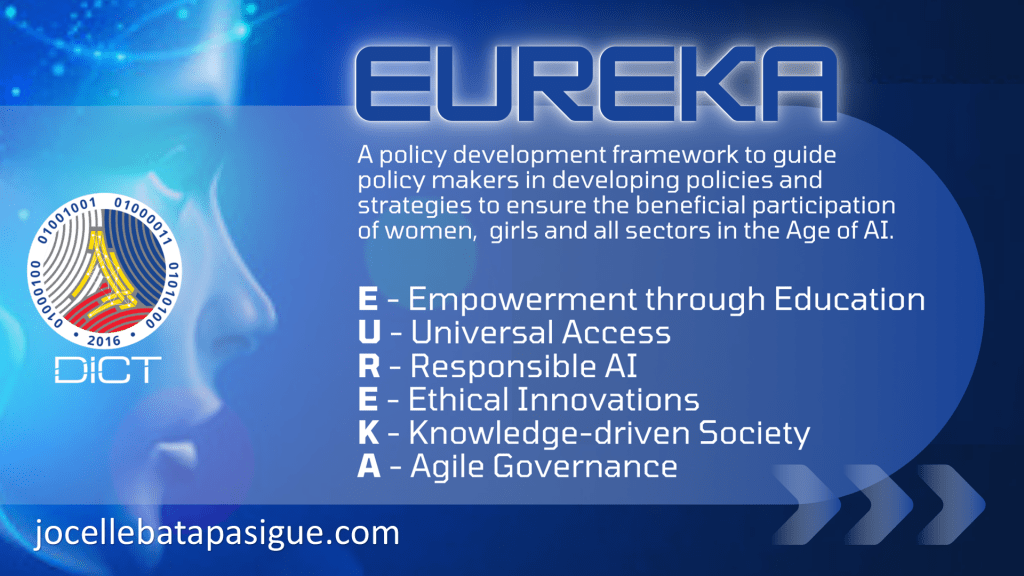
Jocelle Batapa-Sigue is advocating for this AI Governance Policy and Strategy Framework as part of her pioneering work in ensuring that emerging technologies, particularly artificial intelligence, are governed ethically, inclusively, and for the public good. She co-led the four-day intensive training conducted by the Alan Turing Institute in the Philippines. As one of the first leaders in the Philippines to initiate a structured national policy conversation on AI, she authored the EUREKA Framework at the Department of Information and Communications Technology (DICT) and served as the Chair of the ASEAN Digital Senior Officials’ Meeting in 2023, where she played a key role in the drafting and approval of the ASEAN Guide on AI Governance and Ethics. She also led the Philippine delegation’s participation in the landmark Bletchley Declaration on AI safety and contributed to the development of the International AI Safety Report. Her advocacy is driven by the firm belief that the Philippines must not only adopt AI—but shape its future responsibly, anchored in strong governance and inclusive innovation.



 Jocelle Batapa Sigue
Leave a comment