
The Philippines improved its International Telecommunication Union (ITU) ICT Development Index (IDI) 2025 score by 13 points in two years, from 65.0 in 2023 to 78.0 in 2025. This shows a remarkable upward trend, outperforming its income group average and nearing the Asia-Pacific regional average (80).
In the latest 2025 IIDI report, the Philippines has demonstrated a strong trajectory of digital progress, posting a notable overall score of 78.0, up from 65.0 in 2023—a 20% increase over two years. This performance positions the country well above the average for lower-middle-income economies, signaling effective digital policy implementation and growing investor confidence in the Philippine digital ecosystem.
The ITU has released its 2025 edition of the IIDI, featuring an enhanced methodology that offers a broader and more accurate view of countries’ digital progress. It plays a crucial role in ensuring that all countries—especially developing ones like the Philippines—can participate fairly and fully in the digital future. The updated framework focuses on two core dimensions—Universal Connectivity, which assesses access and affordability of internet services, and Meaningful Connectivity, which measures the depth, quality, and impact of internet use. This refined approach reflects the growing importance of not just being online, but also deriving real value from digital participation, making the IDI a vital tool for policymakers, investors, and development leaders shaping the future of digital economies.
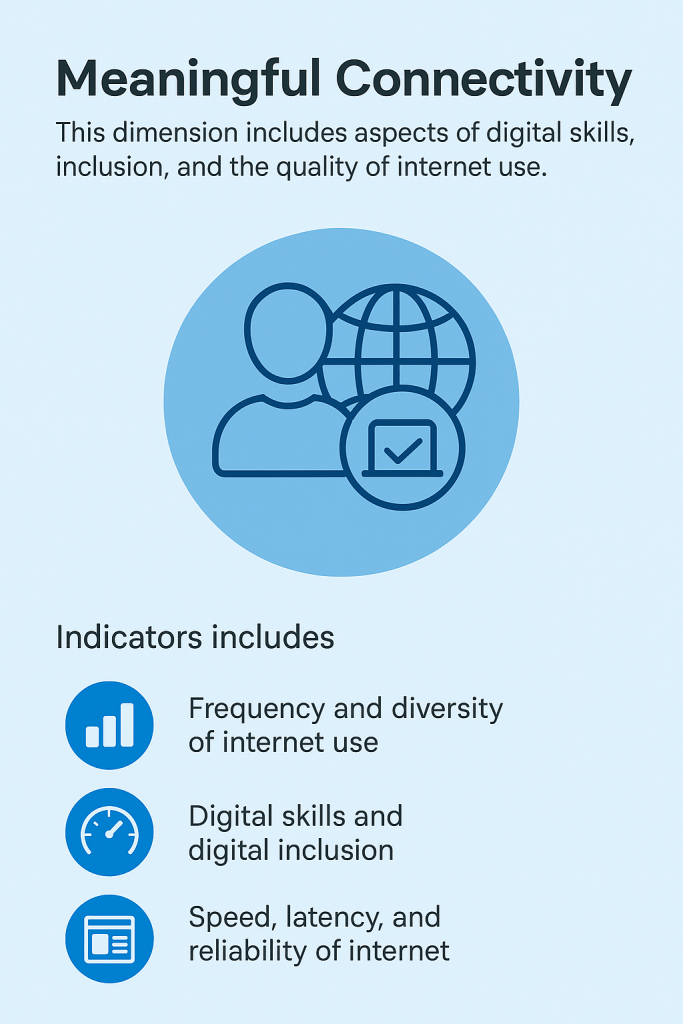

The country recorded a Universal Connectivity score of 69.8, indicating continued improvements in nationwide access to broadband and mobile networks. More impressively, its Meaningful Connectivity score reached 86.3, outpacing the global average and reflecting enhanced quality, frequency, and impact of internet use across sectors.
Importantly, the Philippines is now closing the gap with the Asia-Pacific regional average of 80, positioning itself as a competitive digital hub in Southeast Asia. This momentum underscores the nation’s readiness for digital investments, tech-enabled services, and inclusive innovation, particularly in sectors such as e-commerce, fintech, and digital governance.
The 2025 ICT Development Index (IDI) reveals a global average score of 78.2, reflecting steady but uneven progress in digital transformation worldwide. High-income countries continue to lead with an average score of 92, underscoring their advantage in both infrastructure and digital maturity. In contrast, lower-middle-income countries, including the Philippines, average just 66, highlighting persistent gaps in access, affordability, and digital literacy. These disparities reinforce the need for targeted investments and inclusive policies, especially in emerging markets, to bridge the digital divide and unlock the full economic potential of digital technologies across all income groups.
The country’s digital growth story in 2025 is marked by strong momentum in mobile broadband penetration and a surge in internet usage intensity, signaling robust consumer engagement and expanding digital demand. These gains are backed by notable improvements in affordability and sustained investments in infrastructure, both public and private. However, despite this progress, the country continues to face unmet needs in universal connectivity, with rural and underserved communities still lagging in access. This highlights a critical opportunity for stakeholders to close the remaining gaps through inclusive investment strategies and localized digital solutions.
Policy Recommendations for the Philippines’ Digital Growth Strategy
To capitalize on its upward trajectory in the 2025 ICT Development Index (IDI), the Philippines must now adopt a targeted and strategic policy approach that ensures inclusive, sustainable, and innovation-driven digital growth.
1. Enhance Access in Underserved Areas
While national connectivity is improving, rural and geographically isolated areas remain digitally underserved. To address this, government and industry players must incentivize last-mile infrastructure development through public-private partnerships, tax benefits, and co-investment schemes. Equally critical is the need to empower local government units (LGUs) to lead grassroots connectivity programs. By equipping LGUs with technical, financial, and policy support, the country can foster community-driven broadband solutions that ensure no barangay is left behind.
Supporters of the Konektadong Pinoy bill cite the proposal as a game-changing legislation that directly addresses the Philippines’ digital gaps by expanding affordable, inclusive internet access through deregulation, infrastructure incentives, and local government empowerment—aligning with global ICT benchmarks and accelerating the nation’s path to digital equity. However, tech and industry stakeholders caution that while the Konektadong Pinoy bill holds great promise, it must avoid imposing strict data localization requirements, as such mandates could stifle innovation and deter investment; instead, they advocate for an open, competitive digital ecosystem that encourages service innovation and truly expands inclusive, affordable connectivity across the country.
2. Build Human Capital
Infrastructure alone is not enough; a digitally empowered population is the real engine of transformation. The government must aggressively scale up digital literacy programs, focusing on youth, women, indigenous peoples, and other marginalized sectors. These programs should go beyond basic skills to include training in cybersecurity, data privacy, and ethical tech use, creating a safer and more responsible digital environment. Long-term success lies in embedding digital competencies across the education system and community-level initiatives.
Republic Act No. 11927, the Philippine Digital Workforce Competitiveness Act, establishes a bold, cross-sector mandate to develop a future-ready Filipino workforce. At its core, this law recognizes that human capital is the foundation of digital competitiveness and calls on government, industry, academia, and civil society to act in coordinated alignment.
The national government, through an inter-agency council, leads the charge by crafting policies and aligning programs that reskill and upskill Filipino workers to meet global standards. Local governments are empowered to localize these efforts—bringing digital literacy and training directly to the communities that need them most. Meanwhile, industry players are no longer just beneficiaries but co-creators of talent pipelines, working closely with the education sector to co-develop curricula and on-the-job training that meet evolving technological demands.
Crucially, civil society and youth organizations play a strategic role in championing inclusion—ensuring that women, marginalized groups, and underserved regions are equipped not only with digital access but with real opportunities for digital participation and leadership.
RA 11927 is a national blueprint for building digital resilience, unlocking high-value jobs, and driving innovation-led growth. For the Philippines, investing in its digital workforce is no longer optional—it is the catalyst for economic transformation.
This multi-stakeholder approach reflects Jocelle Batapa-Sigue’s long-standing advocacy for inclusive, ethical, and future-proof digital empowerment, ensuring every Filipino has the tools and opportunity to thrive in the digital age.
3. Leverage Strong Meaningful Connectivity
The Philippines’ strong performance in meaningful connectivity—reflected in its above-average ICT Development Index (IDI) score—presents a unique strategic advantage to accelerate digital transformation, strengthen economic competitiveness, and modernize public service delivery.
With a growing number of Filipinos engaging with the internet regularly and effectively, the government is now well-positioned to scale e-governance initiatives by developing secure, user-friendly digital platforms. These can significantly streamline citizen services—ranging from online permit applications and civil registry transactions to healthcare and benefits management. Expanding platforms like eGovPH and integrating AI-driven helpdesks will reduce inefficiencies and enable real-time citizen engagement, especially for underserved and remote populations.
From a private sector lens, enhanced connectivity opens expansive growth opportunities for digital industries and MSMEs. Filipino freelancers, e-commerce entrepreneurs, and fintech users increasingly leverage platforms to access global markets, improve operational efficiency, and drive local economic activity. These trends signal the maturing of a digitally-enabled, innovation-driven workforce that can compete regionally and globally.
To sustain this momentum, targeted investments must be directed toward developing regional innovation hubs—particularly in emerging urban centers like Cebu, Davao, Iloilo, and Bacolod. These ecosystems, supported by public-private partnerships, can serve as launchpads for tech startups, provide skills training, and promote locally relevant digital content tailored to Filipino needs and cultural identity.
In sum, the country’s meaningful connectivity gains represent more than improved access—they are a foundation for inclusive digital economic transformation, and a call to action for both public and private stakeholders to invest in platforms, talent, and innovation that will define the Philippines’ competitive edge in the digital age.
4. Benchmark Against ASEAN Peers
To stay competitive in Southeast Asia’s rapidly evolving digital economy, the Philippines must adopt a structured and proactive benchmarking strategy against leading ASEAN peers such as Malaysia (IDI score 95.3) and Thailand (91.9). These countries have made significant strides by implementing forward-thinking regulatory environments, innovative infrastructure financing models, and robust talent development pipelines—key areas the Philippines can learn from and adapt.
Malaysia, for instance, has championed nationwide 5G deployment under a government-led consortium model, while Thailand has embedded digital skills development into its national education system. By analyzing these success stories, the Philippines can design more effective policies to address connectivity gaps, reduce market entry barriers for digital providers, and create a competitive landscape that encourages innovation.
However, benchmarking must go beyond infrastructure—it must include emerging technologies that define the next wave of digital leadership, such as artificial intelligence (AI), blockchain, and the Internet of Things (IoT). In this space, as former undersecretary of the Department of Information and Communications Technology, Jocelle Batapa-Sigue is especially notable. As a pioneer in digital policy and innovation, she has been instrumental in pushing for ethical AI governance, blockchain applications for transparency, and IoT integration in agriculture, healthcare, and smart cities. Her initiatives emphasize responsible innovation that is inclusive, regionally balanced, and aligned with the needs of Filipino communities—particularly in the countryside.
Integrating these emerging technologies into national development strategies—while using ASEAN best practices as a compass—can elevate the Philippines from a digital participant to a regional leader in ethical and inclusive digital transformation. Policymakers, investors, and ecosystem builders must align around this vision to drive scalable innovation, build future-proof infrastructure, and unlock high-value jobs for Filipinos across the archipelago.
The 2025 IDI reflects a significant digital leap for the Philippines, with meaningful connectivity now exceeding global averages. To sustain this momentum, targeted investments in universal access, digital skills, and inclusive digital services are essential.
 Jocelle Batapa Sigue
Leave a comment