
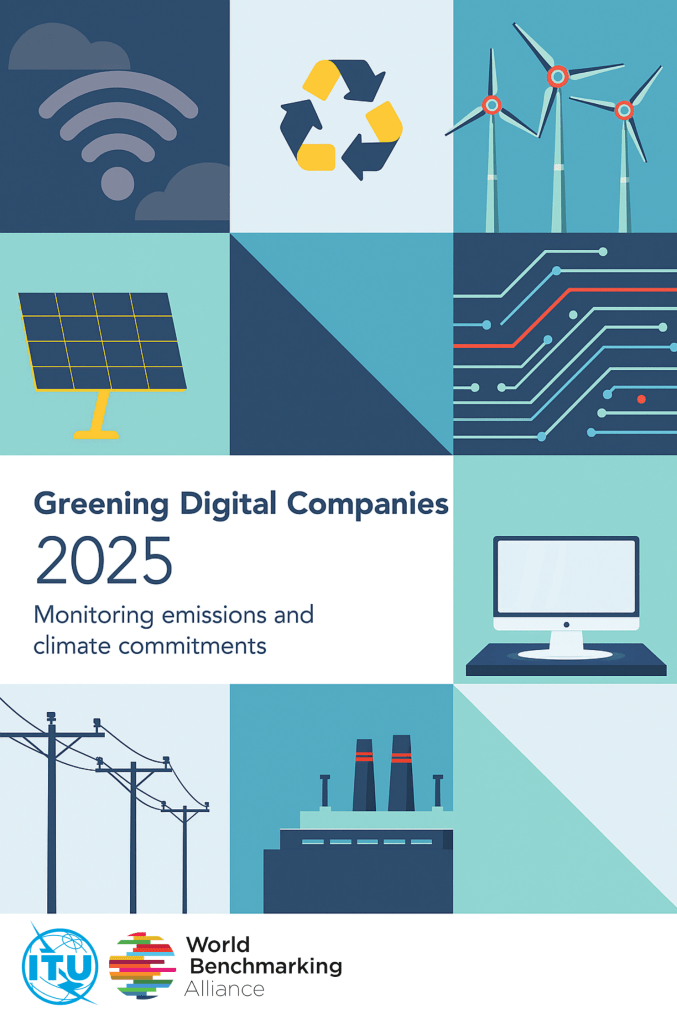
In an era of rapid digital transformation, the environmental impact of the digital sector cannot be overlooked. The “Greening Digital Companies 2025” report, jointly produced by the International Telecommunication Union (ITU) and the World Benchmarking Alliance (WBA), offers a sobering yet hopeful view of how the world’s leading digital companies are addressing climate change. Published in June 2025, this fourth edition assesses the emissions, energy use, and climate commitments of 200 digital companies worldwide.
As a digital advocate rooted in the Philippines, I believe this study is crucial for guiding our nation’s path towards a greener, more inclusive digital economy. I am sharing the key findings, significance, and actionable steps we can take to align with global best practices.
Escalating Emissions and Energy Demand
Operational Emissions Up by 1.4% in 2023
In 2023, 166 of the 200 digital companies assessed disclosed their Scope 1 and 2 operational emissions, totaling an imposing 297 million tonnes of CO₂ equivalent (tCO₂e)—a 1.4% increase compared to 2022. This increase, though modest, is significant given the global imperative to reduce emissions in line with the Paris Agreement’s 1.5°C pathway.
The report highlights that these operational emissions now represent approximately 0.8% of all global energy-related emissions—an alarming share for a single sector that underscores the outsized environmental impact of digital technologies. It also reveals a stark disparity in responsibility: just 50 companies accounted for nearly 90% of these emissions, with the top 10 emitters alone contributing 53%. Yet, despite this clear concentration of emissions, none of these top 10 emitters have set Science-Based Targets initiative (SBTi)-validated goals to align with the Paris Agreement, highlighting a worrying gap between ambition and action.
As a champion of ethical technology and countryside digital innovation in the Philippines, I view these findings as a powerful call to action. They reveal that the path to greening the digital sector—a critical piece of our national digital economy and innovation agenda—is not just about growth and connectivity but also about integrating sustainability at every step. For our country, which is rapidly expanding its digital infrastructure, this means we must not replicate the same mistakes of high-emissions growth but instead leapfrog to climate-smart strategies.
This data also highlights the interconnectedness of our work in digital transformation, renewable energy, and environmental stewardship. We must recognize that digital innovation is not neutral—it either contributes to climate change or actively mitigates it. The insights from this report should energize our policymakers, digital entrepreneurs, and civil society to integrate robust sustainability practices in the rollout of data centers, smart grids, AI solutions, and e-governance.
For the Philippines, this is not just a matter of climate responsibility—it’s also a matter of economic opportunity and global competitiveness. By fostering policies that prioritize green data centers, AI-powered energy efficiency, and transparent emissions reporting, we can position ourselves as a leader in ethical and climate-resilient digital development.
We need to seize this moment to drive inclusive, sustainable progress in our digital economy. We need to ensure that our countryside digital innovation efforts are rooted in climate justice and inclusion.
Electricity Consumption and its Concentration in 2023
The Greening Digital Companies 2025 report reveals that in 2023, digital companies consumed an estimated 581 terawatt-hours (TWh) of electricity, representing 2.1% of global electricity use. However, what’s particularly striking is the concentration of this consumption: just 10 companies accounted for over half (51.9%) of this total electricity use, which underscores the outsized role of a few digital giants in driving global demand. This consumption by the top 10 digital firms is greater than the annual national electricity consumption of countries like Belgium (83 TWh), Chile (88 TWh), Malaysia (187 TWh), Australia (274 TWh), and even Spain (285 TWh).
As a digital transformation advocate, I recognize that this staggering demand has profound implications, especially for the Philippines as we pursue inclusive digital growth. The report’s data show that East Asia-based digital companies lead in overall energy use, driven by major electronics manufacturing and telecom infrastructure, while North American firms are the largest consumers due to their hyperscale data centers and cloud services.
In the Philippine context, these findings remind us of the urgent need to green our digital sector as we expand digital jobs and services. The data also highlight the critical importance of climate-aligned energy policies to ensure that our future digital growth is environmentally sustainable. With such a small number of players consuming such a large share of electricity, there’s a clear case for collaboration and policy incentives to steer these firms—and our entire ICT sector—towards 100% renewable energy adoption.
Rising Carbon Footprints from AI-Driven Emissions Surge
A key driver of this increase is the surge in AI adoption and data center expansion. The report highlights that data centers, particularly those powering AI, are major contributors to these emissions. In fact, data center electricity consumption has been growing at 12% per year since 2017, four times faster than global electricity demand, driven by the rapid proliferation of AI workloads.
This trend is poised to accelerate: the International Energy Agency (IEA) projects that by 2030, global data center electricity consumption will more than double, reaching 945 terawatt-hours (TWh)—surpassing the entire energy consumption of Japan today. Similarly, emissions from AI chip manufacturing surged by over 350% between 2023 and 2024, with much of the production centered in East Asia, fueled by fossil-based energy sources. Some companies saw their operational emissions skyrocket to 150% of their 2020 levels in 2023 due to intensified AI investments and data center expansions.
While AI and digital technologies hold immense potential for inclusive development and job creation in the Philippines, they also come with a heavy carbon footprint if left unchecked. As an advocate for ethical digital innovation and countryside digital jobs generation, I believe this calls for urgent action in the Philippines—both to embrace clean energy transitions in our local digital ecosystem and to build capacity for AI-optimized efficiency and sustainable data practices.
The Challenge and Opportunity of Scope 3 Emissions
The Greening Digital Companies 2025 report shines a powerful light on the Scope 3 emissions challenge within the digital sector. In 2023, among the 102 companies that disclosed complete greenhouse gas inventories, Scope 3 emissions accounted for a staggering 84% of total emissions—more than five times higher than the combined Scope 1 and 2 emissions, which represented only 3% and 13%, respectively.
These Scope 3 emissions include indirect emissions across the entire value chain, such as those from purchased goods and services, capital goods, transportation, and product use. The data gaps and methodological inconsistencies in Scope 3 accounting remain a significant barrier. While 106 companies disclosed all relevant categories, many still struggle with supplier engagement, data transparency, and fragmented methodologies.
From my vantage point as a digital advocate, this underscores a critical lesson: Our environmental accountability must extend beyond operational boundaries. The Philippine digital sector, much like its global counterparts, must address these invisible emissions to truly align with climate-smart growth.
I believe this also speaks to our ethical obligation to champion responsible digital development. The carbon footprint embedded in every digital device, every line of code, and every gigabyte of data centers powering AI must be factored into our plans. As we build our digital economy—especially in our countryside and startup ecosystems—we must ensure that sustainability is not an afterthought, but a foundational pillar.
Scope 3 emissions are indirect greenhouse gas (GHG) emissions that occur in the value chain of a reporting company, including both upstream and downstream emissions. Unlike Scope 1 (direct emissions from owned or controlled sources) and Scope 2 (indirect emissions from purchased electricity, steam, heating, and cooling), Scope 3 covers all other indirect emissions that result from a company’s activities but occur from sources it does not own or directly control.
Greenhouse Gas Protocol
Bridging the Data Divide and the Call for Supply Chain Climate Action
Only 106 of the 200 digital companies evaluated in the Greening Digital Companies 2025 report disclosed all relevant Scope 3 emissions categories in 2023, up from 75 companies in 2022—a notable 41% increase but still leaving nearly half of the sector without full transparency. This signals a significant and persistent gap in the sector’s ability to comprehensively measure and report its climate impact. While Scope 1 and 2 emissions are relatively easier to track within operational boundaries, Scope 3 emissions—indirect emissions from purchased goods and services, transportation, product use, and end-of-life treatment—are far more complex and typically require supplier cooperation and sophisticated modeling.
Indeed, the data reveals that Scope 3 emissions account for a staggering 84% of total emissions for companies with complete inventories, compared to just 3% for Scope 1 and 13% for Scope 2. This highlights how the majority of emissions come from activities beyond the company’s direct operations. Yet, barriers like data blind spots, inconsistent methodologies, and limited supplier engagement continue to hinder robust reporting. This is particularly relevant to the Philippines, where many MSMEs and supply chain actors have limited capacity to measure their climate impact.
As an advocate for ethical digital innovation and countryside ICT inclusion, I see this as both a challenge and a call to action. Companies must expand their climate strategies to include value chain emissions, foster data-sharing partnerships with suppliers, and build capacity for reliable reporting in line with GHG Protocol standards. The path forward lies in transforming Scope 3 data from a transparency gap into an opportunity to drive systemic emissions reduction across the entire digital value chain.

Bridging the Commitment-Action Gap: A Path Forward
While 92 leading digital companies have already set bold targets to achieve net-zero emissions by 2030, 2040, or 2050, the Greening Digital Companies 2025 report also highlights an exciting opportunity to close the gap between ambition and action. Today, only 18% of the sector’s emissions are covered by Science-Based Targets initiative (SBTi)-approved targets, and just 23 companies have achieved 100% renewable electricity sourcing. These figures underscore the potential for transformation. With focused collaboration and a shared commitment to ethical innovation, digital companies can turn these climate pledges into measurable progress, positioning themselves as leaders in the global transition to a low-carbon, green digital future.
Empowering the Green Digital Future: Our Role in Building Sustainable Digital Ecosystems
As we champion digital transformation in the Philippines, the Greening Digital Companies 2025 report serves as both a guidepost and a call to action. It highlights that our digital ambitions must be matched by an unwavering commitment to environmental sustainability. For me, this is not just a technical challenge—it is a matter of integrity and stewardship. Every step we take in advancing our digital infrastructure must consider not only the growth it enables, but also the footprint it leaves behind.
One of the most striking revelations is the outsized role of data centers and AI infrastructure in driving energy demand. In the Philippines, where many of our rural communities still lack reliable digital access, we must seize this moment to rethink how we build digital hubs. It is an opportunity to embed energy efficiency and renewable energy from the start—turning our digital backbone into a showcase of both innovation and climate responsibility. As someone who has long championed countryside innovation and inclusive growth, I see this as a chance to build digital infrastructure that uplifts communities while respecting the planet.
But sustainability doesn’t stop at our own digital operations. The report makes it clear: Scope 3 emissions—those from supply chains and product use—are the real giants of our digital carbon footprint. In the Philippines, this means we must empower our local digital industries, from hardware assemblers to software developers, to adopt sustainable practices and transparent reporting. This isn’t just about compliance—it’s about building resilient industries that can thrive in a world increasingly shaped by climate accountability. It’s about ensuring that our local entrepreneurs, including those in the provinces, are part of global supply chains that are both ethical and green.
Moreover, as I have always believed, global competitiveness in the digital sector will increasingly hinge on sustainability. The investments by large companies in 24/7 carbon-free energy and nuclear power to green their AI infrastructure are setting a new benchmark. For the Philippines to remain an attractive destination for investments and partnerships, we must be proactive. This means crafting policies and incentives that don’t just keep us in the game—but position us as a leader in the green digital economy.
Finally, as I reflect on the rapid rise of AI and digital services in the Philippines—particularly in our BPO hubs and startup ecosystems—I see both urgency and opportunity. Our growth trajectory mirrors the global surge in energy demand, but it also opens the door for us to do things differently. The examples of corporate clean energy and carbon-free operations are proof that sustainable innovation isn’t a luxury—it’s the new standard. For me, this is a clear signal: we must integrate clean energy, smart grid solutions, and AI-optimized infrastructure not just to catch up—but to lead.
Actionable Recommendations for the Philippines
1. Develop a National Green ICT Strategy.
Include clear targets for Scope 1, 2, and 3 emissions, renewable energy sourcing, and transparent climate reporting.
As of now, the Philippines does not have a dedicated National Green ICT Strategy that outlines specific targets for Scope 1, 2, and 3 emissions, renewable energy sourcing, and transparent climate reporting within the Information and Communications Technology (ICT) sector. However, several national policies and initiatives indirectly address these aspects, laying the groundwork for sustainable practices in the ICT industry.
National Climate Commitments and Emission Targets
The Philippines has committed to a 75% reduction in greenhouse gas (GHG) emissions by 2030, as stated in its Nationally Determined Contribution (NDC). This ambitious target encompasses key sectors such as energy, transport, agriculture, waste, and industrial processes. The country’s Biennial Transparency Report provides detailed insights into these commitments and the strategies to achieve them.
Renewable Energy and Energy Efficiency Initiatives
The National Renewable Energy Program (NREP) 2020–2040 aims to increase the share of renewable energy in the country’s power generation mix to 35% by 2030 and 50% by 2040. This includes the development of offshore wind energy, with a technical potential of up to 178 GW
Additionally, the Government Energy Management Program (GEMP) mandates all government offices, including Local Government Units (LGUs), to reduce monthly electricity and petroleum product consumption by 10%, benchmarked against 2004 and 2005 levels .
ICT Sector and Emission Reporting
While there is no specific green ICT strategy, the ICT sector’s energy consumption and emissions are being studied. A joint report by the International Telecommunication Union and the World Bank highlights the need for comprehensive GHG emissions and energy consumption data for the ICT sector, particularly for telecommunications and data centers.
Moreover, corporate climate reporting practices in the ASEAN region, including the Philippines, are evolving. Companies are increasingly disclosing Scope 1, 2, and 3 emissions, as well as fuel consumption from renewable and non-renewable sources .
2. Foster Renewable Energy Adoption in Digital Operations.
Support data centers, telecoms, and tech companies in transitioning to renewable sources through tax incentives, streamlined permitting, and green financing.
Fostering renewable energy adoption in digital operations is crucial for the Philippines’ sustainable development. The country’s ICT sector, encompassing data centers, telecommunications, and tech companies, significantly contributes to energy consumption. Transitioning these operations to renewable energy sources can substantially reduce greenhouse gas emissions and align with national climate goals. The Renewable Energy Act of 2008 provides a legal framework supporting this transition, offering incentives such as income tax holidays and duty-free importation of renewable energy equipment . Moreover, the Department of Energy’s Energy Virtual One-Stop Shop (EVOSS) system streamlines permitting processes, reducing bureaucratic hurdles for renewable energy projects .
Financial mechanisms also play a pivotal role in this transition. The Bangko Sentral ng Pilipinas (BSP) has introduced incentives to encourage sustainable and green project financing, integrating sustainability principles throughout its operations . Additionally, Executive Order No. 32 has streamlined the permit process for the construction and operation of telecommunications and internet infrastructure, facilitating faster network rollouts . These combined efforts create an enabling environment for ICT companies to invest in renewable energy, contributing to the country’s goal of increasing the renewable energy share in the power generation mix to 35% by 2030 and 50% by 2040 .
3. Mandate Climate Disclosures for Digital Firms.
Integrate climate reporting into corporate governance frameworks to ensure accountability, especially for large ICT firms.
We must require digital companies—especially large ICT firms—to integrate climate-related reporting into their core governance and decision-making frameworks. This means moving beyond voluntary disclosures to establish mandatory climate risk and emissions reporting that aligns with globally recognized standards, such as the Task Force on Climate-related Financial Disclosures (TCFD) or the Global Reporting Initiative (GRI).
For me, this recommendation is rooted in the belief that transparency fuels accountability. By embedding climate disclosures into corporate governance, we not only ensure that firms take their environmental impact seriously, but also empower investors, consumers, and regulators to hold them to account. This approach will push companies to quantify and reduce their emissions, including those indirect Scope 3 emissions that make up the bulk of their carbon footprints.
Moreover, by requiring climate disclosures, we create a level playing field for all digital companies, regardless of size. This is particularly crucial in the Philippines, where we must ensure that both large multinationals and local ICT firms contribute to the green transformation. This step will also help attract climate-conscious investors and global partners who demand verifiable, transparent action.
Finally, I believe that climate disclosures can unlock innovation. Once companies begin to see the real numbers—how much carbon they emit, where their biggest impacts lie—they’re better positioned to design smart solutions, invest in green technologies, and participate in sustainable supply chains. This should be the norm, not the exception, to ensure that climate accountability becomes a fundamental pillar of our digital future.
4. Build Skills for Green ICT.
Invest in upskilling the Filipino workforce on sustainable digital practices, AI optimization for energy efficiency, and circular economy principles.
To fully realize our vision of a sustainable digital Philippines, we must prioritize the development of human capital. Investing in skills for Green ICT is essential to ensure that our workforce can adapt to—and thrive in—an era where digital innovation and environmental responsibility go hand in hand.
This means going beyond basic digital literacy. It calls for targeted upskilling initiatives focused on sustainable digital practices, AI optimization for energy efficiency, and circular economy principles. Our workers—from data center operators to software developers and rural ICT entrepreneurs—must be equipped with the know-how to design, deploy, and manage digital solutions that reduce environmental impact and promote circularity.
This also requires embedding these skills into formal education systems, technical training programs, and community-based learning hubs across the country—particularly in underserved rural areas. By weaving green skills development into curricula and certifications, we can ensure that our local talent pool becomes a catalyst for ethical, inclusive, and climate-conscious digital growth.
As an advocate for countryside innovation and youth leadership, I see this as a pathway to not just address climate challenges, but also to create new green jobs and economic opportunities for Filipino communities. We need to unlock the full potential of our digital workforce, fostering a culture of innovation and stewardship that can carry the Philippines into a sustainable digital future.
5. Collaborate with Global Partners.
Leverage programs like the ITU Green Digital Action and WBA’s Climate Benchmark to align our policies and track progress.
To truly accelerate our green digital transition, the Philippines must actively collaborate with global partners and tap into the wealth of expertise, tools, and resources already available worldwide. Initiatives like the ITU Green Digital Action and the World Benchmarking Alliance (WBA) Climate Benchmark offer more than just technical guidance—they provide frameworks for aligning our policies with global best practices and climate science-based targets.
By engaging with these programs, our national and local policymakers can ensure that our climate commitments in the digital sector aren’t just aspirations on paper—they become concrete, measurable actions backed by internationally recognized standards. These collaborations will help us track progress transparently and identify areas for continuous improvement, ensuring that no aspect of our digital ecosystem is left behind.
Moreover, global partnerships open up pathways for capacity building and knowledge sharing—from practical solutions for decarbonizing data centers, to supply chain emissions reporting, to green innovation tailored for developing economies. As an advocate for countryside innovation and inclusive growth, I believe these linkages will also be crucial in empowering our LGUs and local businesses—ensuring that they too benefit from the global transition to a climate-conscious digital economy.
In essence, collaborating with global partners is not just about alignment—it’s about positioning the Philippines as an active player and contributor to the global climate agenda. We need leverage these partnerships to build a future where our digital economy uplifts every Filipino—while respecting the planet we all share.
6. Incentivize Local Innovation.
Support Filipino startups and SMEs developing energy-efficient software, smart grid solutions, and AI for sustainability.
To truly green our digital sector, we must empower Filipino startups and SMEs to become leaders in sustainability. This means going beyond generic support and actively incentivizing innovation that focuses on climate-positive technologies. The Philippine government, LGUs, and financial institutions should work hand in hand to create dedicated green innovation funds—grants, low-interest loans, or equity investments targeted at startups and MSMEs developing energy-efficient software, smart grid solutions, and AI applications for sustainability.
But it is not just about funding. We also need mentorship and capacity-building programs that bring together climate scientists, digital engineers, and rural innovators to co-create solutions tailored to the unique challenges of our archipelago. From managing distributed energy resources in off-grid communities to using AI for climate modeling in coastal areas, our innovators must be supported with the tools and networks they need.
Incentivizing local innovation isn’t just a matter of economic opportunity—it’s about empowering communities and fostering inclusive progress. When we support Filipino entrepreneurs in developing green technologies, we’re not only creating new jobs and industries; we’re also investing in a digital future that uplifts the countryside, respects our environment, and puts people and planet at the center.
Key Takeaways and Future Directions
The Greening Digital Companies 2025 report underscores a dual reality: the digital sector has the power to accelerate climate action, yet its current trajectory falls short of global climate goals.
For the Philippines, the message is clear: We cannot build a competitive digital economy without a green foundation. Policies, investments, and partnerships must converge to ensure our digital future is both inclusive and climate-resilient. As an advocate for digital jobs generation, countryside innovation, and ethical technology, I firmly believe that integrating climate action in our digital journey is not a choice—it’s an imperative. As a country, we need to embrace this challenge with creativity, empathy, and a relentless pursuit of progress.
We need to ensure that our digital transformation journey is one that uplifts our people, respects our environment, and safeguards our future. Let’s move from vision to action, weaving sustainability into the very heart of our digital ambitions—because that is how we build a truly inclusive, resilient, and climate-conscious digital Philippines.



 Jocelle Batapa Sigue
Leave a comment