
Cebu City, Philippines – The 2024 Philippine Innovative Startups Policy Conference (ISPC) was a defining moment for our country’s innovation landscape. Held as a major event under Philippine Startup Week, it brought together national and regional leaders, policy advocates, startup founders, academic institutions, and members of the private sector with one common goal—to build a truly inclusive, resilient, and regionally empowered startup ecosystem.
This conference reaffirms our collective belief that innovation does not only reside in capital cities or high-tech parks. It lives in our countryside—in the ideas of students in provincial universities, in the perseverance of entrepreneurs in rural communities, and in the untapped energy of local talents who seek to solve problems relevant to their own communities.
Anchored in Republic Act No. 11337, or the Innovative Startup Act, the ISPC is part of a broader national strategy to decentralize opportunities, strengthen regional economies, and institutionalize innovation as a driver of inclusive growth
Startups as Engines of Countryside Development
The central theme of ISPC 2024, “Isa Para sa Bayan – Igniting Philippine Innovation,” captured the spirit of the discussions that unfolded across the sessions. Participants from different sectors recognized that startups based in the regions are not just contributors to local economies—they are catalysts for national transformation.
Startups have the potential to solve real-world problems, offer new products and services, create meaningful jobs, and introduce competition that uplifts industries. However, these same startups continue to face a complex array of challenges—limited access to funding, infrastructure gaps, outdated regulatory processes, and the lack of supportive networks in their respective regions.
Recognizing these barriers, the conference focused on concrete and actionable solutions that align with the country’s vision for innovation-led development. It built upon months of multi-sectoral consultations, dialogues, and insights, culminating in the formulation of six strategic policy pillars designed to guide innovation policy across the country.
Six Strategic Policy Pillars for Philippine Startup Growth Identified
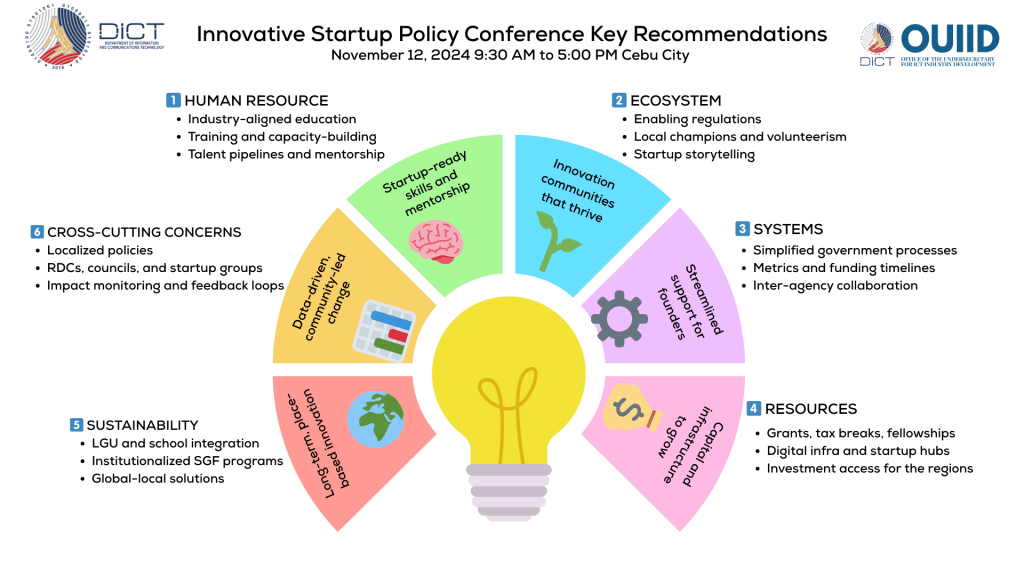
The 2024 ISPC identified several major recommendations and suggestions that can be captured in six (6) areas to serves as a foundation for institutional reform, ecosystem design, and inter-agency collaboration to support startups and innovation actors—particularly in underserved and geographically disadvantaged areas.
1. Human Resource Development
Innovation begins with people. The first policy pillar recognizes the need to build a strong foundation in education, training, and talent development. Key thrusts include:
- Aligning formal education programs and certifications with industry demands
- Creating practical training sessions focused on entrepreneurship and innovation
- Establishing mentorship networks between experienced professionals and emerging founders
- Deepening academe involvement in research, curriculum design, and community projects
- Conducting workshops on startup fundraising and investor relations
This pillar aims to equip Filipinos—especially those outside urban centers—with the skills, mindset, and support they need to become successful entrepreneurs and innovators.
2. Ecosystem Strengthening
A successful startup ecosystem cannot thrive without a healthy enabling environment. The second policy area focuses on:
- Creating startup-friendly regulations and simplifying business registration processes
- Fostering a national mindset that values innovation, resilience, and experimentation
- Encouraging civic participation through volunteerism and community involvement
- Identifying and empowering local champions who can bridge government, industry, and community
This ecosystem approach ensures that innovation is not confined to isolated hubs but is woven into the fabric of communities across the country.
3. Systems Reform
Effective government systems are critical to the success of any national innovation agenda. This pillar calls for:
- Streamlining government processes to reduce delays and bureaucratic burdens
- Aligning program metrics to accurately track and evaluate progress
- Ensuring the timely release of startup grants and support funds
- Promoting interoperability and coordination across relevant government agencies
These reforms are intended to make startup support mechanisms more responsive, efficient, and founder-friendly.
4. Resource Mobilization
Resources—both financial and physical—are essential to scaling innovation. Under this pillar, the ISPC framework proposes:
- Broadening access to grants, loans, and financial tools for qualified startups
- Creating clear pathways for grant applications and disbursements
- Offering tax incentives and breaks to encourage investment in innovation
- Expanding digital and physical infrastructure, especially in rural and semi-urban areas
- Establishing fellowship programs that attract skilled professionals to regional innovation efforts
Access to resources must be equitable, targeted, and aligned with local realities.
5. Sustainability
Sustainable innovation requires systems that endure. This pillar focuses on:
- Customizing innovation approaches to reflect regional characteristics and needs
- Institutionalizing effective programs to withstand leadership transitions
- Establishing a singular office for Startup Grant Fund (SGF) allocation to centralize efforts
- Promoting LGU and school involvement in innovation program implementation
- Supporting the development of solutions that can scale both locally and globally
- Benchmarking international practices to ensure global competitiveness
The goal is not only to launch programs, but to embed innovation into the structure of local governance and economic planning.
6. Cross-Cutting Strategies
Finally, the sixth pillar underscores the importance of localized, data-driven, and community-led strategies that support all other areas. This includes:
- Utilizing data systems and research for better decision-making
- Adapting policies to fit regional contexts and cultural nuances
- Engaging Regional Development Councils, ICT Councils, chambers of commerce, and grassroots communities in innovation planning
- Strengthening startup communities and encouraging collaboration among founders and supporters
Cross-sector and cross-regional cooperation are essential to building a truly national startup ecosystem.
Unified Commitment Through the ISPC Statement of Support
One of the key outputs of ISPC 2024 was the endorsement of a unified Statement of Support. Finalized on December 26, 2024, this document represents a shared commitment to mobilize resources, align policies, and integrate innovation into national development goals.
It sets forth a vision for 2030 that includes:
- Doubling the number of active Philippine startups
- Establishing 50 self-sustaining Technology Business Incubators (TBIs)
- Building a globally competitive innovation workforce with strong countryside roots
This statement was submitted to the Office of the Secretary of the Department of Information and Communications Technology (DICT) and now serves as a key reference for future programs and legislative engagements related to startup development.
Looking Ahead: A Call to Action
The submission of the ISPC Post-Event Report and Policy Framework is not the end—it is the beginning of a long-term process of reform and transformation.
As we move forward, we must remain guided by one fundamental principle: innovation must be inclusive, decentralized, and driven by the people. Every province, every city, and every barangay should have access to the tools, networks, and policies that enable innovation to thrive.
We must ensure that when a young person in Zamboanga dreams of launching a tech solution, or when a farmer’s cooperative in Iloilo develops a digital tool for logistics, the system will not hold them back—but lift them up.
Innovation belongs not just in boardrooms or global conferences, but in classrooms, barangay halls, and local co-working spaces.
The Philippine startup story is still being written—and the countryside must be at its heart.
Let us continue to pursue the progress of our nation. Padayunon naton ang pagpa-uswag sang aton pungsod.
For further updates on startup policy, countryside innovation, and the RISE PH movement, feel free to follow this site or contact my office directly.


 Jocelle Batapa Sigue
Leave a comment