
“Women bring unique perspectives and ideas to the STEAM field.”
This was what Jocelle Batapa-Sigue, Undersecretary for ICT Industry and Development of the Department of Information and Communications Technology (DICT), highlighted in her keynote speech during the 3rd Women in STEAM Summit held last February 13, 2024.
The Women in STEAM Summit featured a diverse agenda focusing on empowering women in science, technology, engineering, arts and agriculture, and mathematics.
With the theme “Transforming Science, Technology, Engineering, Arts/Agriculture, and Mathematics (STEAM) for Lifelong Learning,” the summit commemorates the International Day of Women and Girls in Science. It was held at the University of the Philippines National Institute for Science and Mathematics Education Development (UP NISMED).
The Women in STEAM Summit, organized by the UP NISMED in collaboration with the ILO – Philippines, the Austrian Embassy, and CISTEM, aims to highlight inclusive learning initiatives and innovations by women in STEAM fields.
The undersecretary shared her insights and experiences, particularly regarding her work in promoting gender equality in the digital landscape through the Digital Innovation for Women Advancement (DIWA).
According to the United Nations (UN) Philippines, “75% of jobs will be in STEAM fields by 2050, with women lacking significant representation.” Batapa-Sigue further said that by 2025, 90% of jobs will need some sort of digital skills. This is where DIWA comes in, encouraging more young women to take ICT courses and pursue related careers.
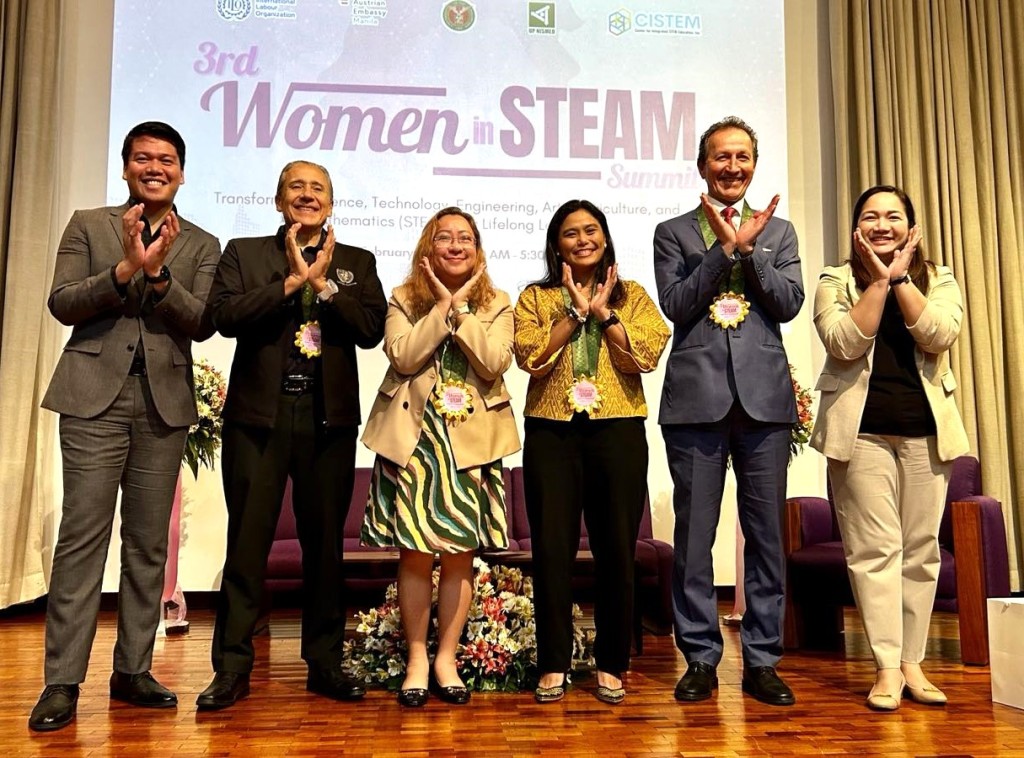
“DIWA is not just a project; it is a movement. It embodies our dedication to dismantling the barriers that hinder women and girls from fully participating in the digital landscape. The goal is really to increase the number of women and girls in ICT courses, careers, and certifications, as well as jobs,” added Undersecretary Batapa-Sigue.
She said that this year, DIWA’s focus group discussions among women and leaders will be in 15 regions in the country. “Promoting, encouraging, and fostering policies and strategies to enhance the digital skills, leadership, and entrepreneurial spirit among women, [creating] a more inclusive, equitable, and prosperous digital future.”
With the Philippines’ extensive international cooperation, Undersecretary Batapa-Sigue shared that the DICT will host a groundbreaking event next year. ““For this year, we are offered to host not the ASEAN Girls in ICT, not the Asia-Pacific Girls in ICT, but the Global Girls in ICT in 2025.”
The announcement comes on the heels of the Philippines’ mid-year evaluation by the International Telecommunication Union (ITU) and the Association of Southeast Asian Nations (ASEAN). The country placed third after Singapore in ASEAN, and even surpassed it in two of the nine indicators: Stakeholder Engagement and International Cooperation.
Having powerful women in ICT isn’t a distant reality. The undersecretary cited ITU’s election of Doreen Bogdan-Martin—its first woman secretary-general, 156 years after it was created. Even in the past, women like Ada Lovelace—whose work on Charles Babbage’s Analytical Engine preceded artificial intelligence (AI)—have contributed immensely to the field.

“Isn’t it beautiful to note that women, combining our creative and technical minds, are capable of conceiving innovation and foreseeing a future filled with so many possibilities?” Undersecretary Batapa-Sigue said.
UP Diliman Chancellor Atty. Edgardo Carlo L. Vistan II, Austrian Ambassador to the Philippines H.E. Dr. Johann Brieger, UN Resident Coordinator Gustavo Gonzalez, and National Project Coordinator Linartes Viloria of the International Labour Organization Country Office for the Philippines (ILO CO-Manila) representing Khalid Hassan, the Director of ILO-Philippines also gave messages of support and goodwill.
Organized by ILO CO-Manila, Austrian Embassy, Center for Integrated STEM Education, Inc., and UP NISMED, this year’s Women in STEAM also featured student exhibits, workshops, and panel discussions from esteemed resource speakers./Edwin Diaz
Keynote Speech by Undersecretary Jocelle Batapa-Sigue
February 12, 2024
3rd Women in Steam Summit
Esteemed Guests, Ladies and Gentlemen – Good morning.
May I begin by sharing with you all to a quote from one of my favorite women in STEAM – who is often celebrated as the first computer programmer in the world.
She said – “Understand well as I may, my comprehension can only be an infinitesimal fraction of all I want to understand.” This quote from Ada Lovelace reminds as all never to lose motivation or to never get tired in acquiring more knowledge every day – because even when we think we know a lot – we only know little compared to all there is to know.
I am so honored to be among you in this 3rd iteration of the Women in STEAM Summit. I congratulate all the organizers – but most of all I congratulate each one of you for grabbing this great opportunity to exchange your ideas on the theme – “Transforming Science Technology Engineering Arts/Agriculture and Mathematics (STEAM) for Lifelong Learning”.
The theme is such a wonderful beacon, guiding us towards a future where innovation, education, and inclusion converge.
It is inspiring to know that a woman – Ada Lovelace, is known for her work on Charles Babbage’s early mechanical general-purpose computer, which is called the Analytical Engine. Her notes on the engine include what is considered the first algorithm intended to be processed by a machine, making her an iconic figure in the history of computing. Although there are many debates, but Ada is also said to have foreseen what we now know as Artificial Intelligence or AI. Her insights are sometimes interpreted as an early prediction of the limitations and possibilities of artificial intelligence.
While she did not use the term “AI” herself—a concept that wouldn’t be formally conceived until over a century later—her understanding that machines could potentially handle tasks beyond simple numerical calculations if they were provided with the right algorithms is seen as a foundational thought in the development of computing and, by extension, of AI.
It is beautiful to note that women – combining our creative and technical minds – are capable of conceiving innovation and foreseeing a future filled with so many possibilities.
Today, I join the voices of everyone here – in celebrating platforms and avenues like what we are having now – for women to benefit or leverage from advent of an interconnected, superfast and digital future – by ensuring that we have access to opportunities for continued learning.
In this era of rapid technological advancement, the Department of Information and Communications Technology or your DICT remains steadfast in our commitment to nurturing an environment where every individual, regardless of gender, can thrive and contribute to the digital economy.
It is with great pride that I highlight one of our cornerstone initiatives – the Digital Innovation for Women’s Advancement or DIWA.
In today’s world, information and communication technology or ICT has become an essential part of our daily lives. It has revolutionized the way we work, communicate, and live. However, there is still a significant gender gap in the field of ICT, with women being underrepresented in this sector.
This gender gap is not only a social issue but an economic issue. Data shows that by 2025, which is a stone’s throw away from now – 90% of jobs require at least some level of digital skills.
With a widening labor and industry skills mismatch, we need to bring women onboard – as women have the talent, creativity, and determination needed to excel in ICT, and we bring unique perspectives and ideas to the field. DIWA aims to encourage more young women to take up ICT courses and pursue careers in this ICD.
We need to break down the stereotypes that suggest that ICT is a male-dominated field and inspire girls to pursue their passions and interests.
By doing this, we can create a more diverse and inclusive economy, where women can contribute to the development and advancement of technology.
Hence, DIWA is not just a project; it is a movement. It embodies our dedication to dismantling the barriers that hinder women and girls from fully participating in the digital landscape.
By promoting, encouraging, and fostering policies and strategies to enhance the digital skills, leadership, and entrepreneurial spirit among women, DIWA aims to create a more inclusive, equitable, and prosperous digital future.
As we delve into the discussions and activities today, let us keep in mind the critical role that we – women play in STEAM fields.
Our perspectives, creativity, and intelligence are indispensable in solving complex problems and driving innovation. Yet, the path to equality and inclusion is full our challenges.
It is therefore our collective responsibility to ensure that women and girls are encouraged, supported, and given equal opportunities to pursue their passions in STEAM.
The journey towards lifelong learning and gender equality in STEAM requires persistence, collaboration, and a shared vision.
Through initiatives like the Women in Steam Summit and DIWA and the collective efforts of everyone here today, I am confident that we can make significant strides towards a more inclusive and innovative future.
As we engage in discussions, share insights, and collaborate on innovative solutions, let us remember that the task at hand is not only for a few but a collective responsibility that calls for the participation of educators, government officials, policymakers, industry leaders, and communities.
In conclusion, transforming STEAM for lifelong learning is not just an educational reform; to me — it is a societal imperative.
It is about preparing individuals not just for the jobs of the future, but for the challenges and opportunities that lie ahead in building a more innovative, inclusive, and sustainable world.
Let us work together to empower the next generation of women in STEAM, fostering an environment where everyone, regardless of gender, can learn, innovate, and thrive. Thank you.


 Jocelle Batapa Sigue
Leave a comment