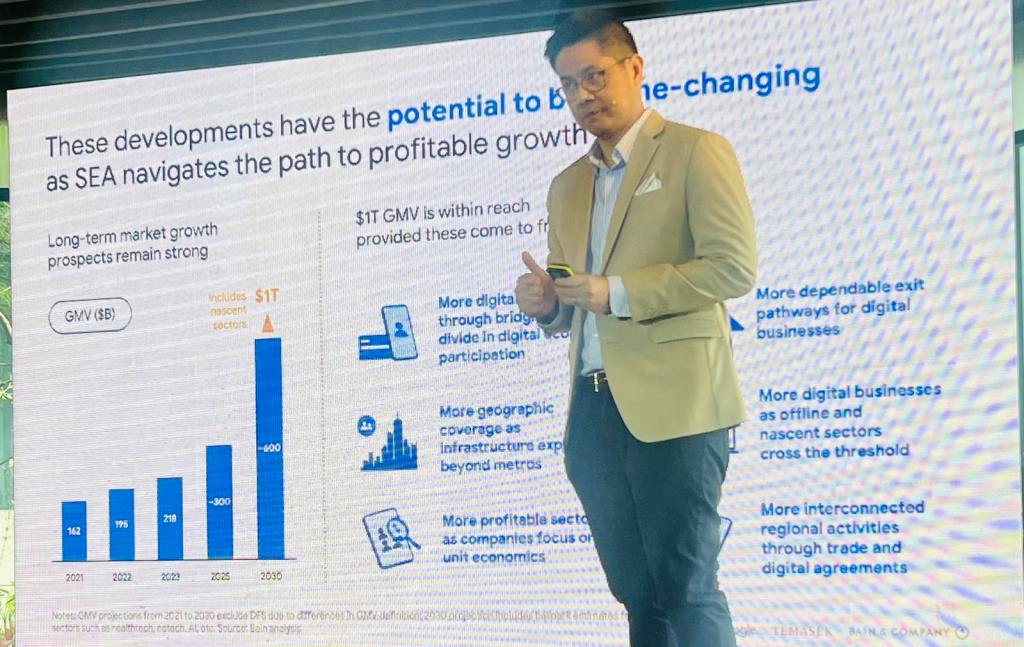

Nikki Librada Del Gallego, Google Philippines Data and Insights Lead
Bennett Aquino, Partner , Bain & Company
MANILA, Philippines – November 21, 2023 – The latest eConomy SEA report reveals a significant surge in the Philippine digital economy, projecting it to hit a remarkable $24 billion Gross Merchandise Value (GMV) by the end of 2023. This growth, representing a 13% Compound Annual Growth Rate (CAGR), is primarily driven by the robust performance of the e-commerce sector. Furthermore, experts anticipate this momentum to continue, with the economy expected to climb to $35 billion by 2025, growing at a 20% CAGR.
Titled “Reaching new heights: Navigating the path to profitable growth,” the report combines insights from Google Trends, Temasek, Bain & Company analysis, and industry experts. It provides an in-depth look at the digital economies of six Southeast Asian countries, including the Philippines. This year’s edition is unique as it introduces revenue numbers alongside GMV, offering a more comprehensive view of business growth amidst economic challenges.

Undersecretary Jocelle Batapa Sigue of the Department of Information and Communications Technology (DICT) recently shared an optimistic vision for the Philippines’ digital economy. In her statement during the launch this week, she expressed confidence that by 2030, the country would emerge as a “formidable growth player and a major growth driver” in the region.
Significantly, the Southeast Asian digital economy’s revenue is set to surpass $100 billion this year, a growth rate 1.7 times faster than the region’s GMV. The report emphasizes the potential of increasing digital participation to further drive growth in what is considered the region’s digital decade.
E-commerce, accounting for 70% of online activities, remains the primary driver of the Philippine digital economy. By 2025, e-commerce is expected to reach a GMV of $24 billion, growing at a 21% CAGR. The Online Media sector follows, projected to hit $5 billion, while Online Travel is anticipated to grow to $4 billion by 2025.
The Philippine digital economy also stands out in 2023 for having the fastest growing Transport and Food, Online Travel, and Online Media sectors in Southeast Asia. The expansion of transportation providers to outer cities and the growing popularity of two-wheeler transportation modes are notable trends.
Key insights into the Philippine digital economy include:
- Continued healthy expansion, driven by domestic demand, services sector recovery, and increased private consumption due to lower unemployment, higher remittances, and tourism resurgence.
- The Online Media sector, encompassing music, video streaming, and gaming, is expected to grow to $3 billion in 2023 at a 13% CAGR and reach $5 billion by 2025.
- The Transport and Food Delivery sector is projected to reach $2 billion in 2023, growing at a 19% CAGR to $3 billion by 2025. This growth is supported by mobility trends and higher spending among High-Value Users.
- Online Travel is experiencing a remarkable 88% growth from 2022 to 2023, on track to reach $3 billion GMV this year and $4 billion by 2025.
- Digital Payments continue to rise, expected to reach $93 billion in 2023 and $126 billion by 2025, with E-wallet and account-to-account payment methods showing the fastest growth.
Industry leaders and government officials express optimism about the sustained growth of the Philippine digital economy, highlighting its resilience and potential to create opportunities for Filipinos.
The DICT’s commitment aligns with the report which highlights several key sectors of the digital economy, including transport, gaming, travel, groceries, eCommerce, food, and streaming. Undersecretary Sigue emphasized the need for a citizens-centric governance approach, ensuring a safe cyberspace, promoting inclusion, and fostering an innovation-driven economy. Particular emphasis was placed on investing in “Homegrown Heroes” as global game changers, highlighting the potential of Filipino talent in the global digital landscape which is the focus of this year’s Philippine Startup Week.

Undersecretary Sigue’s optimism for the Philippines’ digital future is grounded in what she refers to as the “3 Cs”: Citizens Competence, Countryside Inclusion, and Collaboration-Complementarity. The undersecretary is confident that the Philippines will be a key digital economy player by 2030 and hopeful that that this target will be bolstered by the digital competence in line with the Philippine Digital Workforce Competitiveness Law or Republic Act 11927 and DICT’s programs fostering inclusion in rural areas through initiatives like Digital Cities Plus, Digital Careers Expo, and Regional ICT Summit and Exhibitions (RISE), and promoting collaboration among various agencies to avoid redundancy and enhance efficiency.
Furthermore, the report underscores the role of Artificial Intelligence (AI) in driving profitable growth. AI is poised to enhance operational efficiency and user experience in various sectors, including inventory management, route optimization, content personalization, and fraud detection.
Google supports this AI-driven growth with initiatives like the free generative AI skilling courses under its Cloud Skills Boost Program and the Google for AI Startups Cloud Program, which aids AI-centric startups in product and solution development.
 Jocelle Batapa Sigue
Leave a comment